Bruce looks at the diverging performance of European (EGAS) versus US (NG1) natural gas. Stocks covered KEYS, JNEO, VCT.
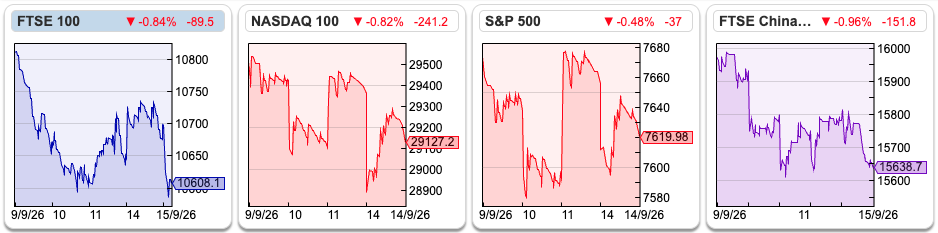
The FTSE 100 fell -1.4% to 10,606 over the last 5 trading days. The Nasdaq100 and S&P 500 were both also down c. -1.4%, while the FTSE China 50 was down -2%. The latter is now down -10% YTD, whereas Japan’s Nikkei 225 is up +26%, the best performing major index, presumably as Japanese exporters are enjoying the benefits of a weak currency.
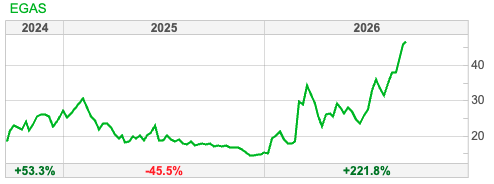
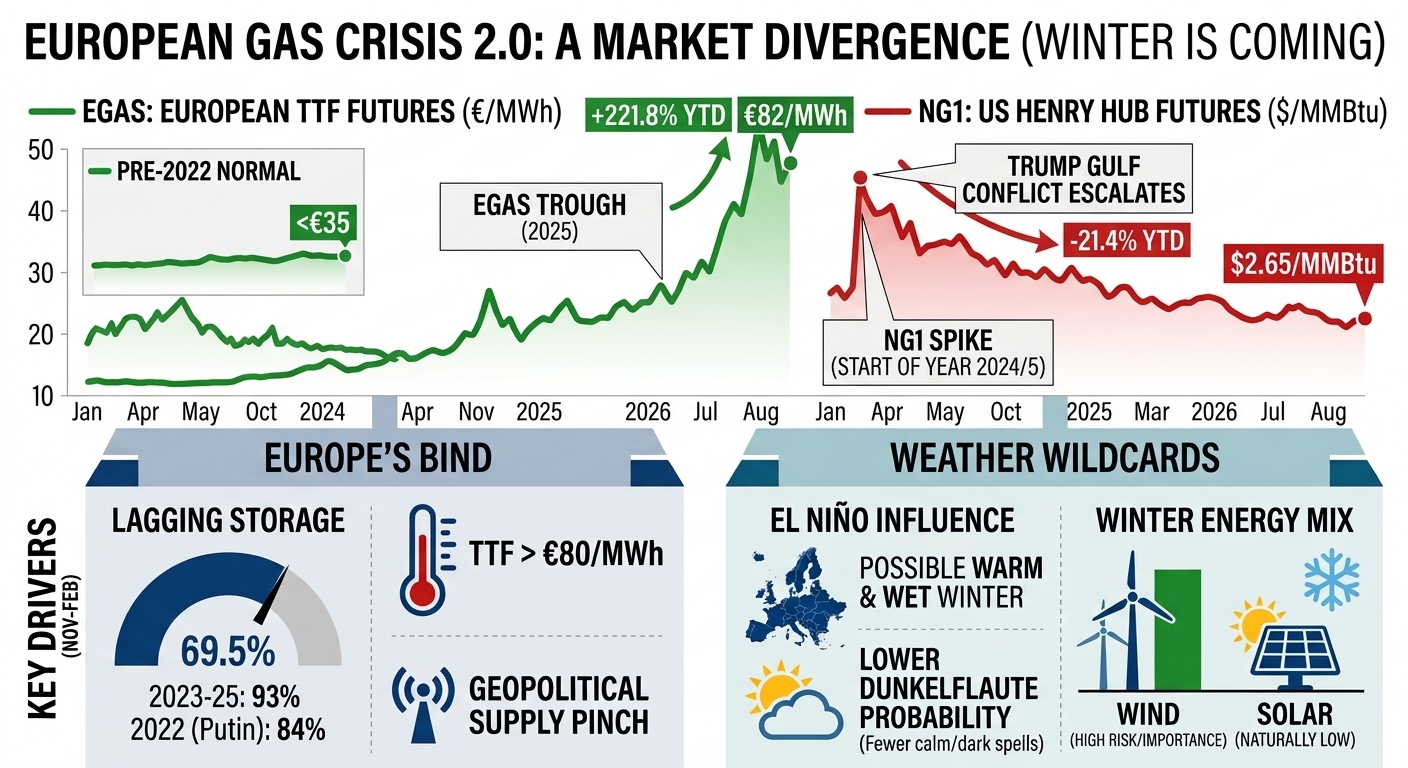
EGAS (European Natural Gas) rose +4% as Trump’s conflict in the Gulf seems to be going badly. EGAS is up +222% YTD, tracks the Dutch Title Transfer Facility (TTF) Natural Gas futures, which is over €80 per MWh. European Natural gas storage is currently just under 70% full, compared to over 90% full 2023-2025 and 84% full 2022, the first year of Putin’s invasion of Ukraine, when there were concerns about supplies not lasting through the winter.
Pre 2022, European natural gas tended to trade below €35 per MWh. Hopefully an El Nino year means that we will have a warm and wet winter, with lower probability of Dunkflaute. Solar generation is low Nov-Feb, so wind generation will be important over the winter months. It’s important to track the EGAS ticker though, because ShareScope shows NG1 (the US Henry Hub Natural Gas Front-Month Futures Contract traded on the NYMEX) is down -21% YTD, chart below.
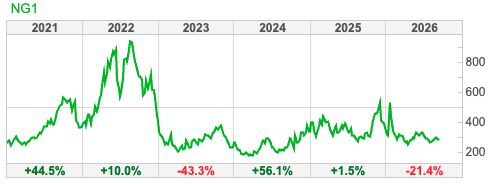
Pre 2022, European natural gas tended to trade below €35 per MWh. Hopefully an El Nino year means that we will have a warm and wet winter, with lower probability of Dunkflaute. Solar generation is low Nov-Feb, so wind generation will be important over the winter months. It’s important to track the EGAS ticker though, because ShareScope shows NG1 (the US Henry Hub Natural Gas Front-Month Futures Contract traded on the NYMEX) is down -21% YTD,.
This week I look at Journeo, the transport software group’s strong performance and examine Victrex’s turnaround +44% YTD, to see if there were signs of improvement we could have spotted earlier. But I start with Keystone Law, “comfortably ahead” outlook, suggesting little signs yet of AI disruption in legal services.
Keystone Law H1 July Results, “comfortably ahead” FY Jan
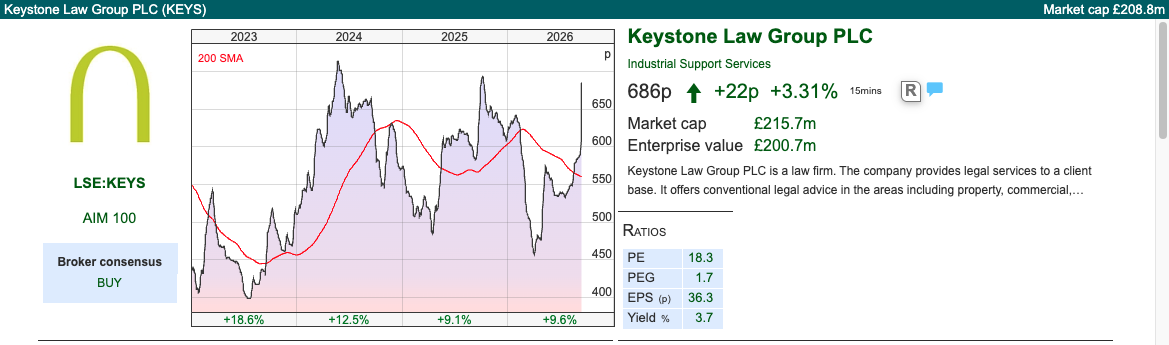
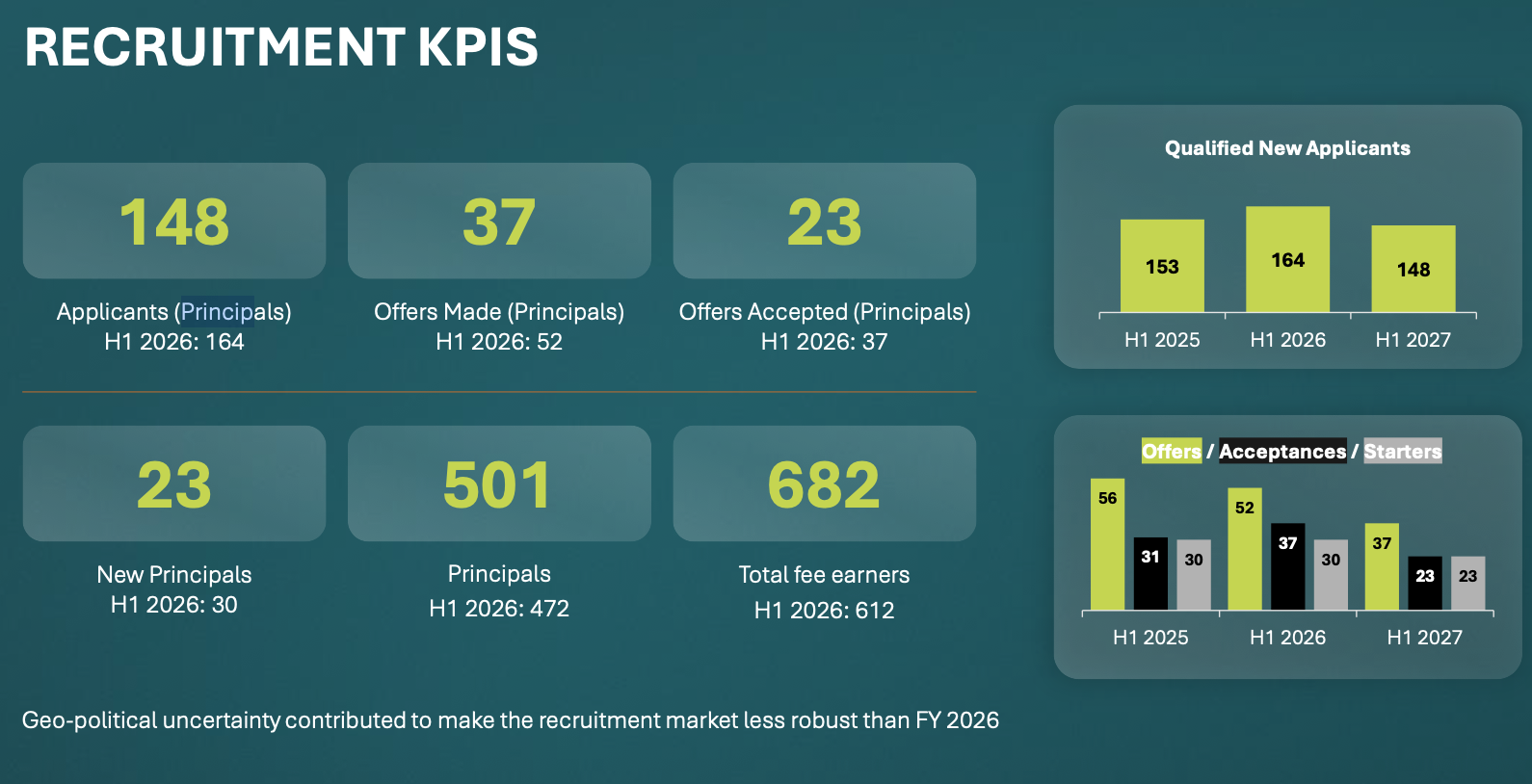
This legal services firm announced H1 Jul results with revenues up +23% to £66m and statutory PBT up by a third to £9.2m. Some of the revenue growth is driven by 23 Principals (effectively law firm partners by a different name) joining. So revenue per Principal, which shows how productive each fee earner is, was up +15% to £134K. That’s arguably a better measure of “underlying” growth, similar to Like-for-Likes comparisons in the retail sector.
Net cash grew to £10.5m Jun 2026, versus £6.5m at the end of Jun 2025, despite operating cash conversion dropping from 104% to a still impressive 96% and payout a 10p H1 dividend and a £1.5m buyback during the period.
In other words Keystone is fundamentally cash generative, operating a different type of business model to the likes of Gateley and Manolete, which have struggled to convert accounting profits into cashflow. Keystone operates a fee-share platform model that outsources working capital risk to its lawyer Principals, who earn a 75% fee share. KEYS earns its 25%, for providing IT platform, support services, access to networking events etc. One broker I used to work at had a similar model, which we called “the hedge fund hotel”, as hedge fund managers should be raising funds from investors and working out which stocks to buy and sell, rather than struggling with back office tasks. The KEYS model removes significant personal liability, administrative burdens and doesn’t require a substantial buy-in (often funded with debt) compared to a traditional legal firm partnership. Perhaps the greatest attraction is work/life autonomy.
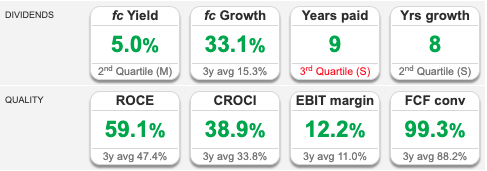
Outlook: Management suggest that they will be “materially ahead” of consensus of FY Dec 2027F revenue of £123m and adjusted PBT of £15.8m. Those figures were already anticipating revenue growth of +7% and +3%. Management also mention rolling out AI capabilities such as CoCounsel Legal, a professional-grade generative AI tool specifically designed for the legal industry.
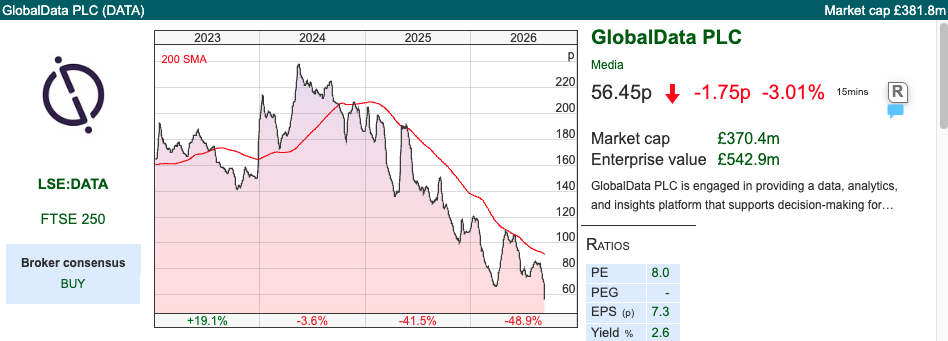
Disruption risk v DATA: There’s some potential for this type of knowledge work being disrupted, similar to GlobalData which profit warned on Monday, which writes in-depth industry research reports. Unlike DATA, I think Keystone Law are harder to disrupt. My own experience is that LLM are good for sense checking legal topics but transactions that requires a contract are – by their nature – high value and contain “edge cases”. Imagine for instance a shareholder agreement between founders or creating a Family Trust, with a life of 80 years. That means sensible people will continue to rely on a solicitor for peace of mind. Matt Levine, at Bloomberg, has suggested that law firm partners underprice their hourly rate, and overprice their associates, and it is the latter which can be replaced by an LLM. Billing out the associates’ time at eye-wateringly high hourly rates for newly qualified lawyers in their 20’s is, in practice, a way to capture more value for the partners.
Valuation: KEYS shares are trading on a PER of 16x Jan 2028F and EV/EBITDA 12x the same year. EPS is forecast to be flat at 40p out to Jan 2029F, so I would imagine there will be upward pressure on those estimates.
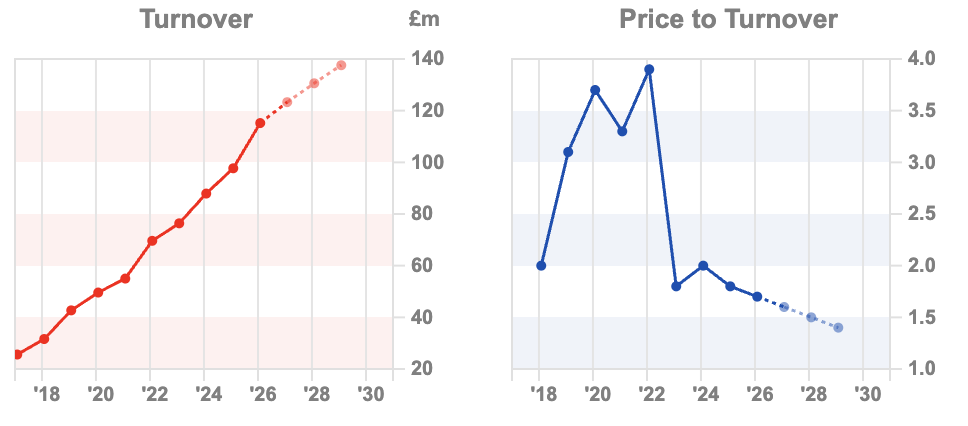
Looking at the turnover and price to turnover chart, this is yet another AIM stock which hasn’t disappointed, but has been substantially de-rated. That’s similar to Gateley and Manolete, but I think KEYS looks to have been even more harshly treated given performance has been so strong.
The phenomenon isn’t confined to legal services, going back through my notes groups as diverse as Zotefoams, Rightmove, Alpha Group, YouGov and Craneware as experiencing the same dynamic. Some of that is disruption risk (YouGov, Rightmove and Craneware) and falling margins – but I think KEYS performance has been tarnished by investors avoiding the AIM index, probably switching into global index trackers.
Opinion: I like the investment case, though frustrated that I didn’t buy during the first half when AI disruption fears were at their highest and the shares troughed at 450p. Nowadays, we seem to be worrying less about AI disrupting SaaS business models, and instead AI exterminating humanity.
My feeling is that KEYS has good story, but there’s potentially even more upside in the lower quality companies like MANO and GTLY, which if they can improve cash conversion and expand margins, management have some hope of restoring credibility and have potential to multi-bag. If you prefer the superior track record, then KEYS could be for you.
Journeo H1 June Results
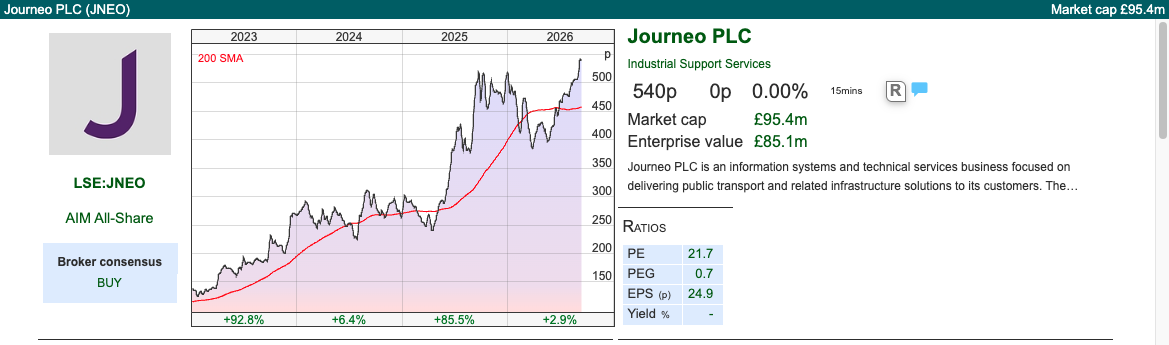
Journeo, up +800% March 2019, was flagged by Eric Langton in Oct 2023 and even earlier in Oct 2023. H1 results show revenues up +53% to £37.6m and statutory PBT up +10% to £2.96m. The divergence between revenue and costs is partly explained by falling finance income, but also a jump in admin expenses up +73% to £11.6m. That’s likely related to the acquisition of Crime and Fire Defence Systems (CFDS) in Sept last year for £11m in cash, £2m in deferred cash and £1m of shares issued. Hence group cash has fallen to £12.6m v £18m Jun last year.
They have renamed CFDS Infrastructure Protection and said that it generated revenue of £10.6m in H1. The acquired business has a gross margin 45% above the 38% for the group last H1. I can’t find an organic revenue or profit growth figure given by management, but subtracting £10.6m of revenue from CFDS in H1 would imply organic revenue growth of +10%.
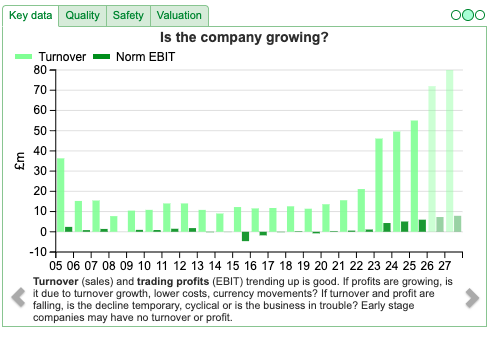
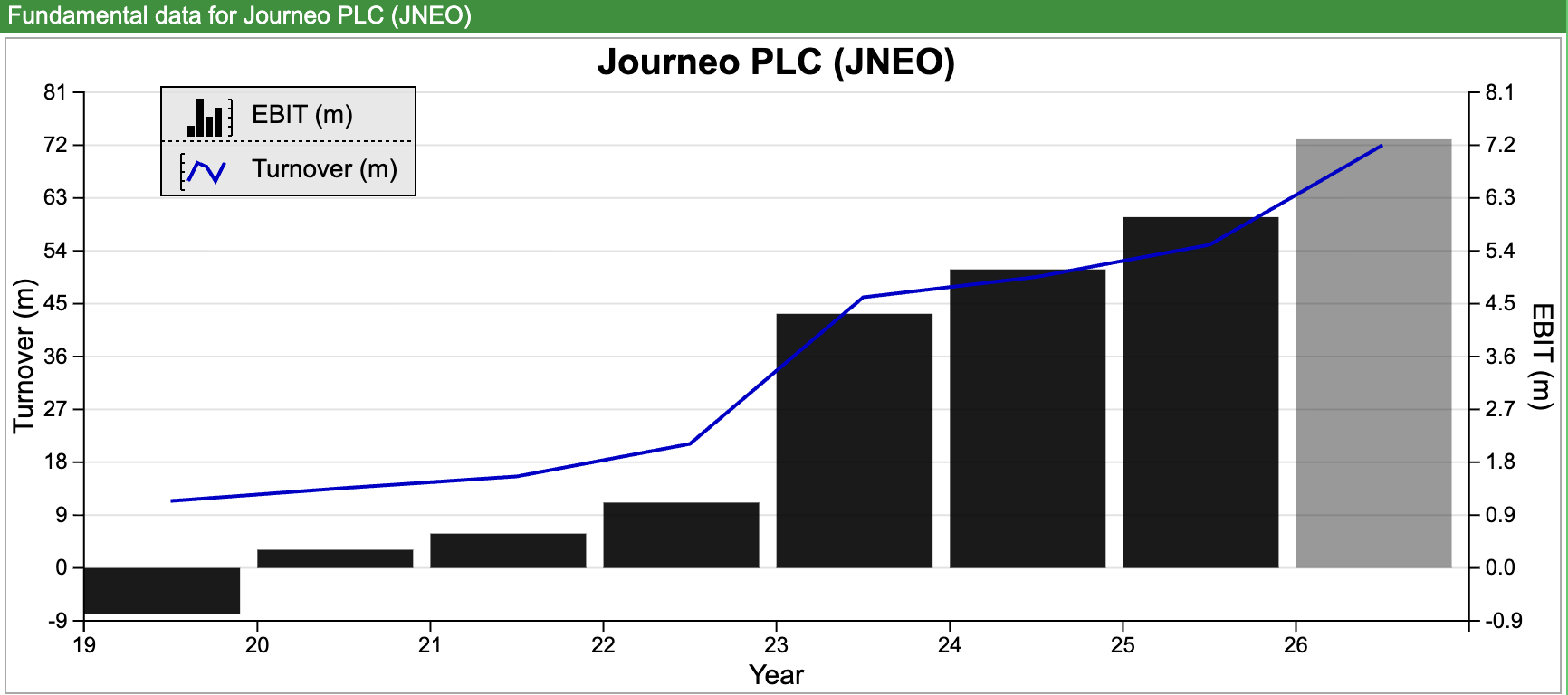
History: The group was founded in 1975 and has been listed on AIM since 1995. ShareScope shows that the share price struggled a decade ago, as revenue was less than £12m and the business was loss making. New management transformed the business from a low-margin hardware reseller/installer into an intelligent transport systems (ITS) and SaaS model. The financial graph below reveals how revenue has increased (blue line, left axis) from less than £12m FY 2019 to £72m forecast FY 2026F the operational gearing means that the EBIT (blocks, right axis) has improved from negative to above 10%.
Outlook: Management have a medium-term ambition to grow annual revenue above £150m (v £55m FY Dec 2025), through organic growth and disciplined M&A, while maintaining strong margins. Cavendish, their NOMAD, are forecasting FY Dec 2027F revenue of £80m and adj EPS of 33.4p. Management reiterated Cavendish’s FY 2026F expectations of £72m and 32.2p EPS.
Valuation: The shares are trading on 16x PER Dec 2027F, and 8x EV/EBITDA the same year. Despite rising so strongly since 2019 the shares remain below £100m market cap, so off the radar screen for most institutional fund managers.
Opinion: It’s tempting to suggest anyone who doesn’t own the shares has missed the upside. However, Eric made a similar point in 2021, back when the price was 122p. At the very least, I think the investment case is worth looking at closely to understand how a stock has been such a great performer, and what the early signs were.
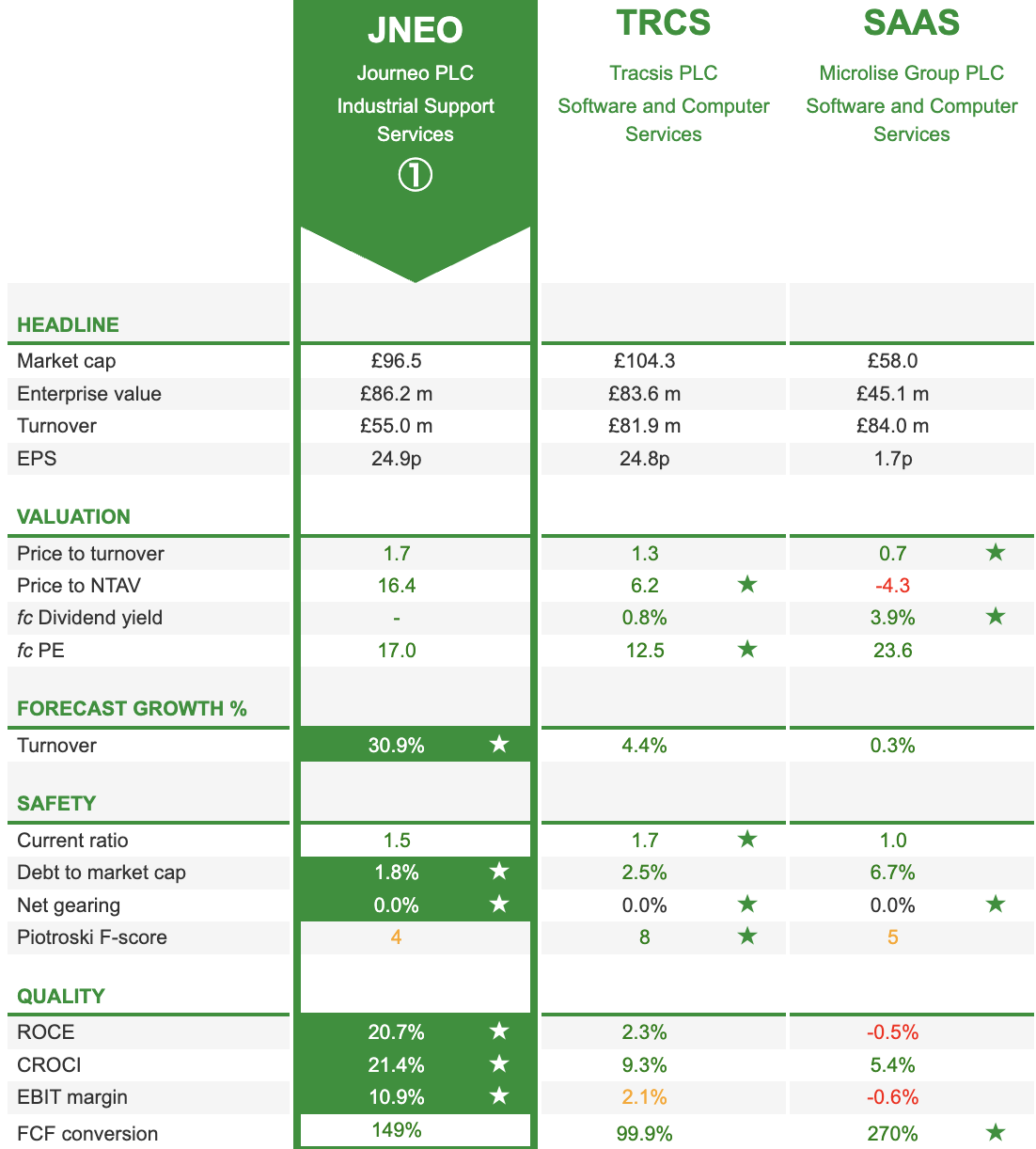
JNEO makes an interesting case study to compare against the likes of Tracsis, which I covered at the beginning of this month and Microlise, which I covered earlier this summer. All three operate in the transport software sector, but compared to JNEO the wheels seem to have fallen off both of those groups in recent years. Shearwater has also tried to adapt from a reseller to a recurring revenue SaaS business model, but struggled and had to write down the value of its acquisitions.
Victrex FY Sept Update
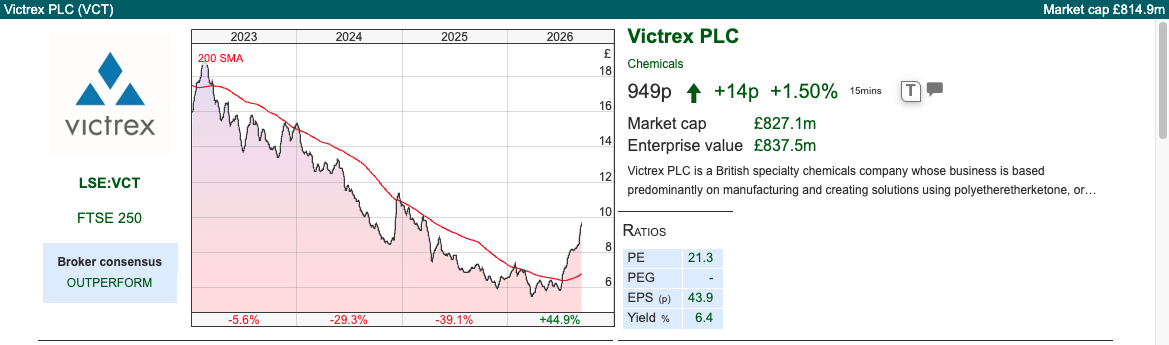
I briefly mentioned this polymer group at the start of the month, as they’d been the worst performer in the 2019 Fundsmith filter. The shares are up +44% YTD as performance has stabilised after a couple of inline updates. Last week their FY Sept pre-close update said they now expect underlying PBT to be in the range of £45m to £47m, (ahead of prior guidance of £42m to £44m given at the H1 March in May, unchanged in their July RNS). Back in February management had flagged an H2 weighting, which can often leave the door open for a later profit warning. Victrex’s reported H1 Mar £19m underlying PBT, so their H2 could be as high as £28m.
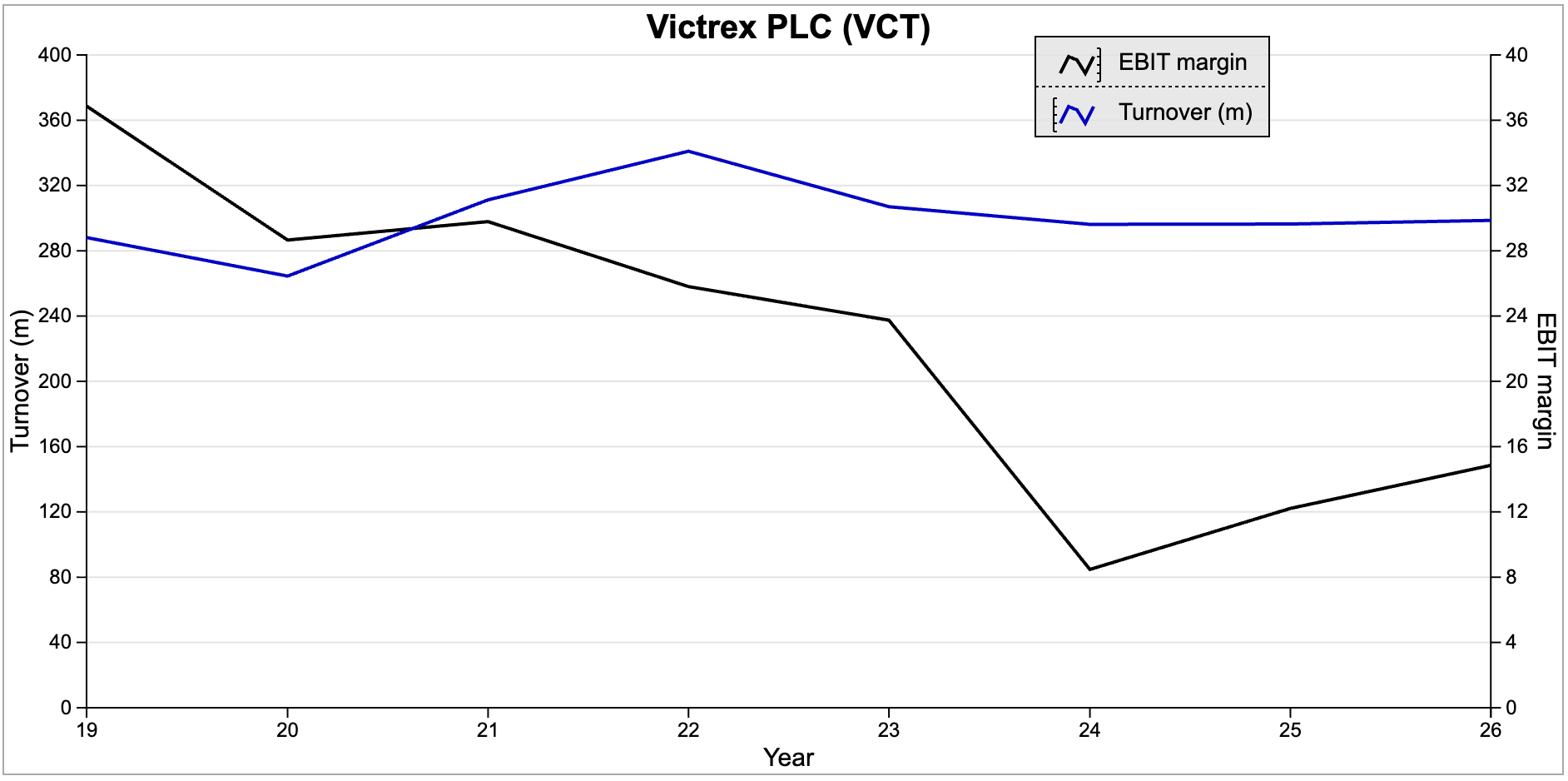
History: VCT is a specialty chemical group with a dominant position in PEEK (polyetheretherketone) polymers that are used in Aerospace, Automotive, Electronics, Energy, Medical sectors. Underlying PBT peaked at £127m in FY Sept 2018, versus £19m H1 this year (down -14% y-o-y) when the group also reported a statutory loss of £44m. A number of separate issues occurred around the same time: i) customers over ordering during Covid, then spending the next couple of years de-stocking ii) the medical division’s PEEK-OPTIMA product faced substitution from porous titanium iii) their Chinese factory struggled with operational issues, and they have now written down the value by £60.6m (around 80-90% of the invested capital) iv) operational gearing in the face of declining revenues. As the ShareScope chart below shows, turnover (blue line, left axis) peaked in FY Sept 2022 at £341m, and the EBIT margin (black line, right axis) fell from 26% to below 10% in FY Sept 2024.
Valuation: VCT shares are trading on a PER of 19x Sept 2027F and 11x EV/EBITDA. 19x appears expensive, but EPS is forecast to be below 50p in Sept 2027, versus a peak of 108p in 2019 (same number of shares outstanding). Cockney Rebel flagged this as a potential “bowly bottom” in July. Well done to him for noting the potential upside.
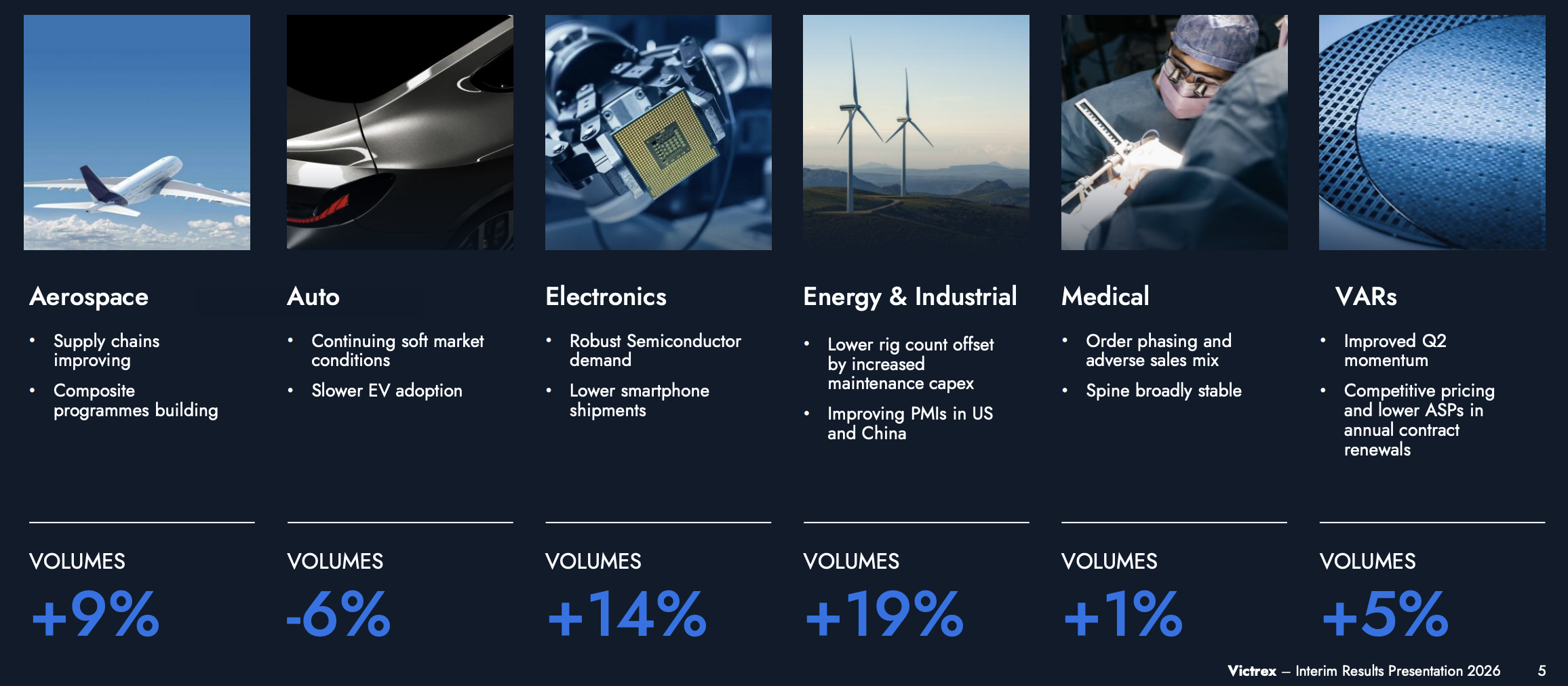
Opinion: Looking for measures that flag the inflection point I would suggest: i) cashflow stabilised even when reported profits were written down with significant non cash impairment charges ii) management maintained, but did not grow, the dividend (FY 60p, consisting of 13p interim, 46p final) for a couple of years. They promised to keeping paying the dividend as long as net debt did not exceed 1x EBITDA iii) volumes decreased -4% in Q1 Dec 2025, but then bounced +14% Q2 Mar 2026. That suggested the destocking cycle had ended and operational gearing would turn positive.
I have a tendency to buy into turnarounds too early (MANO, FDEV, IPX there are more) so will try to learn from this. I wrote about FDEV in January 2025, and VCT tells a similar story: both are fascinating examples of how investors can value the same amount of revenues, cashflows and dividends at wildly different ratings, depending on the second derivative, whether it looks like performance is improving or deteriorating. Well done to anyone who did catch this early.
Bruce Packard
@bruce_packard
Notes
Bruce owns shares in MANO and TRCS.
This article is for educational purposes only. It is not a recommendation to buy or sell shares or other investments. Do your own research before buying or selling any investment or seek professional financial advice.





Bi-Weekly Market Commentary | 16/09/2026 | EGAS, NG1, KEYS, JNEO, VCT | Heat is on for European Natural Gas
Bruce looks at the diverging performance of European (EGAS) versus US (NG1) natural gas. Stocks covered KEYS, JNEO, VCT.
The FTSE 100 fell -1.4% to 10,606 over the last 5 trading days. The Nasdaq100 and S&P 500 were both also down c. -1.4%, while the FTSE China 50 was down -2%. The latter is now down -10% YTD, whereas Japan’s Nikkei 225 is up +26%, the best performing major index, presumably as Japanese exporters are enjoying the benefits of a weak currency.
EGAS (European Natural Gas) rose +4% as Trump’s conflict in the Gulf seems to be going badly. EGAS is up +222% YTD, tracks the Dutch Title Transfer Facility (TTF) Natural Gas futures, which is over €80 per MWh. European Natural gas storage is currently just under 70% full, compared to over 90% full 2023-2025 and 84% full 2022, the first year of Putin’s invasion of Ukraine, when there were concerns about supplies not lasting through the winter.
Pre 2022, European natural gas tended to trade below €35 per MWh. Hopefully an El Nino year means that we will have a warm and wet winter, with lower probability of Dunkflaute. Solar generation is low Nov-Feb, so wind generation will be important over the winter months. It’s important to track the EGAS ticker though, because ShareScope shows NG1 (the US Henry Hub Natural Gas Front-Month Futures Contract traded on the NYMEX) is down -21% YTD, chart below.
Pre 2022, European natural gas tended to trade below €35 per MWh. Hopefully an El Nino year means that we will have a warm and wet winter, with lower probability of Dunkflaute. Solar generation is low Nov-Feb, so wind generation will be important over the winter months. It’s important to track the EGAS ticker though, because ShareScope shows NG1 (the US Henry Hub Natural Gas Front-Month Futures Contract traded on the NYMEX) is down -21% YTD,.
This week I look at Journeo, the transport software group’s strong performance and examine Victrex’s turnaround +44% YTD, to see if there were signs of improvement we could have spotted earlier. But I start with Keystone Law, “comfortably ahead” outlook, suggesting little signs yet of AI disruption in legal services.
Keystone Law H1 July Results, “comfortably ahead” FY Jan
This legal services firm announced H1 Jul results with revenues up +23% to £66m and statutory PBT up by a third to £9.2m. Some of the revenue growth is driven by 23 Principals (effectively law firm partners by a different name) joining. So revenue per Principal, which shows how productive each fee earner is, was up +15% to £134K. That’s arguably a better measure of “underlying” growth, similar to Like-for-Likes comparisons in the retail sector.
Net cash grew to £10.5m Jun 2026, versus £6.5m at the end of Jun 2025, despite operating cash conversion dropping from 104% to a still impressive 96% and payout a 10p H1 dividend and a £1.5m buyback during the period.
In other words Keystone is fundamentally cash generative, operating a different type of business model to the likes of Gateley and Manolete, which have struggled to convert accounting profits into cashflow. Keystone operates a fee-share platform model that outsources working capital risk to its lawyer Principals, who earn a 75% fee share. KEYS earns its 25%, for providing IT platform, support services, access to networking events etc. One broker I used to work at had a similar model, which we called “the hedge fund hotel”, as hedge fund managers should be raising funds from investors and working out which stocks to buy and sell, rather than struggling with back office tasks. The KEYS model removes significant personal liability, administrative burdens and doesn’t require a substantial buy-in (often funded with debt) compared to a traditional legal firm partnership. Perhaps the greatest attraction is work/life autonomy.
Outlook: Management suggest that they will be “materially ahead” of consensus of FY Dec 2027F revenue of £123m and adjusted PBT of £15.8m. Those figures were already anticipating revenue growth of +7% and +3%. Management also mention rolling out AI capabilities such as CoCounsel Legal, a professional-grade generative AI tool specifically designed for the legal industry.
Disruption risk v DATA: There’s some potential for this type of knowledge work being disrupted, similar to GlobalData which profit warned on Monday, which writes in-depth industry research reports. Unlike DATA, I think Keystone Law are harder to disrupt. My own experience is that LLM are good for sense checking legal topics but transactions that requires a contract are – by their nature – high value and contain “edge cases”. Imagine for instance a shareholder agreement between founders or creating a Family Trust, with a life of 80 years. That means sensible people will continue to rely on a solicitor for peace of mind. Matt Levine, at Bloomberg, has suggested that law firm partners underprice their hourly rate, and overprice their associates, and it is the latter which can be replaced by an LLM. Billing out the associates’ time at eye-wateringly high hourly rates for newly qualified lawyers in their 20’s is, in practice, a way to capture more value for the partners.
Valuation: KEYS shares are trading on a PER of 16x Jan 2028F and EV/EBITDA 12x the same year. EPS is forecast to be flat at 40p out to Jan 2029F, so I would imagine there will be upward pressure on those estimates.
Looking at the turnover and price to turnover chart, this is yet another AIM stock which hasn’t disappointed, but has been substantially de-rated. That’s similar to Gateley and Manolete, but I think KEYS looks to have been even more harshly treated given performance has been so strong.
The phenomenon isn’t confined to legal services, going back through my notes groups as diverse as Zotefoams, Rightmove, Alpha Group, YouGov and Craneware as experiencing the same dynamic. Some of that is disruption risk (YouGov, Rightmove and Craneware) and falling margins – but I think KEYS performance has been tarnished by investors avoiding the AIM index, probably switching into global index trackers.
Opinion: I like the investment case, though frustrated that I didn’t buy during the first half when AI disruption fears were at their highest and the shares troughed at 450p. Nowadays, we seem to be worrying less about AI disrupting SaaS business models, and instead AI exterminating humanity.
My feeling is that KEYS has good story, but there’s potentially even more upside in the lower quality companies like MANO and GTLY, which if they can improve cash conversion and expand margins, management have some hope of restoring credibility and have potential to multi-bag. If you prefer the superior track record, then KEYS could be for you.
Journeo H1 June Results
Journeo, up +800% March 2019, was flagged by Eric Langton in Oct 2023 and even earlier in Oct 2023. H1 results show revenues up +53% to £37.6m and statutory PBT up +10% to £2.96m. The divergence between revenue and costs is partly explained by falling finance income, but also a jump in admin expenses up +73% to £11.6m. That’s likely related to the acquisition of Crime and Fire Defence Systems (CFDS) in Sept last year for £11m in cash, £2m in deferred cash and £1m of shares issued. Hence group cash has fallen to £12.6m v £18m Jun last year.
They have renamed CFDS Infrastructure Protection and said that it generated revenue of £10.6m in H1. The acquired business has a gross margin 45% above the 38% for the group last H1. I can’t find an organic revenue or profit growth figure given by management, but subtracting £10.6m of revenue from CFDS in H1 would imply organic revenue growth of +10%.
History: The group was founded in 1975 and has been listed on AIM since 1995. ShareScope shows that the share price struggled a decade ago, as revenue was less than £12m and the business was loss making. New management transformed the business from a low-margin hardware reseller/installer into an intelligent transport systems (ITS) and SaaS model. The financial graph below reveals how revenue has increased (blue line, left axis) from less than £12m FY 2019 to £72m forecast FY 2026F the operational gearing means that the EBIT (blocks, right axis) has improved from negative to above 10%.
Outlook: Management have a medium-term ambition to grow annual revenue above £150m (v £55m FY Dec 2025), through organic growth and disciplined M&A, while maintaining strong margins. Cavendish, their NOMAD, are forecasting FY Dec 2027F revenue of £80m and adj EPS of 33.4p. Management reiterated Cavendish’s FY 2026F expectations of £72m and 32.2p EPS.
Valuation: The shares are trading on 16x PER Dec 2027F, and 8x EV/EBITDA the same year. Despite rising so strongly since 2019 the shares remain below £100m market cap, so off the radar screen for most institutional fund managers.
Opinion: It’s tempting to suggest anyone who doesn’t own the shares has missed the upside. However, Eric made a similar point in 2021, back when the price was 122p. At the very least, I think the investment case is worth looking at closely to understand how a stock has been such a great performer, and what the early signs were.
JNEO makes an interesting case study to compare against the likes of Tracsis, which I covered at the beginning of this month and Microlise, which I covered earlier this summer. All three operate in the transport software sector, but compared to JNEO the wheels seem to have fallen off both of those groups in recent years. Shearwater has also tried to adapt from a reseller to a recurring revenue SaaS business model, but struggled and had to write down the value of its acquisitions.
Victrex FY Sept Update
I briefly mentioned this polymer group at the start of the month, as they’d been the worst performer in the 2019 Fundsmith filter. The shares are up +44% YTD as performance has stabilised after a couple of inline updates. Last week their FY Sept pre-close update said they now expect underlying PBT to be in the range of £45m to £47m, (ahead of prior guidance of £42m to £44m given at the H1 March in May, unchanged in their July RNS). Back in February management had flagged an H2 weighting, which can often leave the door open for a later profit warning. Victrex’s reported H1 Mar £19m underlying PBT, so their H2 could be as high as £28m.
History: VCT is a specialty chemical group with a dominant position in PEEK (polyetheretherketone) polymers that are used in Aerospace, Automotive, Electronics, Energy, Medical sectors. Underlying PBT peaked at £127m in FY Sept 2018, versus £19m H1 this year (down -14% y-o-y) when the group also reported a statutory loss of £44m. A number of separate issues occurred around the same time: i) customers over ordering during Covid, then spending the next couple of years de-stocking ii) the medical division’s PEEK-OPTIMA product faced substitution from porous titanium iii) their Chinese factory struggled with operational issues, and they have now written down the value by £60.6m (around 80-90% of the invested capital) iv) operational gearing in the face of declining revenues. As the ShareScope chart below shows, turnover (blue line, left axis) peaked in FY Sept 2022 at £341m, and the EBIT margin (black line, right axis) fell from 26% to below 10% in FY Sept 2024.
Valuation: VCT shares are trading on a PER of 19x Sept 2027F and 11x EV/EBITDA. 19x appears expensive, but EPS is forecast to be below 50p in Sept 2027, versus a peak of 108p in 2019 (same number of shares outstanding). Cockney Rebel flagged this as a potential “bowly bottom” in July. Well done to him for noting the potential upside.
Opinion: Looking for measures that flag the inflection point I would suggest: i) cashflow stabilised even when reported profits were written down with significant non cash impairment charges ii) management maintained, but did not grow, the dividend (FY 60p, consisting of 13p interim, 46p final) for a couple of years. They promised to keeping paying the dividend as long as net debt did not exceed 1x EBITDA iii) volumes decreased -4% in Q1 Dec 2025, but then bounced +14% Q2 Mar 2026. That suggested the destocking cycle had ended and operational gearing would turn positive.
I have a tendency to buy into turnarounds too early (MANO, FDEV, IPX there are more) so will try to learn from this. I wrote about FDEV in January 2025, and VCT tells a similar story: both are fascinating examples of how investors can value the same amount of revenues, cashflows and dividends at wildly different ratings, depending on the second derivative, whether it looks like performance is improving or deteriorating. Well done to anyone who did catch this early.
Bruce Packard
@bruce_packard
Notes
Bruce owns shares in MANO and TRCS.
This article is for educational purposes only. It is not a recommendation to buy or sell shares or other investments. Do your own research before buying or selling any investment or seek professional financial advice.