Bruce returns to a Terry Smith filter from 2019, and examines what has gone wrong with the “buy quality and then do nothing” approach to investing. Company mentioned TRCS
 y-02-09-2026-trcs
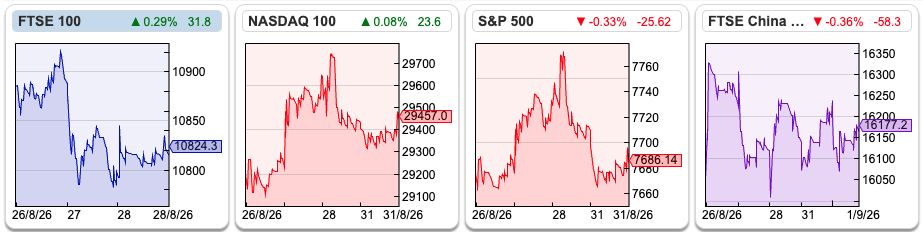
The FTSE 100 was flat over the last 5 trading days at 10,824. The Nasdaq100 rose +1.5%, while the FTSE China 50 was up less than +1.0%. The US 10Y government bond (USTSY10) yields 4.78% and the UK 10Y government bond (UKTSY10) yields 5.21%, with the spread between the 2 and 10 year currently 1%.
The second half of August has been quiet, as few companies have reported updates. I have taken the time to examine why Terry Smith’s performance has struggled. Although Terry is an “active” fund manager, he tends not to trade in and out of stocks, trying to avoid fads. Famously, his process is to i) buy quality companies ii) don’t overpay iii) do nothing. Very wu wei.
In the pursuit of knowledge, every day something is added. In the practice of The Way, every day something is dropped. Less and less is done, until non-action (wu wei) is achieved. When nothing is done, nothing is left undone. Lao Tzu

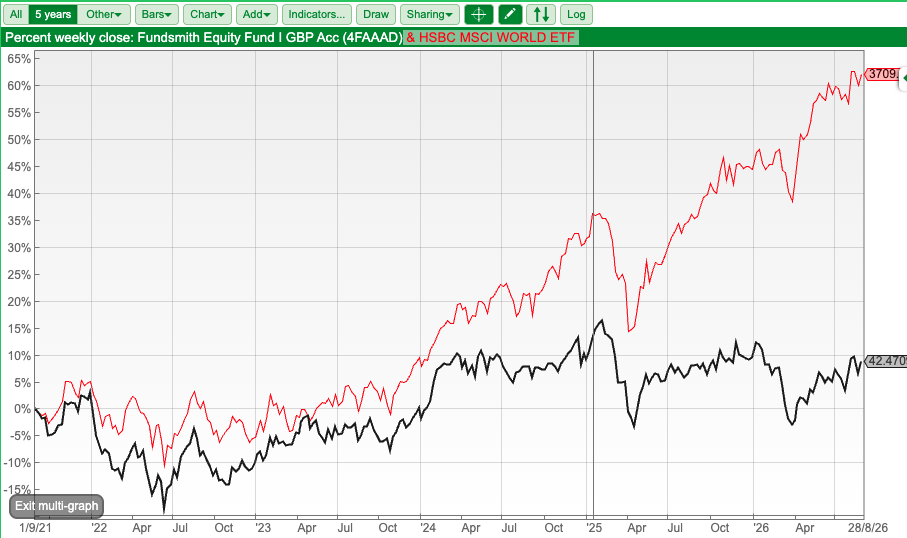
Below is a chart of Fundsmith GBP Accumulation units (ie dividends reinvested) in black underperforming the MSCI World ETF (red). Sadly “do nothing” has underperformed.
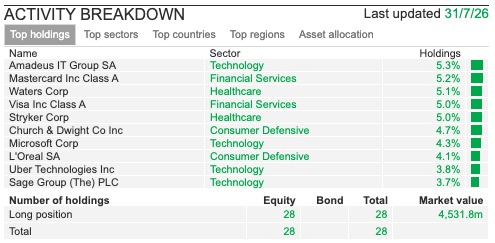
Yet more evidence that professional fund managers fail persistently to outperform. Partly that’s size, for instance, Terry decided to sell Unilever’s spin-off Magnum Ice Cream, because at less than £10bn market cap the stock was likely too small to be a top 10 position. Using ShareScope to examine his current “top 10” holdings, Sage is by far the smallest at $14bn.
I wanted to use ShareScope to explore the idea that high RoCE, high PER stocks, often called Quality at a Reasonable Price (QaaRP) have struggled in recent years. To do that, I created a portfolio in ShareScope from the Fundsmith March 2019 Top 10 holdings and exported it to Google Sheets.*
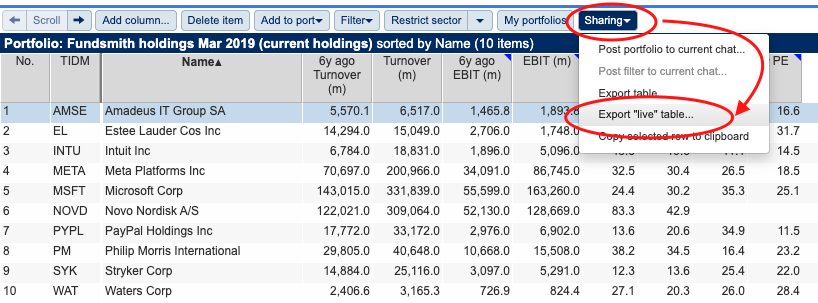
Notwithstanding the “do nothing” approach, his top 10 shareholdings have changed over time – Terry cut his positions in PayPal and Intuit. The point of the exercise was to analyse fundamentals to see what we could learn. While revenue and EBIT both increased at a CAGR of 10%, RoCE fell from 32% to 24%. The top 10 portfolio also saw a PER de-rating from 32x in 2019 to 24x currently, as the table below shows.
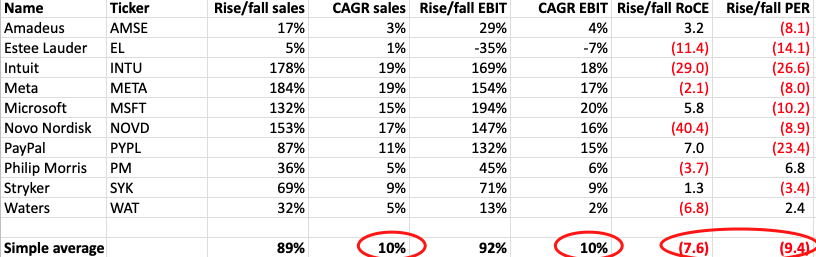
We can see that 8 of the top 10 Fundsmith holdings saw a PER de-rating (final column to the right), only tobacco group Philip Morris and Waters, which makes laboratory instruments for the life sciences sector, saw a PER expansion. The majority also saw a decline in profitability, as measured by RoCE, with Intuit and Novo Nordisk doing particularly badly and INTU falling from 49% to below 20% and NOVD 83% RoCE to 43%.
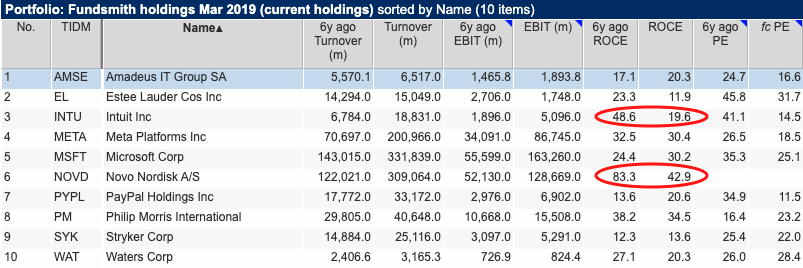
Put simply: as inflation expectations and interest rates rose, many of these “quality” picks, weren’t able to sustain performance to justify high PER ratios above 30x.
I wanted to test whether this observation applied more generally. It is a seductive idea, to buy good quality companies and then do nothing. Substack is full of authors quoting Munger and publishing about “quality compounders”.
ShareScope has a couple of Terry Smith filters, built by Richard before the pandemic. Back then Terry’s fund was outperforming, so it made sense to replicate his approach with a filter for UK stocks. We can use this to pose the question: did the process break because Terry could only fish for mega cap stocks from Mauritius? or did the same problems occur for smaller UK listed companies in Richard’s “Fishing Like Fundsmith” March 2019 filter?

Richard took his criteria from the Fundsmith User Manual and applied it to UK listed shares. In his original article, Richard pointed out that although the screen looked for profitability (RoCE) and valuation (free cashflow yield) ratios, Fundsmith investments have qualitative attributes like brand names, market dominance, patents, large installed bases to service, distribution networks and deep relations with customers. It is often nigh-on impossible to value these assets, so accountants rarely bother. Bear that caveat in mind: this financial filter was meant to be a starting point.
Richard’s top 20 stocks and performance since March 2019 are below:
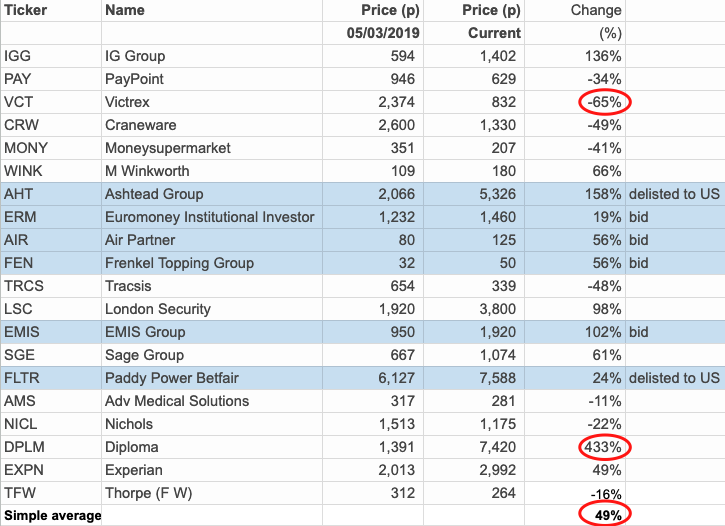
From the original 20, 5 (Air Partner, Dignity, EMIS, Euromoney, Frenkel Topping) were bid for and are no longer listed. Ashtead and Betfair/Paddy Power, now called Flutter, moved their listing to the US. Diploma the best performer up more than 5x. The worst performer in the filter was Victrex, the polymer materials group that has struggled with several profit warnings. Assuming an equal weight position, the filter itself was only up +49%, and underperformed Terry’s Fundsmith portfolio. That suggests to me that Terry’s problem hasn’t been size only – smaller, UK companies that fit the Fundsmith profile have also struggled.
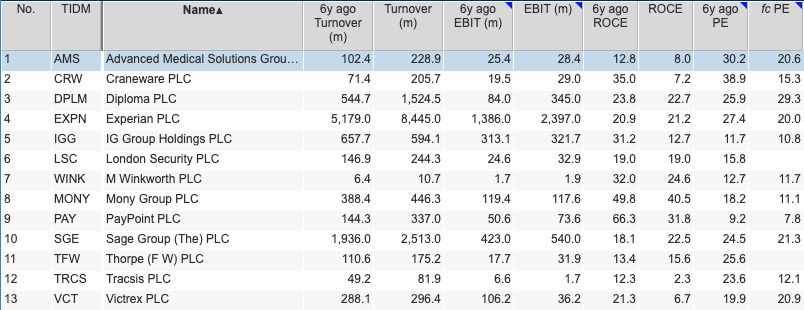
Richard’s portfolio was less profitable (as measured by RoCE) but also better value (as measured by PE ratio). Both Richard’s FLFsmith filter and the Fundsmith Top 10 saw a similar level of revenue growth (9% CAGR) but EBIT growth was up only 3% CAGR for FLFsmith. Diploma did fantastically well with a 27% CAGR EBIT performance, but was an outlier, the next best after that was Experian and FW Thorpe, which both reported 10% CAGR EBIT. Richard’s UK portfolio saw average RoCE fall from 27% 6 years ago to 18% in 2025, and the average PER de-rate from 22x to 16x.
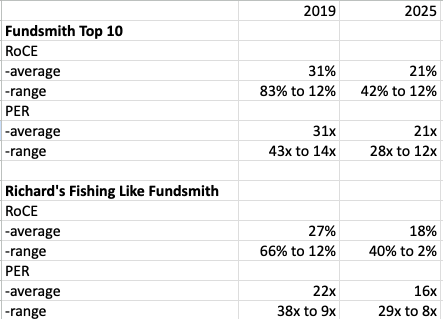
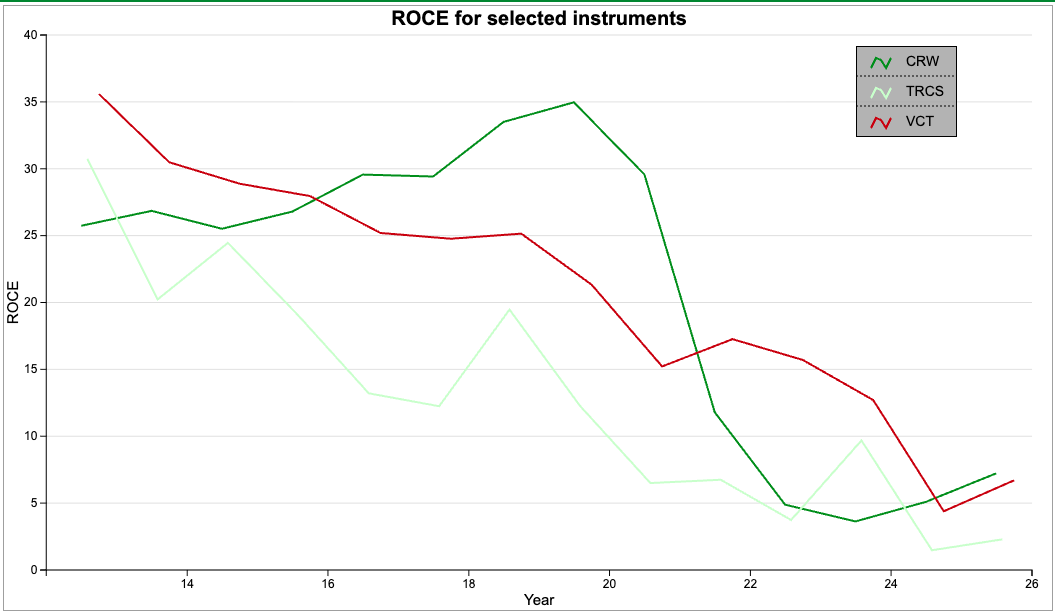
Many “Quality at a Reasonable Price” QaaRP shares weren’t so reasonably priced: trading at 31x on average for the Fundsmith portfolio and 22x for Richard’s UK portfolio — with hindsight it looks like those valuations were inflated by a decade of Quantitative Easing (QE) and near zero interest rates. Many of these groups de-rated as we discovered that consistently high reported RoCE wasn’t synonymous with “moats” and franchises lacked the power to raise prices when inflation reappeared. ShareScope shows the historic RoCE charts for Craneware, Tracsis and Victrex are particularly disappointing (below).
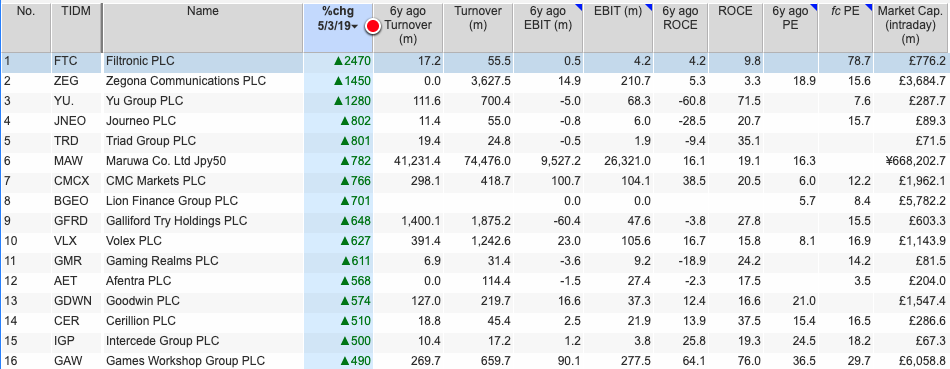
The hindsight portfolio: I was curious to see what has performed well since March 2019, surviving both the pandemic and the inflation caused by Putin’s invasion of Ukraine. I used ShareScopes “Quick Filter” to exclude miners, because we shouldn’t be beating ourselves up for missing unprofitable junior goldminers like Altyngold or Metals Exploration.
The top performer was Filtronic, which wouldn’t have been picked up by any QaaRP filter back then. Instead, investors like Richard Staveley, who paid attention to the contract win announcements could jump on the bandwagon early. Turnarounds like Yu, Triad and Journeo were not QaaRP stocks in 2019, as they were unprofitable. Zegona buys underperforming or non-core TMT assets, cuts structural costs and improves performance: “buy, fix, sell”. The investment case relied heavily on a correct assessment of the high quality of the management team, rather than a filter.
Probably the filter should have caught: CMCX, VLX, CER, GAW – which were excluded because they lacked the track record (as measured by 5 and 10 year RoCE) to be caught in the filter’s net. Goodwin was on the original list, but was the only one.
Up until a couple of years ago, Terry was proudly telling anyone who would listen that unlike Warren Buffett, he avoided banks. Famously, Buffett avoids technology “because he doesn’t understand it”; Terry, on the other hand, avoids banks because he DOES understand them – being a former banks’ analyst.
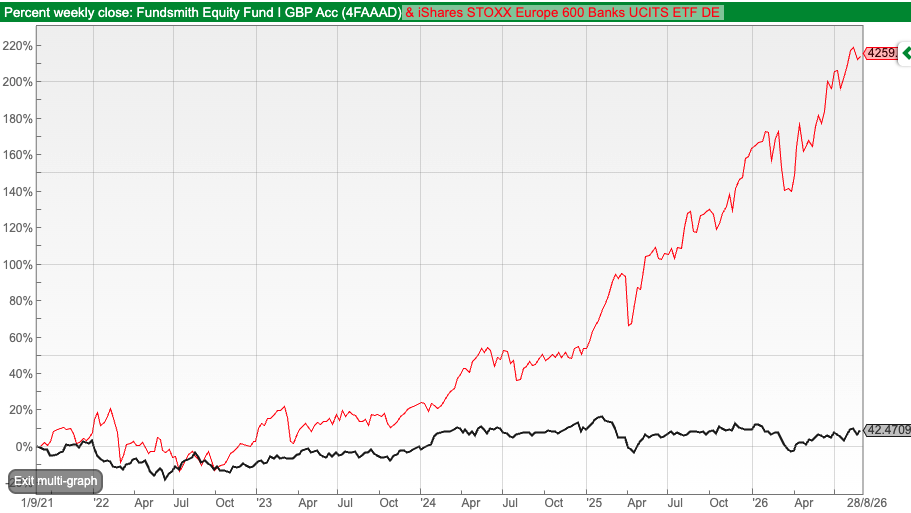
The MSCI European banking sector (red in the chart below) has been a strong performer, as rising interest rates have been helpful. BGEO is 8th in the list above of top performers since 2019, but banks almost everywhere have enjoyed a helpful tailwind. Owning some bank exposure, the Sage of Omaha once again proves himself to be “il miglior fabbro”.
Buffett also successfully discarded his own “avoid technology” rule of thumb and ten bagged his investment in Apple. I think we can learn from this: Buffett characterises his investment style as “lethargy, bordering on sloth”, but his mind remains extremely active.
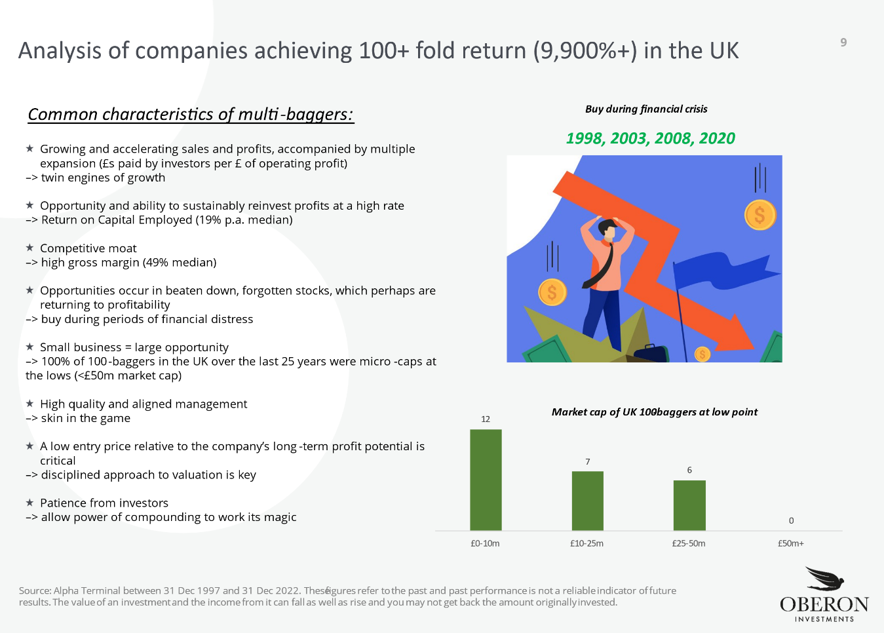
8 of the top 16 best performers in the list (above) reported revenue of less than £20m in 2019. Sub £20m revenue companies should be an interesting pool for ShareScope readers to be fishing in, as they are uninvestable for the vast majority of professional fund managers, who are constrained by size. Richard Penny, at Oberon, points out that of the 25 UK listed companies that have hundred bagged, three quarters (19/25) had a market cap of less than £25m at their low. None of the hundred baggers started with a market cap greater than £50m.
If the last 6-7 years have been a difficult time for QaaRP, UK and small and mid-cap shares, the contrarian in me wonders if it is now time to dust off the filter. Several of the names are still there: Andrew Sykes, Diploma, Experian, but there are many new additions like CBOX and BMY. See below for the first 15 names, and naturally you can still find the Fishing like Fundsmith filter on the ShareScope tab to play with and run yourself.
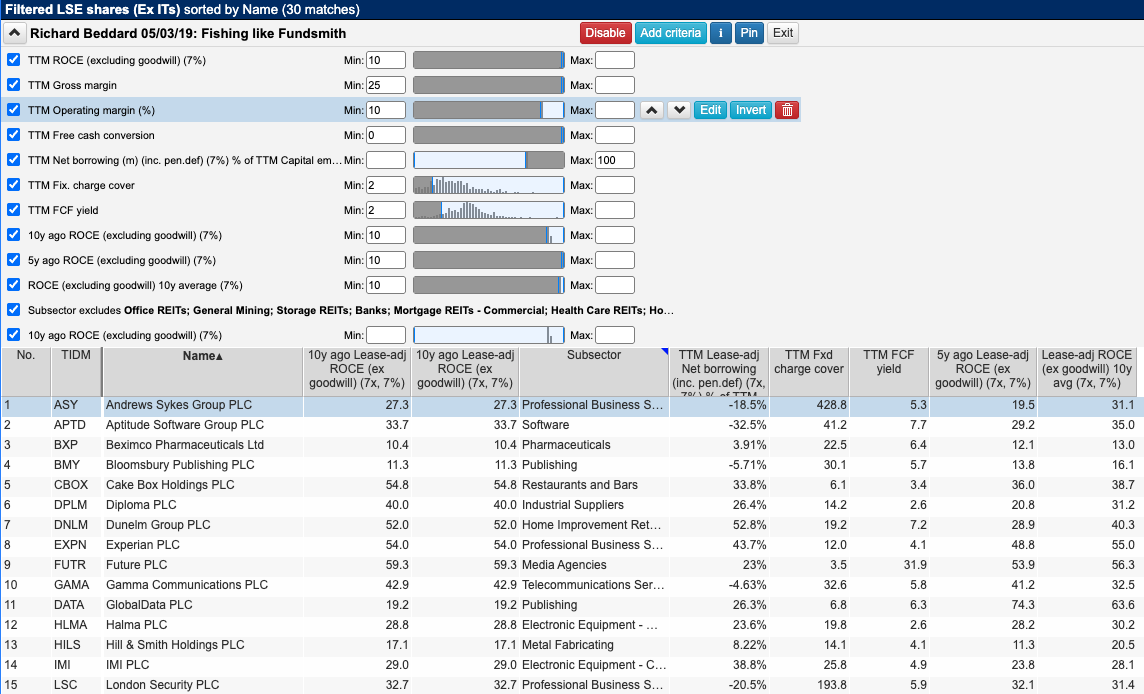
The above list could be a good starting point, though I would avoid Future, GlobalData and Moneysupermarket (just off the page) as these are at risk of disruption from AI agents, in my opinion.
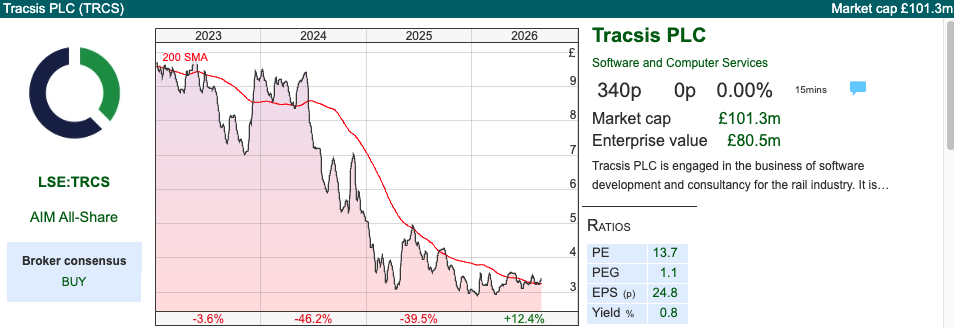
A different contrarian approach: look at the names that have dropped out of the filter as RoCE has declined, such as Craneware, Victrex or Tracsis and hope that perhaps they can recover their profitability. I covered Craneware in March. Victrex chart looks like it has formed a bottom, with management reporting in July that guidance for FY Sept would be maintained (in other words, after several profit warnings the situation has stabilised). Finally, Tracsis reported a trading update last week, and is now trading above its 200 simple moving average.
Tracsis Trading Update
Tracsis reported FY Jul 2026F revenue is expected to be £85.5m + 4% from the previous year. However that includes the contribution from the Events Transport Planning business, which management have sold to Private Equity for £7.25m Enterprise Value. The previous year (ie FY July 2025) that Events business generated revenue of c.£20.4m and adjusted EBITDA of c.£1.9m.
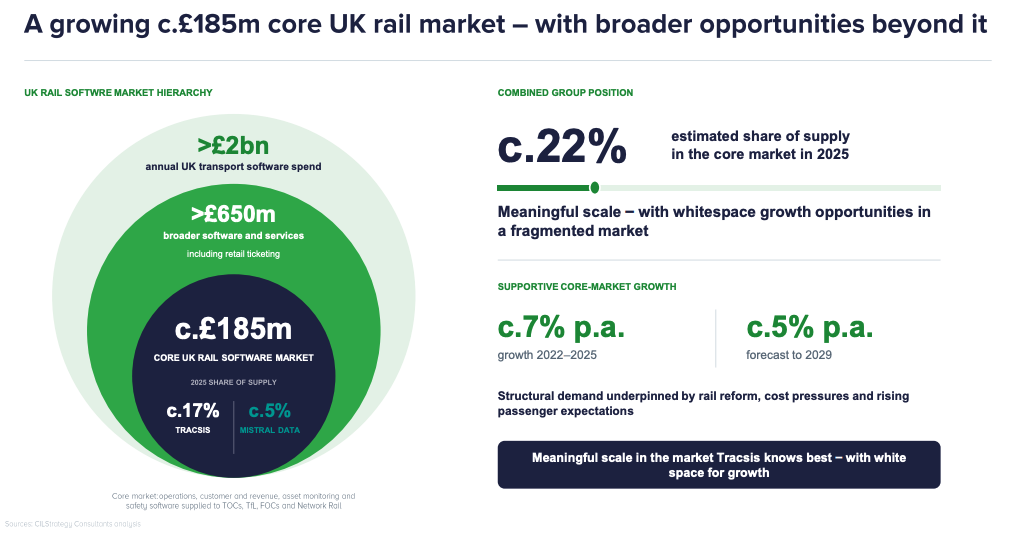
Management expect adj EBITDA to be +7% to £13.5m (including the disposal). Year end cash stood at £19m, excluding the £7.25m, which they received early August. They are using their cash to buy Mistral Data, for £48m – so the financial position goes from net cash to around £20m net debt (or 1.5x net debt to EBITDA). Mistral has an adj EBITDA margin of 30%, with 85% recurring revenue.
At the Jan H1 results, there was £42m of intangible assets on the balance sheet, versus £65m shareholders’ equity. Paul Hill, of Vox Markets, suggests that rail budgets have been frozen for the last 3 years, but that in a year’s time TRCS could be very well positioned to win more business. He owns a full position in the shares.
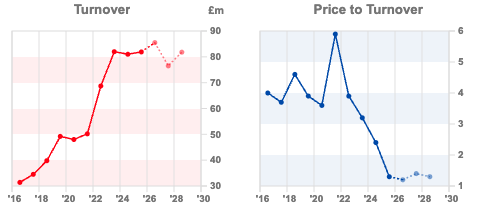
Valuation: The shares are trading on a PER of 12x FY Jul 2027F and 1.4x turnover. I’m assuming those forecasts are stale, and have not yet factored in the corporate activity. However, the forecasts won’t be too far off; during the pandemic TRCS was trading on 6x turnover, the share count hasn’t increased from 2021 when the shares peaked at £11 per share in 2021.
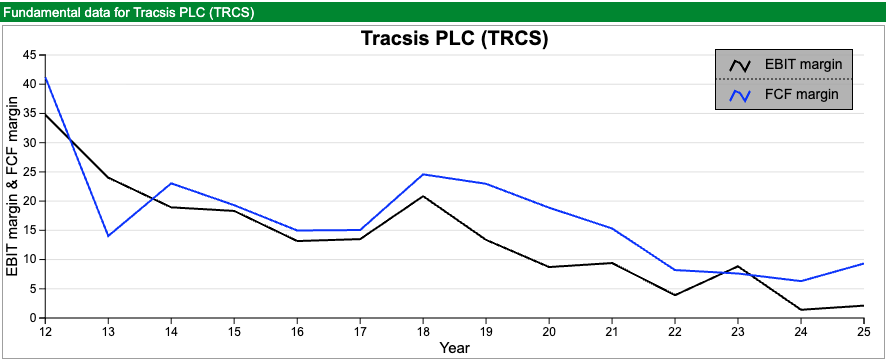
Opinion: This looks like an interesting turnaround story. The investment case comes down to the quality of the management and whether they grow sales while improving the EBIT margin. This is a software group with gross margins around 60%, so the EBIT and FCF margin really should be higher.
I’ve taken a small position. David Frost, CEO, and Andy Kelly, CFO, will host a virtual investor presentation on Wednesday 16 September at 11:00am BST, providing an overview of the Mistral Data acquisition and what this means for the enlarged group, followed by Q&A.
Investors can register to attend here: https://engageinvestor.news/TRCS_IP_0926
A final thought on AI tools
I mentioned a couple of weeks ago that playing with the AI tools given away for free might be a better way to play the “bubble” than chasing Nvidia shares higher or buying into OpenAI or Anthropic’s IPOs. My friend Ron, who was head of IT at a company I worked at in the 1990’s has had a stroke. The new tools have allowed him to create excellent YouTube content on themes as diverse as Chinese history, the future of AI or the transition to renewables. Ron points out that it wouldn’t have been possible for one man to create this content a couple of years ago. Do have a look.
Notes
Bruce owns shares in Tracsis and Bank of Georgia
*It is possible to export from ShareScope into MS Excel. However, I’m using a Mac with MS Excel, and it misbehaves sometimes because Microsoft and the Apple operating system don’t talk to each other seamlessly. For a task like this, I prefer to use Google Sheets.
This article is for educational purposes only. It is not a recommendation to buy or sell shares or other investments. Do your own research before buying or selling any investment or seek professional financial advice.


Bi-Weekly Market Commentary | 02/09/2026 | TRCS | To do nothing requires an active mind
The FTSE 100 was flat over the last 5 trading days at 10,824. The Nasdaq100 rose +1.5%, while the FTSE China 50 was up less than +1.0%. The US 10Y government bond (USTSY10) yields 4.78% and the UK 10Y government bond (UKTSY10) yields 5.21%, with the spread between the 2 and 10 year currently 1%.
The second half of August has been quiet, as few companies have reported updates. I have taken the time to examine why Terry Smith’s performance has struggled. Although Terry is an “active” fund manager, he tends not to trade in and out of stocks, trying to avoid fads. Famously, his process is to i) buy quality companies ii) don’t overpay iii) do nothing. Very wu wei.
In the pursuit of knowledge, every day something is added. In the practice of The Way, every day something is dropped. Less and less is done, until non-action (wu wei) is achieved. When nothing is done, nothing is left undone. Lao Tzu
Below is a chart of Fundsmith GBP Accumulation units (ie dividends reinvested) in black underperforming the MSCI World ETF (red). Sadly “do nothing” has underperformed.
Yet more evidence that professional fund managers fail persistently to outperform. Partly that’s size, for instance, Terry decided to sell Unilever’s spin-off Magnum Ice Cream, because at less than £10bn market cap the stock was likely too small to be a top 10 position. Using ShareScope to examine his current “top 10” holdings, Sage is by far the smallest at $14bn.
I wanted to use ShareScope to explore the idea that high RoCE, high PER stocks, often called Quality at a Reasonable Price (QaaRP) have struggled in recent years. To do that, I created a portfolio in ShareScope from the Fundsmith March 2019 Top 10 holdings and exported it to Google Sheets.*
Notwithstanding the “do nothing” approach, his top 10 shareholdings have changed over time – Terry cut his positions in PayPal and Intuit. The point of the exercise was to analyse fundamentals to see what we could learn. While revenue and EBIT both increased at a CAGR of 10%, RoCE fell from 32% to 24%. The top 10 portfolio also saw a PER de-rating from 32x in 2019 to 24x currently, as the table below shows.
We can see that 8 of the top 10 Fundsmith holdings saw a PER de-rating (final column to the right), only tobacco group Philip Morris and Waters, which makes laboratory instruments for the life sciences sector, saw a PER expansion. The majority also saw a decline in profitability, as measured by RoCE, with Intuit and Novo Nordisk doing particularly badly and INTU falling from 49% to below 20% and NOVD 83% RoCE to 43%.
Put simply: as inflation expectations and interest rates rose, many of these “quality” picks, weren’t able to sustain performance to justify high PER ratios above 30x.
I wanted to test whether this observation applied more generally. It is a seductive idea, to buy good quality companies and then do nothing. Substack is full of authors quoting Munger and publishing about “quality compounders”.
ShareScope has a couple of Terry Smith filters, built by Richard before the pandemic. Back then Terry’s fund was outperforming, so it made sense to replicate his approach with a filter for UK stocks. We can use this to pose the question: did the process break because Terry could only fish for mega cap stocks from Mauritius? or did the same problems occur for smaller UK listed companies in Richard’s “Fishing Like Fundsmith” March 2019 filter?
Richard took his criteria from the Fundsmith User Manual and applied it to UK listed shares. In his original article, Richard pointed out that although the screen looked for profitability (RoCE) and valuation (free cashflow yield) ratios, Fundsmith investments have qualitative attributes like brand names, market dominance, patents, large installed bases to service, distribution networks and deep relations with customers. It is often nigh-on impossible to value these assets, so accountants rarely bother. Bear that caveat in mind: this financial filter was meant to be a starting point.
Richard’s top 20 stocks and performance since March 2019 are below:
From the original 20, 5 (Air Partner, Dignity, EMIS, Euromoney, Frenkel Topping) were bid for and are no longer listed. Ashtead and Betfair/Paddy Power, now called Flutter, moved their listing to the US. Diploma the best performer up more than 5x. The worst performer in the filter was Victrex, the polymer materials group that has struggled with several profit warnings. Assuming an equal weight position, the filter itself was only up +49%, and underperformed Terry’s Fundsmith portfolio. That suggests to me that Terry’s problem hasn’t been size only – smaller, UK companies that fit the Fundsmith profile have also struggled.
Richard’s portfolio was less profitable (as measured by RoCE) but also better value (as measured by PE ratio). Both Richard’s FLFsmith filter and the Fundsmith Top 10 saw a similar level of revenue growth (9% CAGR) but EBIT growth was up only 3% CAGR for FLFsmith. Diploma did fantastically well with a 27% CAGR EBIT performance, but was an outlier, the next best after that was Experian and FW Thorpe, which both reported 10% CAGR EBIT. Richard’s UK portfolio saw average RoCE fall from 27% 6 years ago to 18% in 2025, and the average PER de-rate from 22x to 16x.
Many “Quality at a Reasonable Price” QaaRP shares weren’t so reasonably priced: trading at 31x on average for the Fundsmith portfolio and 22x for Richard’s UK portfolio — with hindsight it looks like those valuations were inflated by a decade of Quantitative Easing (QE) and near zero interest rates. Many of these groups de-rated as we discovered that consistently high reported RoCE wasn’t synonymous with “moats” and franchises lacked the power to raise prices when inflation reappeared. ShareScope shows the historic RoCE charts for Craneware, Tracsis and Victrex are particularly disappointing (below).
The hindsight portfolio: I was curious to see what has performed well since March 2019, surviving both the pandemic and the inflation caused by Putin’s invasion of Ukraine. I used ShareScopes “Quick Filter” to exclude miners, because we shouldn’t be beating ourselves up for missing unprofitable junior goldminers like Altyngold or Metals Exploration.
The top performer was Filtronic, which wouldn’t have been picked up by any QaaRP filter back then. Instead, investors like Richard Staveley, who paid attention to the contract win announcements could jump on the bandwagon early. Turnarounds like Yu, Triad and Journeo were not QaaRP stocks in 2019, as they were unprofitable. Zegona buys underperforming or non-core TMT assets, cuts structural costs and improves performance: “buy, fix, sell”. The investment case relied heavily on a correct assessment of the high quality of the management team, rather than a filter.
Probably the filter should have caught: CMCX, VLX, CER, GAW – which were excluded because they lacked the track record (as measured by 5 and 10 year RoCE) to be caught in the filter’s net. Goodwin was on the original list, but was the only one.
Up until a couple of years ago, Terry was proudly telling anyone who would listen that unlike Warren Buffett, he avoided banks. Famously, Buffett avoids technology “because he doesn’t understand it”; Terry, on the other hand, avoids banks because he DOES understand them – being a former banks’ analyst.
The MSCI European banking sector (red in the chart below) has been a strong performer, as rising interest rates have been helpful. BGEO is 8th in the list above of top performers since 2019, but banks almost everywhere have enjoyed a helpful tailwind. Owning some bank exposure, the Sage of Omaha once again proves himself to be “il miglior fabbro”.
Buffett also successfully discarded his own “avoid technology” rule of thumb and ten bagged his investment in Apple. I think we can learn from this: Buffett characterises his investment style as “lethargy, bordering on sloth”, but his mind remains extremely active.
8 of the top 16 best performers in the list (above) reported revenue of less than £20m in 2019. Sub £20m revenue companies should be an interesting pool for ShareScope readers to be fishing in, as they are uninvestable for the vast majority of professional fund managers, who are constrained by size. Richard Penny, at Oberon, points out that of the 25 UK listed companies that have hundred bagged, three quarters (19/25) had a market cap of less than £25m at their low. None of the hundred baggers started with a market cap greater than £50m.
If the last 6-7 years have been a difficult time for QaaRP, UK and small and mid-cap shares, the contrarian in me wonders if it is now time to dust off the filter. Several of the names are still there: Andrew Sykes, Diploma, Experian, but there are many new additions like CBOX and BMY. See below for the first 15 names, and naturally you can still find the Fishing like Fundsmith filter on the ShareScope tab to play with and run yourself.
The above list could be a good starting point, though I would avoid Future, GlobalData and Moneysupermarket (just off the page) as these are at risk of disruption from AI agents, in my opinion.
A different contrarian approach: look at the names that have dropped out of the filter as RoCE has declined, such as Craneware, Victrex or Tracsis and hope that perhaps they can recover their profitability. I covered Craneware in March. Victrex chart looks like it has formed a bottom, with management reporting in July that guidance for FY Sept would be maintained (in other words, after several profit warnings the situation has stabilised). Finally, Tracsis reported a trading update last week, and is now trading above its 200 simple moving average.
Tracsis Trading Update
Tracsis reported FY Jul 2026F revenue is expected to be £85.5m + 4% from the previous year. However that includes the contribution from the Events Transport Planning business, which management have sold to Private Equity for £7.25m Enterprise Value. The previous year (ie FY July 2025) that Events business generated revenue of c.£20.4m and adjusted EBITDA of c.£1.9m.
Management expect adj EBITDA to be +7% to £13.5m (including the disposal). Year end cash stood at £19m, excluding the £7.25m, which they received early August. They are using their cash to buy Mistral Data, for £48m – so the financial position goes from net cash to around £20m net debt (or 1.5x net debt to EBITDA). Mistral has an adj EBITDA margin of 30%, with 85% recurring revenue.
At the Jan H1 results, there was £42m of intangible assets on the balance sheet, versus £65m shareholders’ equity. Paul Hill, of Vox Markets, suggests that rail budgets have been frozen for the last 3 years, but that in a year’s time TRCS could be very well positioned to win more business. He owns a full position in the shares.
Valuation: The shares are trading on a PER of 12x FY Jul 2027F and 1.4x turnover. I’m assuming those forecasts are stale, and have not yet factored in the corporate activity. However, the forecasts won’t be too far off; during the pandemic TRCS was trading on 6x turnover, the share count hasn’t increased from 2021 when the shares peaked at £11 per share in 2021.
Opinion: This looks like an interesting turnaround story. The investment case comes down to the quality of the management and whether they grow sales while improving the EBIT margin. This is a software group with gross margins around 60%, so the EBIT and FCF margin really should be higher.
I’ve taken a small position. David Frost, CEO, and Andy Kelly, CFO, will host a virtual investor presentation on Wednesday 16 September at 11:00am BST, providing an overview of the Mistral Data acquisition and what this means for the enlarged group, followed by Q&A.
Investors can register to attend here: https://engageinvestor.news/TRCS_IP_0926
A final thought on AI tools
I mentioned a couple of weeks ago that playing with the AI tools given away for free might be a better way to play the “bubble” than chasing Nvidia shares higher or buying into OpenAI or Anthropic’s IPOs. My friend Ron, who was head of IT at a company I worked at in the 1990’s has had a stroke. The new tools have allowed him to create excellent YouTube content on themes as diverse as Chinese history, the future of AI or the transition to renewables. Ron points out that it wouldn’t have been possible for one man to create this content a couple of years ago. Do have a look.
Notes
Bruce owns shares in Tracsis and Bank of Georgia
*It is possible to export from ShareScope into MS Excel. However, I’m using a Mac with MS Excel, and it misbehaves sometimes because Microsoft and the Apple operating system don’t talk to each other seamlessly. For a task like this, I prefer to use Google Sheets.
This article is for educational purposes only. It is not a recommendation to buy or sell shares or other investments. Do your own research before buying or selling any investment or seek professional financial advice.