As yen intervention signals a possible unwind of the carry trade Bruce Packard looks at cybersecurity firm SWG, mental health app KOO and Tbilisi based CGEO.
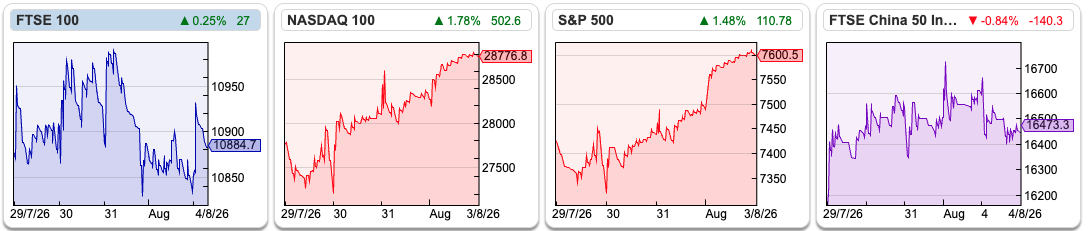
The FTSE 100 was hitting new highs though has retraced below 10,900 and is now flat over the last 5 trading days. The Nasdaq100 and S&P500 were both up around +2.5%, even as SpaceX’s first set of lock-ups expire allowing insiders to sell more shares. The FTSE China 50 was also up +2.4%, though the SSE Composite (Shanghai) which contains over 2,000 Chinese listed smaller stocks continues to struggle, and is now down -4% YTD.
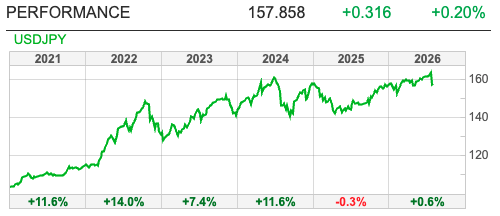
The US administation has intervened to sell Euros and buy Yen. ShareScope puts the move into context, with the Yen now flat against the dollar YTD, but falling from 100 Yen / USD at the start of 2021.
The chart below from the Bank of England’s Financial Stability Report shows that US, Chinese, Euro area and UK government debt/GDP ratios rising. For decades, hedge funds have used the Yen as a cheap funding currency to borrow in, and reinvest in higher yielding government debt. Thus Yen weakness and US and UK government funding are likely two sides of the same coin: carry trade.
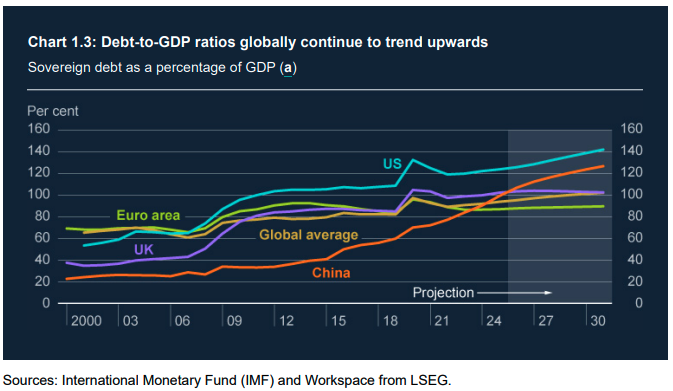
Missing from the chart above is Japanese Government debt which remains over 200% of GDP, but down from its pandemic peak of 258% in 2020. Effects of carry trade unwind could be: i) bad news for momentum driven mega caps in the USA ii) bad news for UK and US long term government bonds.
On the positive side, a weak Yen has boosted Japanese exporters, so UK and European high value engineering firms have had their order books hollowed out as Yen weakness has boosted Japanese competitors. Yen weakness reversing could be positive for UK small and mid cap manufacturers with an international client base.
This week I look at Shearwater, the cybersecurity group and Kooth, the mental health app, June trading updates. Plus Georgia Capital H1 June results, where NAV has continued to compound as management have bought back over a third of their market cap since demerging from Bank of Georgia in 2018.
Shearwater FY Jun 2026 Trading Update
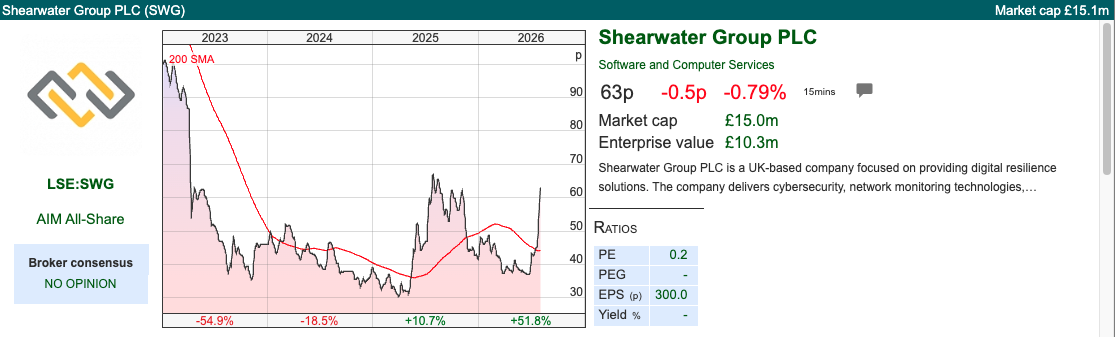
This small cybersecurity group has been reporting improved performance and contract wins recently. The market cap is below £20m so the price spike also reflects some illiquidity in the shares. Last week they said a strong H2, meant FY Jun 2026 revenues and adj EBITDA would be “ahead of market expectations”. They now say FY Jun revenue up +33% to £42m and adj EBITDA of £2.5m (Cavendish expectations were £35.5m and adj EBITDA of £2.4m, so that implies £6.5m of extra revenue has only translated into £0.1m of additional EBITDA). The group had net cash Jun 2026 of £5.6m (versus £5.1m Jun 2025), the group said on the 1st July that £5.6m cash figure was -20% below expectations, but also announced a major £25m contract win (see below).
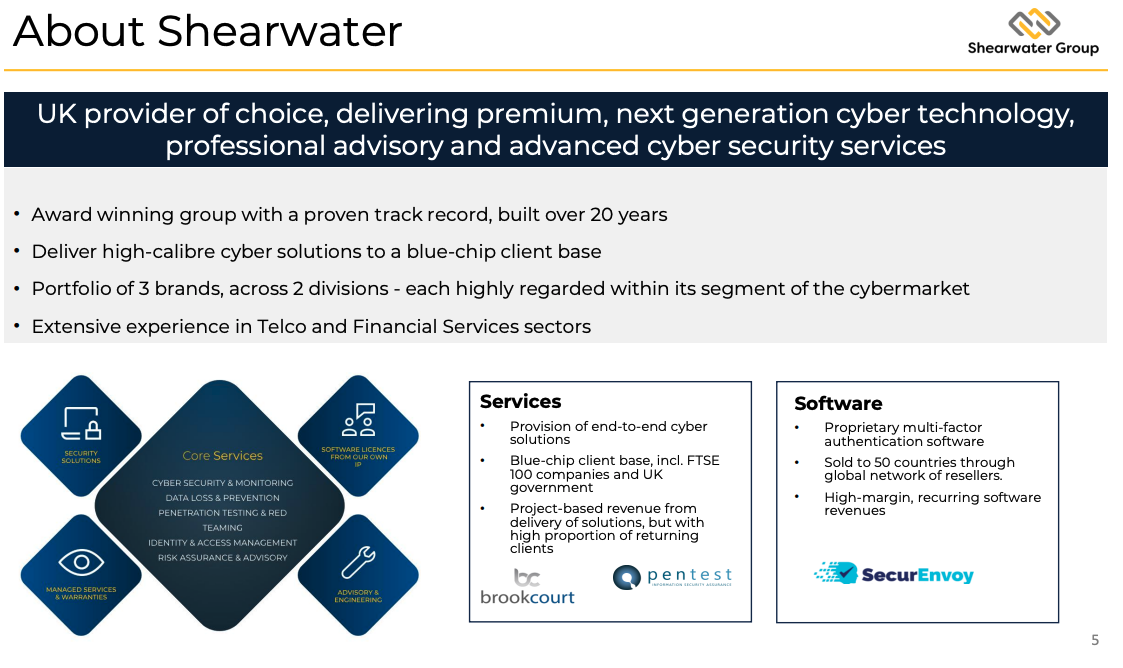
Contract win: On the first of July, just after the FY Jun year end SWG announced a c.£25m revenue over five-years contract win, providing significant revenue visibility into future years. Approximately £12.5m of that would be recognised in FY Jun 2026, reflecting the delivery of initial software and support licenses. The board reiterated confidence in achieving market expectations for FY 2026 EBITDA, with revenue expected to be slightly ahead of expectations. It seems surprising that a contract win of £25m, of which £12m in FY Jun 2026 was already in the brokers’ estimates.
I was also intrigued, that the group reported a gross margin of only 17% in H1, compared to SaaS (Software as a Service) groups which report gross margins in the 70-90% range. That’s because the SWG is primarily a reseller, through Brookcourt which it bought in Aug 2018 for £30m (1.4x sales, 15x EV/EBITDA). That’s not a bad thing. Computacentre (gross margin 24%) and Softcat (gross margin 34%) are both up strongly this year: CCC up +66% YTD and SCT +36% YTD.
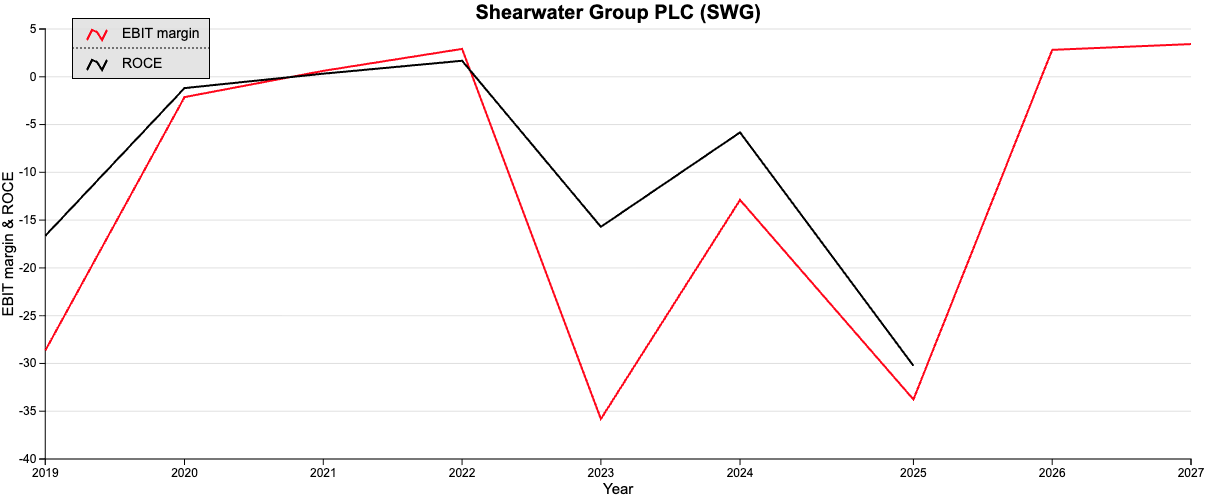
Shearwater changed its year end to June last year. In November they announced a £13.4m impairment, of which £9.3m was their software business. This comprises of GeoLang, which protects sensitive data, while SecurEnvoy focuses on verifying and managing user identities. These SaaS businesses report attractive gross margin of 81%, but generates only £2m of revenue, and the top line has been falling in recent years (-12% decline in H1.)
Outlook: Management talk about “positive momentum, supported by continued demand for its cybersecurity services and a strong pipeline of opportunities”. However, Cavendish, their NOMAD, have left FY Jun 2027F forecasts unchanged, at £38m of revenues and adj EBITDA of £2.6m. That implies a decline in revenue of -10%, and flat ad EBITDA. A reminder that outlook statements are becoming increasingly meaningless if read in isolation – we also need to know what brokers, who speak to management, are doing with their numbers.
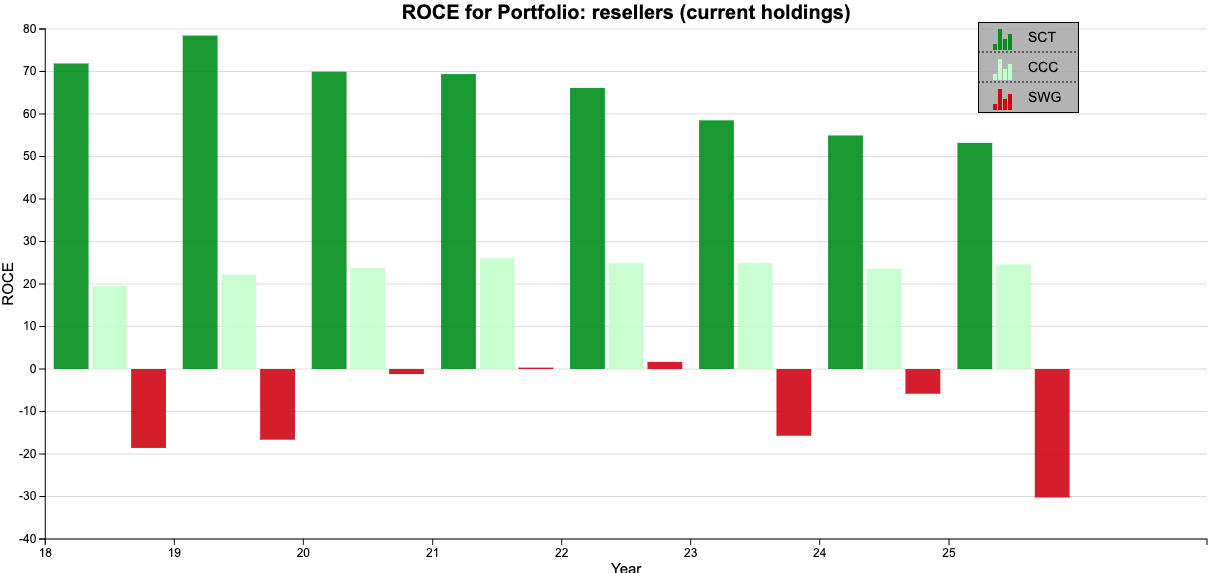
Valuation: The shares are trading on a PER of 11x Jun 2027F, around half the level of SCT and CCC on c. 20x PER. One feature of ShareScope that I think I should be using more, is the ability to compare profitablity of companies using the “Financial Charts” tab.

Using the “List” tab on the left with a porfolio of companies selected, creates a chart like the one below, which shows SWG the (lack of) historic profitability in red versus larger resellers CCC and SCT.
Opinion: The adj EBITDA margin of 3% in the Services (Brookcourt) division at H1 looks very low, even for a reseller. Presumably there could be a margin expansion story here if management can grow the business? The £12.5m additional revenue recognised right at the end of FY Jun 2026 having minimal influence on the group adj EBITDA margin is disappointing, as it implies the new business they’re winning is at a negative margin.
There’s lots of potential in SWG, you can read the bull case on substack, which is £44m of contract wins in the last six months combined with a cheap valuation. But the long term share price decline tells a story: that selling cybersecurity to large enterprises is far from easy. I’ll put this in my “too hard” pile, as the share price has already spiked +66% in a month. Worth keeping an eye on for more contract win RNS’s though.
Kooth HY Jun 2026 Trading Update
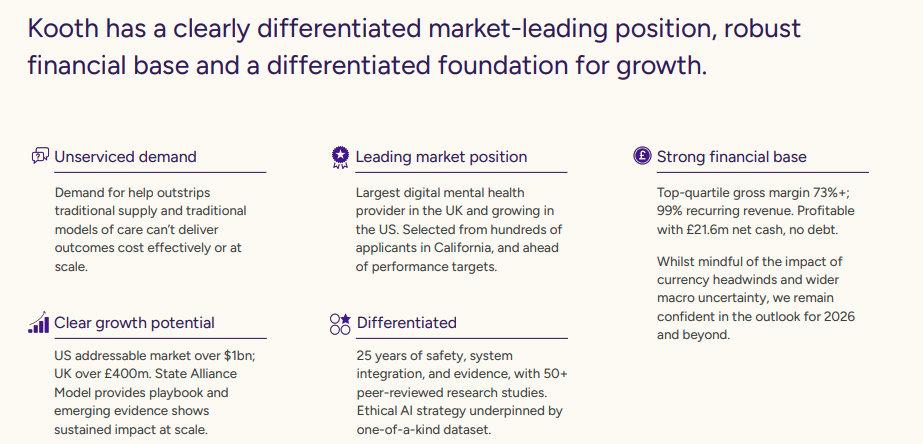
This digital mental health app looks like a very attractive valuation, but there’s a fear that the group might lose a valuable contract with the Californian Department of Health Care Services'(DHCS). Last week they put out an “in-line” trading statement, with H1 Jun revenue down -4% to £31m. That’s partly an FX effect due to a weaker dollar and also planned tapering of Californian product development. Adj EBITDA is expected to be £5-£5.4m, up almost 4x versus H1 last year. KOO had net cash of £23m at the end of June (£15m Jun 2025), over 40% of the market cap.
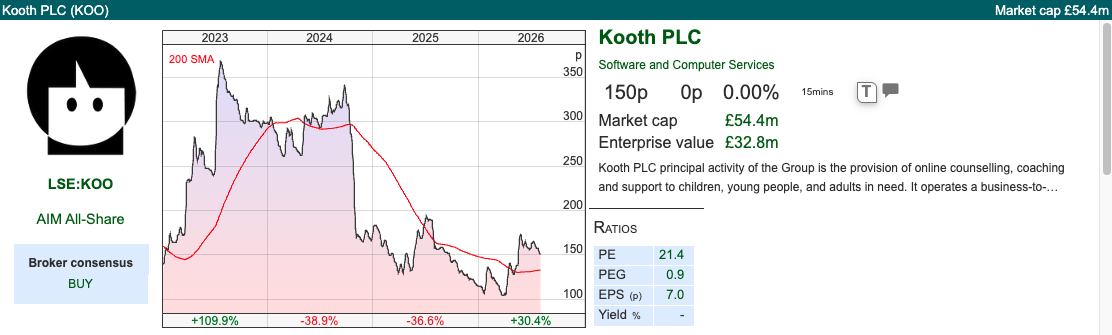
In July 2023 KOO raised £10m at 300p per share to fund the expansion and the service went live in January 2024. However, Kooth’s share price halved in October 2024, when Pennsylvania announced that they would terminate their much smaller contract with Kooth. This was a few days after Root Capital, the early backer of KOO, had sold 10% of the company at 280p per share. The reasons given for the Pennsylvania early termination was i) parental push back against councilor anonymity, which meant parents were unable to verify the credentials and background checks on the coaches that their children were communicating with; ii) opponents objected to children discussing sensitive topics (including gender identity, self-harm, and severe distress) without parental involvement.
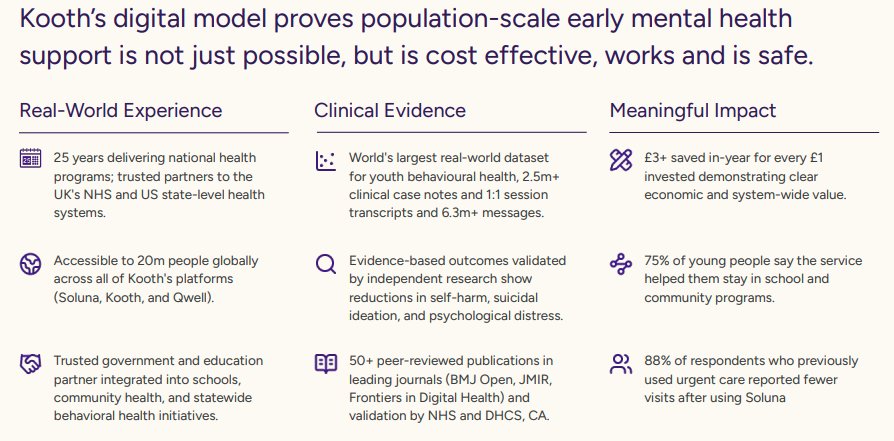
At $3m, the Pennsylvania contract that was canceled was insignificant in financial terms compared to California’s $188 million contract. However, the company had initially hoped that when the contract was signed in Oct 2022, the $3m pilot phase to 30 school districts, encompassing a school population of 150,000 students, it could later be extended to Pennsylvania’s 500 school districts (that is, the contract could become more than 15x larger). Investors were also anxious that if Kooth could lose a contract in Pennsylvania, then the much larger California deal is also at risk.
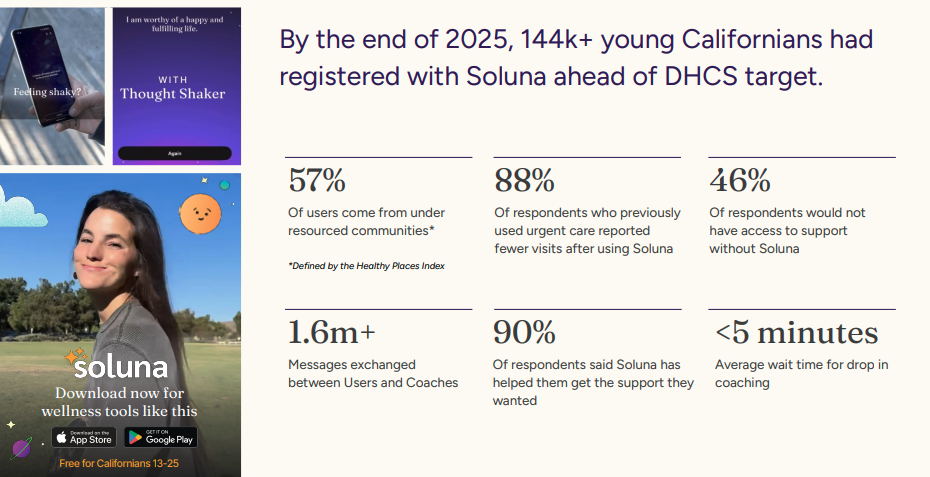
Kooth has now entered the final year of their 4 year, $188m California contract. Management say that they have exceeded performance targets with 187k registrations by the end of June 2026. The value of Soluna, their mental health app, has been independently validated through both the California Department of Health Care Services’ (DHCS) 2025 Impact Report and independent research from Northwestern University’s Lab for Scalable Mental Health.
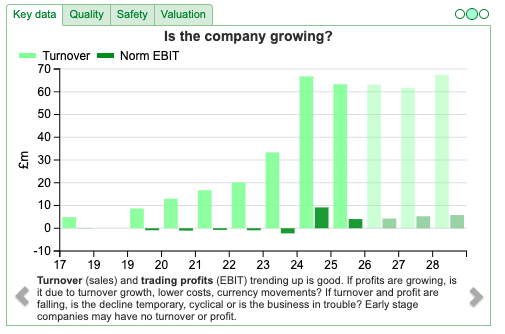
Valuation: The shares are trading on a PER 14x Dec 2027, though estimates are likely to be assuming no further contract losses. In EV/EBITDA the shares are on just 2x, due to the large cash component of Enterprise Value. In theory that cash should provide some downside protection in case of more bad news, however the price bottomed out at £1 in March this year so I don’t think we can assume the worst case scenario is in the current share price well above that level.
Opinion: Back in 2023, when the share price was 349p, I wrote: “I would really like this to be successful, but despite the contract wins, I think it could disappoint at some stage.”
Now, with the share price at c. 150p KOO seems like a much better risk/reward. The risk of further contract losses should be uncorrelated with the rest of the stockmarket. It seems to me that management have learnt lessons from the Pennsylvania loss, which was a much about understanding that they had to keep parents informed of the benefits of the service. Harwood have an 11% position, I’m not sure they know anything more than the rest of us, but it does show that the investment case is appealing to a institution with a good track record. I don’t own any KOO yet, much may buy into the story in the future.
Georgia Capital HY Jun 2026 Results
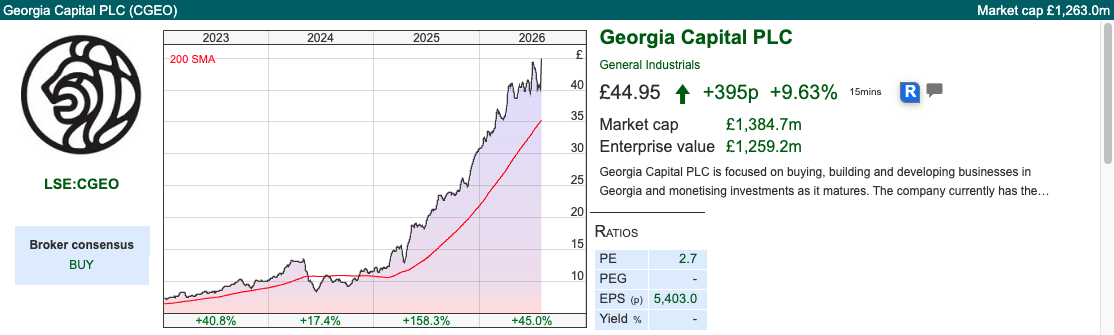
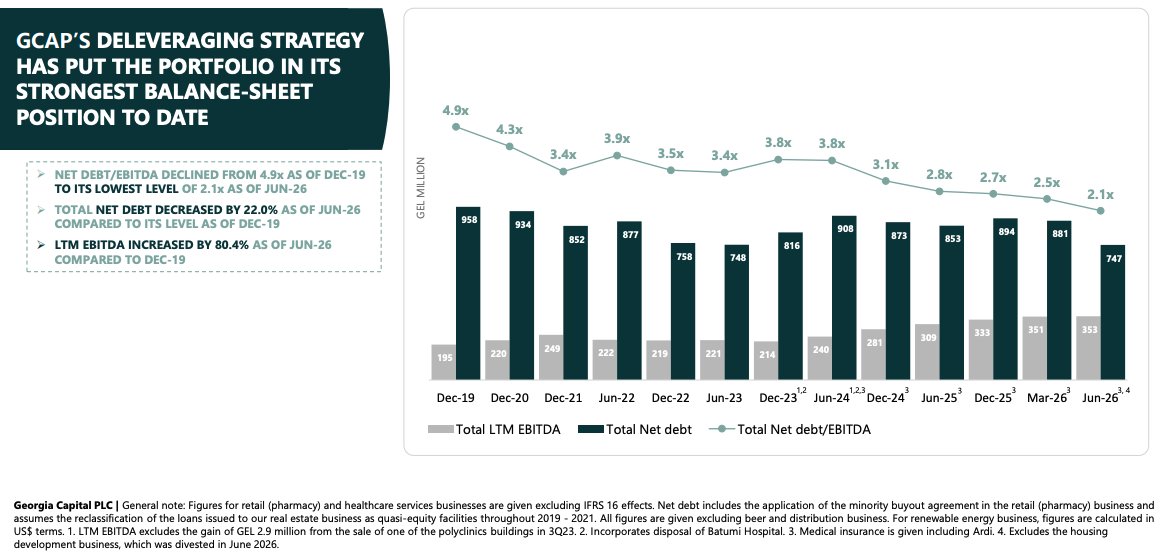
This Tbilisi headquartered spin-off from Bank of Georgia has quadrupled since I last wrote about it in summer 2024, back then it was trading at a > 50% discount to NAV of £22. Management have been slowly reducing leverage and moving to a more “capital light” model, for instance by selling their property development business, M2. Net debt/EBITDA has fallen from 4.9x before the pandemic, to 2.1x Jun 2026. Or put another way, net debt has fallen in absolute terms by 22% to ₾747m (£209m) since 2019, while EBITDA has increased by 80% to ₾353m (£99m).
Thus, NAV per share is now £50 per share (up from £34 per share H1 last year) and with the share price at £45 the discount has narrowed to 9%. The other driver of the re-rating is that the group still owns £710m of Lion Finance shares, which has three bagged since Jun 2024 (and 12 bagged since Putin invaded Ukraine). BGEO now represents £23 of that £50 CGEO NAV per share (versus £9 of the £22 CGEO NAV Jun 2022). I chatted briefly with Irakli Gilauri the Chief Exec of Georgia Capital in June when I visited Tbilisi – he seemed pretty relaxed about the future prospects of the group, though did admit that perhaps the Tbilisi property market might be running a little hot so it wasn’t a bad time to sell a property development business. He was also excited about the prospects for expanding into Armenia, as Georgia and Armenia are similar growth stories. Georgia Capital already has operates 23 pharmacy stores in the country and management are looking to expand further.
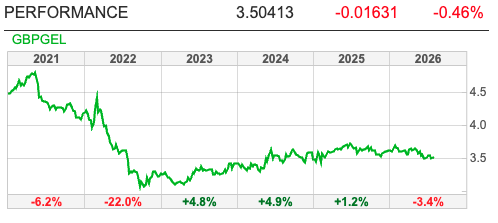
Buyback: The original intention of CGEO management was to invest and grow businesses in Georgia. However, the shares had been trading at such a large discount, and most of the businesses were FCF positive, so that management have bought back 16.7m shares (c. 35% of the market cap) since the group demerged from Bank of Georgia in mid 2018. In this week’s RNS, CGEO announced a new buyback of ₾700m (c. £200m) which represents a further 16% of the current market cap. Hence, it seems likely that NAV will continue to compound while the discount to NAV will also narrow further. Worth noting too, that although the Georgian Lari weakened to 4.8 to GBP during the pandemic, it has held a constant level at around 3.5 to GBP since 2024. A decade ago the value was 3 Lari to the pound.
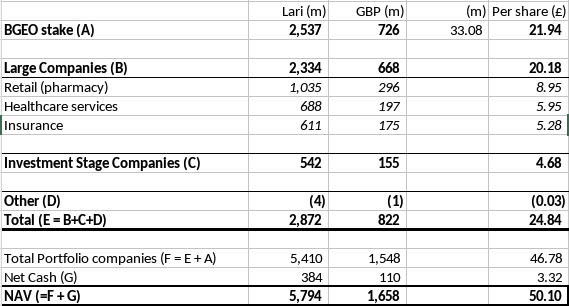
Valuation: I’ve updated my valuation table from a couple of years ago, breaking NAV down into the various component businesses (BGEO stake, plus unlisted pharmacy, healthcare and insurance). This table has become easier to understand as management have sold various businesses (property developer, water utility). A couple of years ago CGEO was operating with £100m of net debt (or £2.47 per share) and following the disposal of the property business this has now swung to £110m of net cash (or 3.32 per share).
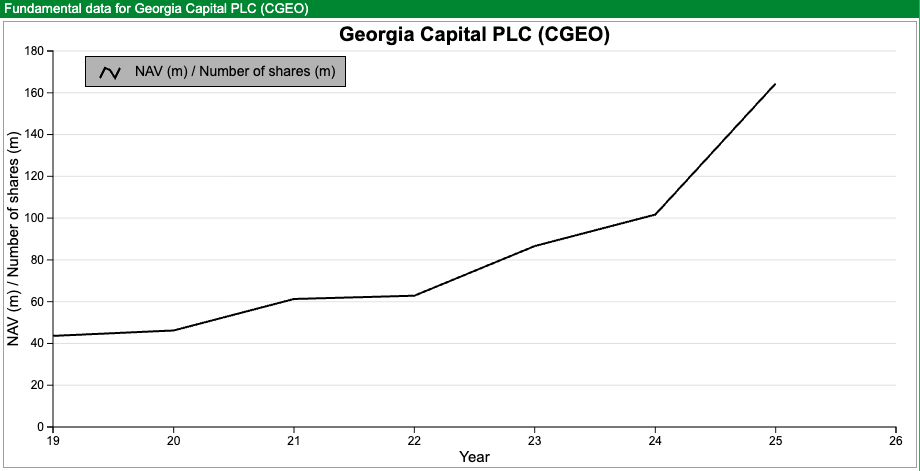
The analytical breakdown above is rather static. The ShareScope chart below shows how NAV per share has compounded from around ₾40 lari per share to ₾175 currently, helped of course by holding a significant stake in BGEO.
Opinion: I own it and like it. The politics and geography close to Russia has given both CGEO and BGEO a “postcode discount”. However, the likelihood of Putin invading seems low, given he has his hands full with Ukraine and in the meantime the influx of Russians escaping their regime has given a boost to the Georgian economy. If you are thinking of taking a large position, I’d recommend a visit to the country to get a qualitative feel for the hospitality and natural optimism of the people.
Bruce Packard
@bruce_packard
Note:
Bruce owns shares in Georgia Capital
This article is for educational purposes only. It is not a recommendation to buy or sell shares or other investments. Do your own research before buying or selling any investment or seek professional financial advice.



Bi-Weekly Market Commentary | 05/08/2026 | SWG, KOO, CGEO | Carry trade unwind
As yen intervention signals a possible unwind of the carry trade Bruce Packard looks at cybersecurity firm SWG, mental health app KOO and Tbilisi based CGEO.
The FTSE 100 was hitting new highs though has retraced below 10,900 and is now flat over the last 5 trading days. The Nasdaq100 and S&P500 were both up around +2.5%, even as SpaceX’s first set of lock-ups expire allowing insiders to sell more shares. The FTSE China 50 was also up +2.4%, though the SSE Composite (Shanghai) which contains over 2,000 Chinese listed smaller stocks continues to struggle, and is now down -4% YTD.
The US administation has intervened to sell Euros and buy Yen. ShareScope puts the move into context, with the Yen now flat against the dollar YTD, but falling from 100 Yen / USD at the start of 2021.
The chart below from the Bank of England’s Financial Stability Report shows that US, Chinese, Euro area and UK government debt/GDP ratios rising. For decades, hedge funds have used the Yen as a cheap funding currency to borrow in, and reinvest in higher yielding government debt. Thus Yen weakness and US and UK government funding are likely two sides of the same coin: carry trade.
Missing from the chart above is Japanese Government debt which remains over 200% of GDP, but down from its pandemic peak of 258% in 2020. Effects of carry trade unwind could be: i) bad news for momentum driven mega caps in the USA ii) bad news for UK and US long term government bonds.
On the positive side, a weak Yen has boosted Japanese exporters, so UK and European high value engineering firms have had their order books hollowed out as Yen weakness has boosted Japanese competitors. Yen weakness reversing could be positive for UK small and mid cap manufacturers with an international client base.
This week I look at Shearwater, the cybersecurity group and Kooth, the mental health app, June trading updates. Plus Georgia Capital H1 June results, where NAV has continued to compound as management have bought back over a third of their market cap since demerging from Bank of Georgia in 2018.
Shearwater FY Jun 2026 Trading Update
This small cybersecurity group has been reporting improved performance and contract wins recently. The market cap is below £20m so the price spike also reflects some illiquidity in the shares. Last week they said a strong H2, meant FY Jun 2026 revenues and adj EBITDA would be “ahead of market expectations”. They now say FY Jun revenue up +33% to £42m and adj EBITDA of £2.5m (Cavendish expectations were £35.5m and adj EBITDA of £2.4m, so that implies £6.5m of extra revenue has only translated into £0.1m of additional EBITDA). The group had net cash Jun 2026 of £5.6m (versus £5.1m Jun 2025), the group said on the 1st July that £5.6m cash figure was -20% below expectations, but also announced a major £25m contract win (see below).
Contract win: On the first of July, just after the FY Jun year end SWG announced a c.£25m revenue over five-years contract win, providing significant revenue visibility into future years. Approximately £12.5m of that would be recognised in FY Jun 2026, reflecting the delivery of initial software and support licenses. The board reiterated confidence in achieving market expectations for FY 2026 EBITDA, with revenue expected to be slightly ahead of expectations. It seems surprising that a contract win of £25m, of which £12m in FY Jun 2026 was already in the brokers’ estimates.
I was also intrigued, that the group reported a gross margin of only 17% in H1, compared to SaaS (Software as a Service) groups which report gross margins in the 70-90% range. That’s because the SWG is primarily a reseller, through Brookcourt which it bought in Aug 2018 for £30m (1.4x sales, 15x EV/EBITDA). That’s not a bad thing. Computacentre (gross margin 24%) and Softcat (gross margin 34%) are both up strongly this year: CCC up +66% YTD and SCT +36% YTD.
Shearwater changed its year end to June last year. In November they announced a £13.4m impairment, of which £9.3m was their software business. This comprises of GeoLang, which protects sensitive data, while SecurEnvoy focuses on verifying and managing user identities. These SaaS businesses report attractive gross margin of 81%, but generates only £2m of revenue, and the top line has been falling in recent years (-12% decline in H1.)
Outlook: Management talk about “positive momentum, supported by continued demand for its cybersecurity services and a strong pipeline of opportunities”. However, Cavendish, their NOMAD, have left FY Jun 2027F forecasts unchanged, at £38m of revenues and adj EBITDA of £2.6m. That implies a decline in revenue of -10%, and flat ad EBITDA. A reminder that outlook statements are becoming increasingly meaningless if read in isolation – we also need to know what brokers, who speak to management, are doing with their numbers.
Valuation: The shares are trading on a PER of 11x Jun 2027F, around half the level of SCT and CCC on c. 20x PER. One feature of ShareScope that I think I should be using more, is the ability to compare profitablity of companies using the “Financial Charts” tab.
Using the “List” tab on the left with a porfolio of companies selected, creates a chart like the one below, which shows SWG the (lack of) historic profitability in red versus larger resellers CCC and SCT.
Opinion: The adj EBITDA margin of 3% in the Services (Brookcourt) division at H1 looks very low, even for a reseller. Presumably there could be a margin expansion story here if management can grow the business? The £12.5m additional revenue recognised right at the end of FY Jun 2026 having minimal influence on the group adj EBITDA margin is disappointing, as it implies the new business they’re winning is at a negative margin.
There’s lots of potential in SWG, you can read the bull case on substack, which is £44m of contract wins in the last six months combined with a cheap valuation. But the long term share price decline tells a story: that selling cybersecurity to large enterprises is far from easy. I’ll put this in my “too hard” pile, as the share price has already spiked +66% in a month. Worth keeping an eye on for more contract win RNS’s though.
Kooth HY Jun 2026 Trading Update
This digital mental health app looks like a very attractive valuation, but there’s a fear that the group might lose a valuable contract with the Californian Department of Health Care Services'(DHCS). Last week they put out an “in-line” trading statement, with H1 Jun revenue down -4% to £31m. That’s partly an FX effect due to a weaker dollar and also planned tapering of Californian product development. Adj EBITDA is expected to be £5-£5.4m, up almost 4x versus H1 last year. KOO had net cash of £23m at the end of June (£15m Jun 2025), over 40% of the market cap.
In July 2023 KOO raised £10m at 300p per share to fund the expansion and the service went live in January 2024. However, Kooth’s share price halved in October 2024, when Pennsylvania announced that they would terminate their much smaller contract with Kooth. This was a few days after Root Capital, the early backer of KOO, had sold 10% of the company at 280p per share. The reasons given for the Pennsylvania early termination was i) parental push back against councilor anonymity, which meant parents were unable to verify the credentials and background checks on the coaches that their children were communicating with; ii) opponents objected to children discussing sensitive topics (including gender identity, self-harm, and severe distress) without parental involvement.
At $3m, the Pennsylvania contract that was canceled was insignificant in financial terms compared to California’s $188 million contract. However, the company had initially hoped that when the contract was signed in Oct 2022, the $3m pilot phase to 30 school districts, encompassing a school population of 150,000 students, it could later be extended to Pennsylvania’s 500 school districts (that is, the contract could become more than 15x larger). Investors were also anxious that if Kooth could lose a contract in Pennsylvania, then the much larger California deal is also at risk.
Kooth has now entered the final year of their 4 year, $188m California contract. Management say that they have exceeded performance targets with 187k registrations by the end of June 2026. The value of Soluna, their mental health app, has been independently validated through both the California Department of Health Care Services’ (DHCS) 2025 Impact Report and independent research from Northwestern University’s Lab for Scalable Mental Health.
Valuation: The shares are trading on a PER 14x Dec 2027, though estimates are likely to be assuming no further contract losses. In EV/EBITDA the shares are on just 2x, due to the large cash component of Enterprise Value. In theory that cash should provide some downside protection in case of more bad news, however the price bottomed out at £1 in March this year so I don’t think we can assume the worst case scenario is in the current share price well above that level.
Opinion: Back in 2023, when the share price was 349p, I wrote: “I would really like this to be successful, but despite the contract wins, I think it could disappoint at some stage.”
Now, with the share price at c. 150p KOO seems like a much better risk/reward. The risk of further contract losses should be uncorrelated with the rest of the stockmarket. It seems to me that management have learnt lessons from the Pennsylvania loss, which was a much about understanding that they had to keep parents informed of the benefits of the service. Harwood have an 11% position, I’m not sure they know anything more than the rest of us, but it does show that the investment case is appealing to a institution with a good track record. I don’t own any KOO yet, much may buy into the story in the future.
Georgia Capital HY Jun 2026 Results
This Tbilisi headquartered spin-off from Bank of Georgia has quadrupled since I last wrote about it in summer 2024, back then it was trading at a > 50% discount to NAV of £22. Management have been slowly reducing leverage and moving to a more “capital light” model, for instance by selling their property development business, M2. Net debt/EBITDA has fallen from 4.9x before the pandemic, to 2.1x Jun 2026. Or put another way, net debt has fallen in absolute terms by 22% to ₾747m (£209m) since 2019, while EBITDA has increased by 80% to ₾353m (£99m).
Thus, NAV per share is now £50 per share (up from £34 per share H1 last year) and with the share price at £45 the discount has narrowed to 9%. The other driver of the re-rating is that the group still owns £710m of Lion Finance shares, which has three bagged since Jun 2024 (and 12 bagged since Putin invaded Ukraine). BGEO now represents £23 of that £50 CGEO NAV per share (versus £9 of the £22 CGEO NAV Jun 2022). I chatted briefly with Irakli Gilauri the Chief Exec of Georgia Capital in June when I visited Tbilisi – he seemed pretty relaxed about the future prospects of the group, though did admit that perhaps the Tbilisi property market might be running a little hot so it wasn’t a bad time to sell a property development business. He was also excited about the prospects for expanding into Armenia, as Georgia and Armenia are similar growth stories. Georgia Capital already has operates 23 pharmacy stores in the country and management are looking to expand further.
Buyback: The original intention of CGEO management was to invest and grow businesses in Georgia. However, the shares had been trading at such a large discount, and most of the businesses were FCF positive, so that management have bought back 16.7m shares (c. 35% of the market cap) since the group demerged from Bank of Georgia in mid 2018. In this week’s RNS, CGEO announced a new buyback of ₾700m (c. £200m) which represents a further 16% of the current market cap. Hence, it seems likely that NAV will continue to compound while the discount to NAV will also narrow further. Worth noting too, that although the Georgian Lari weakened to 4.8 to GBP during the pandemic, it has held a constant level at around 3.5 to GBP since 2024. A decade ago the value was 3 Lari to the pound.
Valuation: I’ve updated my valuation table from a couple of years ago, breaking NAV down into the various component businesses (BGEO stake, plus unlisted pharmacy, healthcare and insurance). This table has become easier to understand as management have sold various businesses (property developer, water utility). A couple of years ago CGEO was operating with £100m of net debt (or £2.47 per share) and following the disposal of the property business this has now swung to £110m of net cash (or 3.32 per share).
The analytical breakdown above is rather static. The ShareScope chart below shows how NAV per share has compounded from around ₾40 lari per share to ₾175 currently, helped of course by holding a significant stake in BGEO.
Opinion: I own it and like it. The politics and geography close to Russia has given both CGEO and BGEO a “postcode discount”. However, the likelihood of Putin invading seems low, given he has his hands full with Ukraine and in the meantime the influx of Russians escaping their regime has given a boost to the Georgian economy. If you are thinking of taking a large position, I’d recommend a visit to the country to get a qualitative feel for the hospitality and natural optimism of the people.
Bruce Packard
@bruce_packard
Note:
Bruce owns shares in Georgia Capital
This article is for educational purposes only. It is not a recommendation to buy or sell shares or other investments. Do your own research before buying or selling any investment or seek professional financial advice.