
Michael Taylor looks at why averaging down can feel sensible but become dangerously expensive, especially for traders. Using examples including Thomas Cook, Debenhams and Games Workshop, he explains why cutting losers, checking risk and averaging up into strength may be the better discipline.
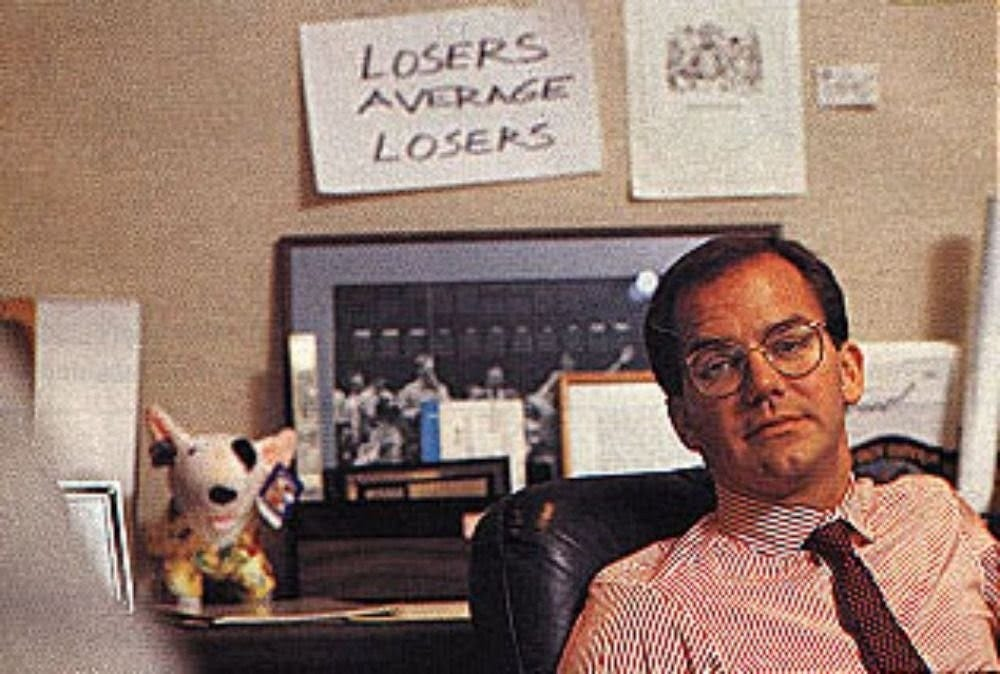
There’s a famous photograph of Paul Tudor Jones in his office as a young trader. He’s leaning back with his feet up, and tacked to the wall behind him is a single sheet of paper with three words on it.
Losers average losers.
He’s a billionaire now. Now, in fairness, I’m also a subscriber to that idea. But unlike Paul Tudor Jones, I am not a billionaire.
But what usually happens is private investors will see a share they own drops 20%. They don’t sell it. They buy more, because it’s “cheaper” now, and because a lower average price means it doesn’t have to climb as far before they get their money back.
I’ve written here before that my trading improved the moment I stopped averaging down and cut the loss instead. I’ll stand by that.
However, I also concede the fact that if you’re a long-term investor, then you are playing a different game to that of a trader. It makes complete sense to average down if you have already factored in the possibility that you will do so, and it is part of a well-structured plan. It is not okay to average down if it wasn’t part of your plan, because then you are committing more money to a position that is showing you a loss.
Why it feels so clever
Averaging down is seductive because the arithmetic is true. Buy more at a lower price and your average cost falls. Nobody can argue with that.
The trouble is what the arithmetic leaves out.
Your average price has gone down, but the amount of money you have riding on the stock has gone up. You have increased your exposure to the one position the market has just told you is wrong.
Why do we do it?
Behavioural finance has had a name for it since 1985, when Hersh Shefrin and Meir Statman identified the disposition effect: investors sell their winners and hang on to their losers. Shefrin’s own description was a predisposition toward “get-evenitis”.
As I wrote in my last article, Peter Lynch, who ran the Magellan Fund at Fidelity with a 29.2% CAGR over a 13-year period, most of his investors actually lost money (despite it being one of, if not the best, funds of that time).
Averaging down is get-evenitis with a bigger overdraft. You’re no longer asking whether this is a good trade. You’re asking how to make the pain of the last one go away.
The market has no idea what you paid, and it doesn’t care. When I check my P&L there is no column for “undervalued”.
What it does to your risk
Let’s run the numbers on a real one.
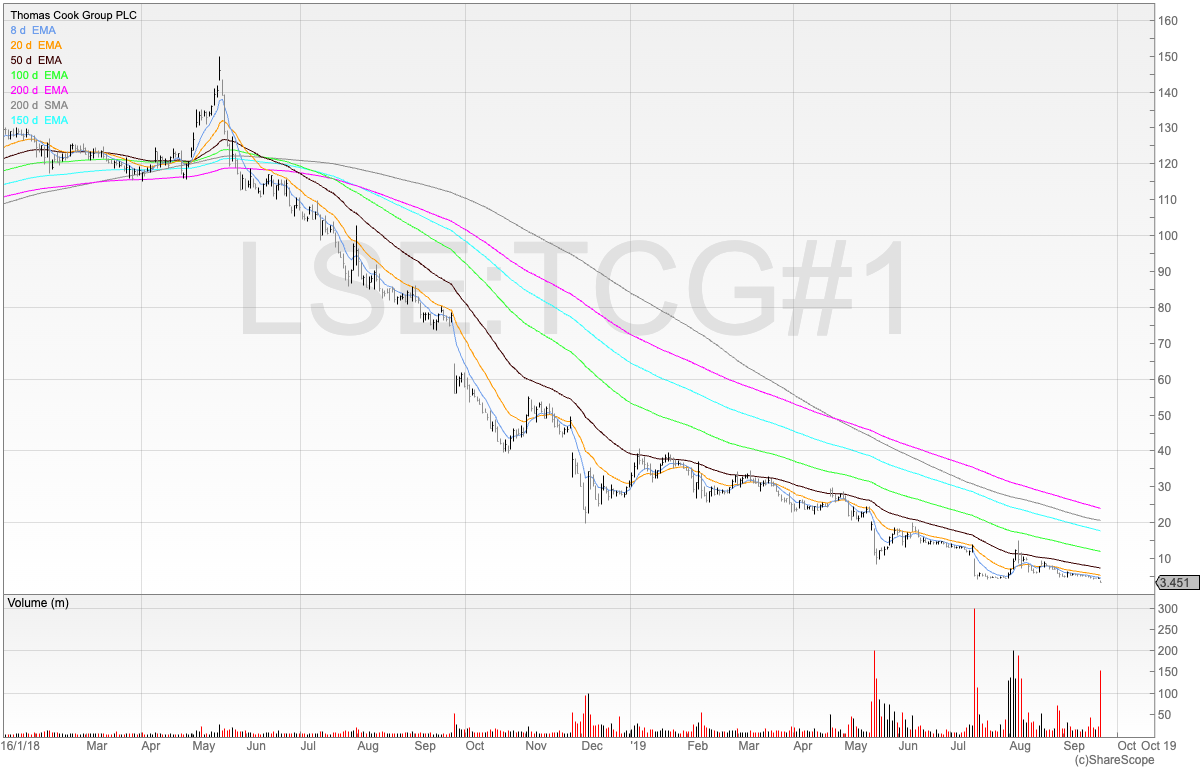
In May 2018 a share in Thomas Cook cost 150p. Three profit warnings followed in less than a year, the first on 24 September 2018 and the third in May 2019. On the Friday before the company went into liquidation the shares closed at 3.45p.
That’s a fall of 97.7%.
For investors who kept on averaging down, their average share price kept falling.
And on 23 September 2019 shareholders were told there was no prospect of a return.
It wasn’t a one-off. Debenhams issued three profit warnings in 2018 and lost 90% of its value in a year. In April 2019 the lenders took control and shareholders got nothing, including Mike Ashley’s Sports Direct, which owned nearly 30% of it.
Aston Martin floated at £19 in October 2018. Ten weeks later the shares were £11.56. Two years later they were 65p.
How many times do you think those were called a bargain on the way down?
For a trader, this is the bit that matters. The 1% rule says you risk no more than 1% of your account on a trade, and your stop is what defines that 1%.
Averaging down can’t live alongside it. If your stop is hit, you’re out, and there’s nothing left to add to. If you’re adding, you never had a stop, and your risk was never 1%.
The problem is that sometimes it works
Here’s what the “never average down” crowd leave out. Sometimes it pays handsomely.
Games Workshop roughly halved between September 2021 and September 2022. Anyone who bought more on the way down looked like a genius, because the shares then rose almost fourfold between mid-2022 and mid-2026.
That is exactly the problem.
The market paid you for a bad habit. Do it on Games Workshop and you feel clever. Do it on Thomas Cook and you’re wiped out. You don’t get to know in advance which one you’re holding.
Of course, you can talk about the fundamentals, but what if you’re wrong? Never adding to losers protects you from being wrong.
But it’s also a fair comment. The balance sheet was completely different. Thomas Cook was servicing £1.6 billion of debt. Games Workshop is debt-free.
Debt is what turns a falling share price into a zero.
Three checks before you add
If you’re tempted to buy more of something that’s below your purchase price, do three things first.
- Check the stage. Unless you’ve developed a fetish for losing money, we should not be buying Stage 4 stocks, and that includes the ones we already own.
- Check whether it can go bust. Open the Financials and look at net debt and cash flow. A company with cash in the bank can survive a bad year. A company that needs its lenders’ permission to keep trading can’t.
- Check your own plan. Was this purchase written down before you bought the first lot, with the total position sized for it? If it wasn’t, it isn’t a plan. It’s a rescue mission.
Average up instead
Among the don’ts in Stan Weinstein’s Secrets for Profiting in Bull and Bear Markets is averaging down in a negative situation. Professionals, he says, average up.
Averaging up feels horrible. You’re paying more than you paid last time, and every instinct says you’ve missed it.
Look at Games Workshop again. By August 2020 the shares were up more than ten-fold since 2017. Every purchase made during that run was at a higher price than the one before.
That’s where the money was.
The way I do it is to treat each addition as a separate trade within a trade. I only add once the stock has built a new base and broken out of it, and the paper profit on the first position funds the risk on the next.
It has its own problems.
Adding raises your average price, so an ordinary pullback can turn a comfortable winner into a loser. Stops get gapped, as anyone who has held a stock through a profit warning knows. And cutting your losers means you’ll sometimes sell a Games Workshop near the low and watch it quadruple without you.
That last one stings. It’s still cheaper than the alternative.
None of this means buying a faller is always wrong. If you’ve done the work on the balance sheet, you’re thinking in years, and you planned to buy in stages from the start, that’s a scale-in. Averaging down can work for investors.
For traders, it’s a losing game.
Decide before you buy
Do the premortem. Before the trade, write down the price at which you’re wrong and what you’ll do when it gets there. Then do it.
And tonight, go through your portfolio. For every position below your purchase price, ask yourself one question.
Would I buy this today if I didn’t already own it?
If the answer is no, you shouldn’t be adding to it. You should be asking why you still hold it.
I will always be of the opinion that fundamental analysis is not one of my strengths, and to protect against that weakness of mine, I will let the numbers do the work.
You may feel differently. But one thing is for certain. If you never average down, you never risk blowing your account.
Michael Taylor
Get Michael’s trade ideas: https://newsletter.buythebullmarket.com/
Free educational content: @shiftingshares
This article is for educational purposes only. It is not a recommendation to buy or sell shares or other investments. Do your own research before buying or selling any investment or seek professional financial advice.
This article is for educational purposes only. It is not a recommendation to buy or sell shares or other investments. Do your own research before buying or selling any investment or seek professional financial advice.

Grand Theft Auto VI PC Edition: Hype, Hope, and High Expectations https://gta6pc.surge.sh
GTA 6 on Windows: Download AnyPS5 and Stay Ready https://anyps5.surge.sh