Making the leap to full-time trading means understanding the financial pressure that comes with it. Michael Taylor explains how his Financial Audit sheet can help traders work out the returns they need to cover costs and keep their capital growing.

I was listening to the Alpha Mind podcast recently with Steven Goldstein and Mark Randall and they had distinguished guest Lance Bernstein on, who is a coach to SMB Capital (Mike Bellafiore’s firm).
Lance said that he very nearly didn’t make it. It was one of those sliding doors moments where, if he’d been offered a very good job with a high salary, he probably would’ve jumped and left his trading job (even though he was advised to give it another 6 months because he was making progress).
Lance said that for almost two years, he was trading obsessively and didn’t really see much progress. When people say they want to be a trader, I often think what they really like is the idea of being a trader, and not the reality. This is, of course, often the case for many jobs and industries
But how many people, in reality, would be prepared to give something 2 years, consumed and obsessed by the very thing where they are failing to see any progress? My estimate is very few.
Trading is not really a linear journey. For example, if you were consumed and obsessed by accounting for two years, then it’s highly likely you would make significant and tangible progress on the road to becoming an accountant. Likewise, medical school is hard, but if you actually do the work, and you stick it out, then you have a very good chance of achieving your goal of working in the medical industry. That, unfortunately, is absolutely not the case when it comes to trading.
I can count myself lucky because I got involved in a market where a rising tide lifted all boats, and it was a rampant bull market in UK small caps in 2016. And if I had been offered the Vodafone Discover Graduate programme in Germany (at a nice office with nice colleagues and a nice salary, and on the fast track to become an absolute corporate big dog), then it’s highly likely I never would have become a full-time trader at all.
Maybe I would’ve started dancing on TikTok in 2020 instead, and become a content creator, but who really knows.

Giving up a lucrative and safe salary to jump in on something completely unstable (remember, as a trader, I sometimes have losing months) would have been a crazy trade in itself.
For most traders who aspire to become full-time on the markets, I always say it’s far better to go part-time and have some alternative form of income before you embark on the full-time journey. This, of course, makes me a hypocrite because I did no such thing and borrowed money from Deutsche Bank, which I absolutely would not recommend anyone to do, But having at least some income negates the extreme emotional swings you will feel from trading.
This will definitely make you a better trader because you are not 100% reliant on the market, and therefore you’re more regulated in how you feel. How people feel has unfortunately cost them lots of money.
When emotions are heightened, people react with predictability. They take on more risk in order to avoid a certain loss, even when they logically know that this is bad. They become overconfident after a big win as dopamine floods the brain, which is why, after a big win, it’s actually best to log off the screens for a few days and do something completely unrelated until your dopamine has reset.
For anyone wanting to make the jump to go full time, I would strongly advise them to go through this process:
- List all of your monthly outgoings and times that by 1.2x This is because you may have forgotten some or not seen them, even when you’ve pulled them from all of your cards, and it allows for a bit of expansion just in case of those monthly outgoings increasing.
- Do the same with your annual outgoings and multiply this by 1.5x.
- Both of these numbers together, and you will get your total costs figure.
- We now double your total costs figure, or TCF, and this will give us our annual profit target, or APT. This is the number that you need to be aiming for in order to comfortably cover your costs and allow your account to compound, as well as give you a cushion.
- Using my financial audit spreadsheet, plug in your account size, and this will give you the percentage returns required to trade full time.
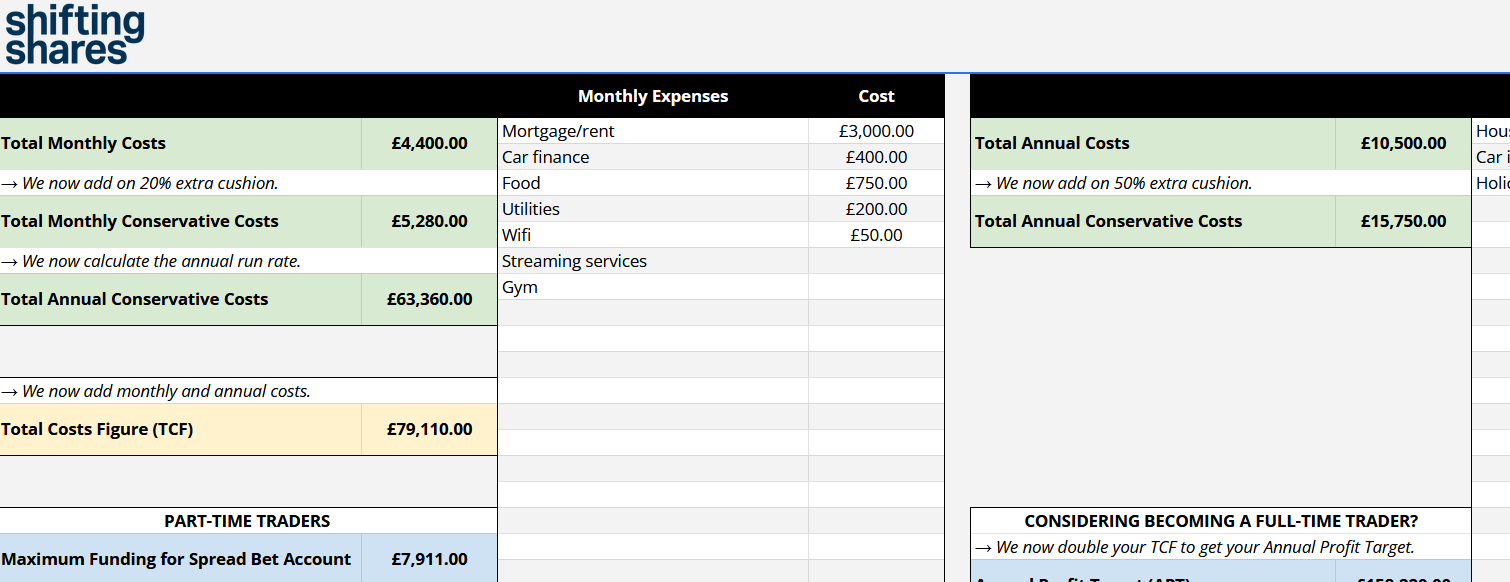
You can use this spreadsheet to work out your required returns based on your costs. It’s a guide, and not financial advice.
Make sure you click File > Make a copy, so you can have your own copy in order to plug in your own data.
Michael Taylor
Get Michael’s trade ideas: https://newsletter.buythebullmarket.com/
Free educational content: @shiftingshares
This article is for educational purposes only. It is not a recommendation to buy or sell shares or other investments. Do your own research before buying or selling any investment or seek professional financial advice.
This article is for educational purposes only. It is not a recommendation to buy or sell shares or other investments. Do your own research before buying or selling any investment or seek professional financial advice.