
Michael Taylor explores the double-edged nature of share buybacks, highlighting how they can enhance shareholder returns when used well. He also warns how, in the wrong hands, they can quietly benefit executives at investors’ expense.
Share buybacks are neither good nor bad. They can be both. But when used effectively, they can be a hugely powerful generator of shareholder returns.
The issue is they can also be used to benefit the executives and not the shareholders.
A share buyback, or share repurchase, is exactly what it sounds like. A company uses its cash to buy its own shares on the open market. Those shares are then either cancelled or held as treasury shares.
The mechanics are simple. If a company has 100 million shares in issue and buys back 10 million of them, you now have 90 million shares. If earnings stay the same, earnings per share (EPS) goes up. If the PE ratio stays the same, the share price goes up.
Companies do buyback for lots of different reasons, and again, some of these are good and some of these are less so.
It’s always worth questioning a buyback too.
Is it because the company has run out of ideas and projects to spend its money on?
Or is because management genuinely believes what they’re saying about the company being materially undervalued?
The cynic in me (or is that I the cynic?) would say that if management think the stock is so materially undervalued, why are they not putting their hands into their own pockets? They might be happy to spend shareholder cash, but perhaps it’s not materially undervalued enough for them to part with their own coins.
However, Warren Buffett has written extensively on share buybacks.
They can be the most sensible use of cash when the stock is trading at a significant discount.
I agree.
But a lot of buybacks exist to offset the dilution caused by executive share option schemes. Think about that for a moment. The CEO gets granted millions of options. They exercise them, creating new shares. The company then uses its cash to buy those shares back. The share count stays roughly flat, you as a shareholder see no obvious dilution, and the CEO pockets the gains. Shareholders paid for it, they just didn’t notice.
And if remuneration bonuses are tied to EPS, reducing the share count helps towards that, too.
If the bonus is tied to EPS growth and organic earnings growth isn’t happening… A well-timed buyback programme makes the metric dance in the right direction. The share count shrinks, EPS rises, the bonus gets paid. And none of this requires the underlying business to have actually improved.
Another special form of muppetry can be seen in the debt-funded buyback.
In the era of ultra-low interest rates, companies discovered they could borrow money cheaply and use those borrowings to buy back their own stock. The logic was this: the cost of debt is low, the earnings yield on the equity is higher, therefore the arbitrage is positive.
Now, loading the balance sheet of debt is a bit like robbing Peter to pay Paul. It’s fine, until it’s not.
When rates went up, suddenly that debt wasn’t so cheap, and the wheels came off.
Taking on debt to pay out money to shareholders via dividends or buybacks, then raising money at far lower share prices because you have no money and no more debt options is idiotic and terrible capital management. So it always pays to be aware.
Here’s a quick checklist for looking at shareholder buybacks:
1 – Is the company debt-free or lightly geared?
If they’re net cash, a buyback can make sense. If they’re carrying significant debt, it’s harder to justify using cash to reduce the share count rather than reducing the interest bill.
2 – Is the stock actually cheap?
This is subjective, but it matters.
A company buying back stock at 30x earnings isn’t doing shareholders any favours if the multiple is stretched.
The best buybacks happen when management have the courage to repurchase aggressively when the stock is beaten up, not when the share price is near all-time highs and they’re just trying to signal confidence.
If a stock has fallen significantly, and the story has now changed, and shares are being repurchased, this means that less shares in issue can accelerate share price movements in future. So for me – this is interesting.
- Is cash generation strong enough?
Go to the cash flow statement. Look at free cash flow – operating cash flow minus capex. That’s the real money the business is generating. Is the buyback being funded from genuine surplus cash, or is it being stretched by cutting capex, taking on debt, or selling assets? None of those are good.
Remember, lots of people look at EPS. It’s one of the most commonly cited metrics for assessing a company’s performance.
But EPS can be artificially inflated via the buyback. The business performance may not have even improved, or even worse, deteriorated.
Always make sure you look at total earnings growth.
To do that, go to Financials > Income to see the various metrics of profit.
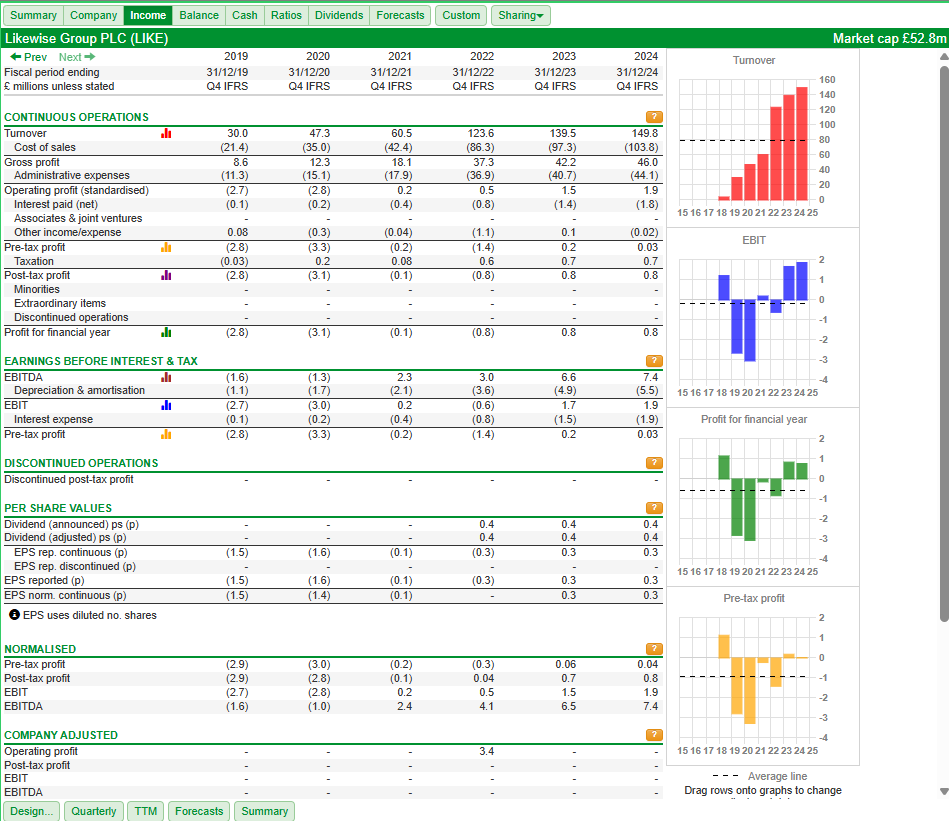
Lots of companies are doing shareholder buybacks at the moment. Not all of these are equal.
Be vigilant.
Michael Taylor
Get Michael’s trade ideas: https://newsletter.buythebullmarket.com/
Free educational content: @shiftingshares
This article is for educational purposes only. It is not a recommendation to buy or sell shares or other investments. Do your own research before buying or selling any investment or seek professional financial advice.
This article is for educational purposes only. It is not a recommendation to buy or sell shares or other investments. Do your own research before buying or selling any investment or seek professional financial advice.


Great breakdown! I like how you explain share buybacks in a simple, practical way and connect them to real trading decisions. It clearly shows that buybacks can boost EPS but don’t always create real value if done at the wrong price —a useful reminder for traders.
Most companies just use them to juice EPS when they don’t have actual growth prospects.