
Michael Taylor explores some of the most dangerous phrases investors and traders can fall into, and why they often lead to costly mistakes. Drawing on past market bubbles and trading discipline, he highlights the psychological traps that continue to trip up market participants.

It’s often said there are four dangerous words in investing. Traders, meanwhile, have their own three-word warning sign.
It pays to be aware of these, as the game rarely changes, only the players.
Human nature never changes, and players are doomed to repeat the same mistakes of players a generation earlier.
“This time it’s different”
How many times has it been different?
Back in 2000, everyone was falling in love with internet stocks.
The internet was going to change the world.
And it did!
26 years later and we can say with absolute certainty that the internet did indeed change the world.
But many of the internet stocks crashed and burned.
Even owning the winners seemed like a pyrrhic victory.
Microsoft took 16 years to get back to breakeven from its Dotcom high.
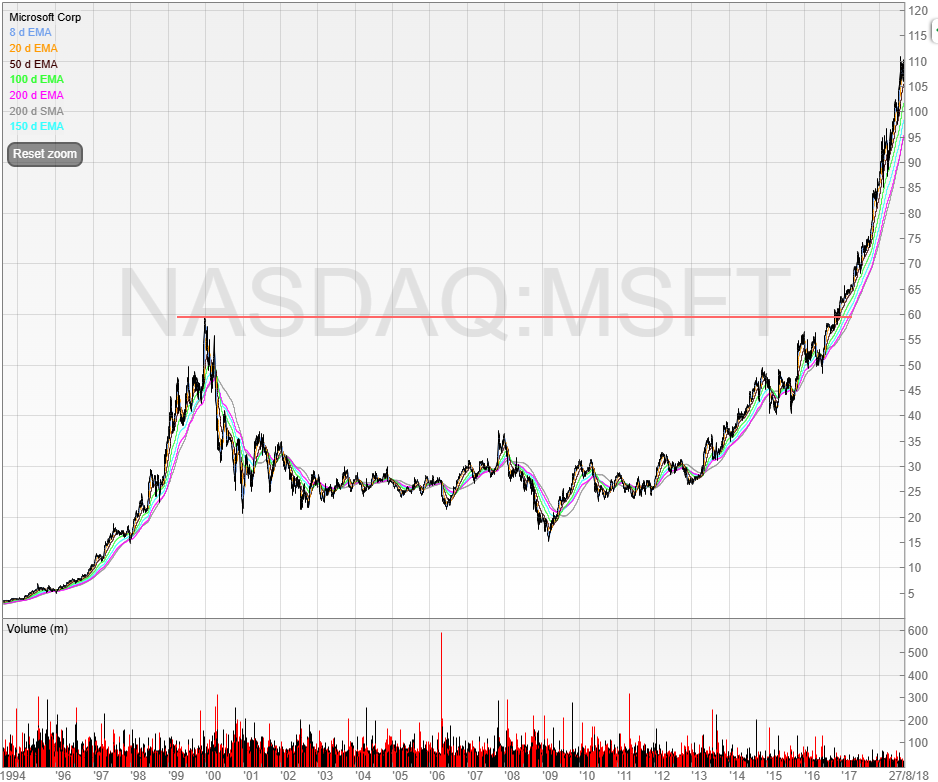
So even if you picked one of the best companies of the Dotcom era, and even one of the best companies in the entire world…
You still would’ve been underwater for 16 years.
Back in 2017, crypto was going to revolutionise finance.
And who knows, maybe it will.
But the bubble collapsed and Bitcoin hit lows of $3,000.
And back in 2020 and 2021, there was a “structural shift” in the market, apparently.
WFH was going to open up new levels of productivity, and the increased levels of consumer spending was going to stay.
Well, it didn’t.
And when Russia invaded Ukraine, that was the final nail in the coffin for the inflated asset bubble.
“This time it’s different” really does have a lot to answer for.
Even now, AI is going to change things, and again, this time it’s different (or supposedly).
Looking at AI, it could be the first technology that reduces jobs rather than creates them.
But it’s very difficult to see what you don’t know.
Those workers who are laid off might find new jobs. They might start new businesses. They might create something entirely new.
It’s easy to be bearish when you don’t see what might happen.
Of course, those people might never find a new job, AI removes the need for everyone, wealth trickles to the top, everyone lives from a pittance and watery gruel.
It’s possible. But unlikely.
That doesn’t mean you should completely ignore AI.
Change should always be embraced. History has shown that Luddites miss out.
But “this time it’s different” isn’t always true.
Bubbles form, and bubbles pop.
But we actually need bubbles. I’m all for them.
Looking back at the railway bubble in the 1800s… if so much capital had not been thrown at railways and invested, then the UK would not have emerged with an advanced railway network which went onto to power an economic boom.
Sure, plenty of investor capital was lost and wasted.
But that’s the very nature of bubbles. Bubbles power investment. Investments are lost. But technological advances are made.
That’s currently the case with the big tech companies.
No longer are they asset light. They’re piling in huge amounts of capital in an AI arms race, to grow and capture the opportunity.
Someone will win. And someone will burn through horrific amounts of capital.
But that’s capitalism!
“Just this once”
When it comes to trading, “just this once” is ruinous.
If you set a stop loss, and then move the stop. You’re already liquidity food. You’re done for.
Because that’s a complete loss of control.
And heaven forbid it actually works out, because if it does, your brain has been rewarded for breaking the rules.
Now you’re just a ticking timebomb until you blow your account.
It’s never just once.
And sometimes, only once is enough to completely blow up.
You set the stop loss for a reason.
You set it before you put the trade on, and before you were a big bowl of Bias Bolognese.
If you can’t follow your own rules, then you can’t trade at the level required to generate profits from the market.
It’s as simple as that.
Mark Minervini said it best:
“Those who trade without stops eventually stop trading”.
You either need a mental stop or a physical stop.
But you absolutely need a stop.
Never listen to the devil on your shoulder whispering the soothing words…
“Just this once”…
Michael Taylor
Get Michael’s trade ideas: https://newsletter.buythebullmarket.com/
Free educational content: @shiftingshares
This article is for educational purposes only. It is not a recommendation to buy or sell shares or other investments. Do your own research before buying or selling any investment or seek professional financial advice.
This article is for educational purposes only. It is not a recommendation to buy or sell shares or other investments. Do your own research before buying or selling any investment or seek professional financial advice.


A very thought provoking read!