
Where is investor money moving, and what might that tell us about the opportunities ahead? David Stevenson looks at rising demand for UK equities, US linkers and Bitcoin, assesses whether Japanese shares still have further to run, and explores a new 7.75% retail bond and a relaunched multi-asset trust built for a more inflationary world.

In this month’s funds article, we dig around in the fund flow data to see what’s hot and what’s not – spoiler alert: US linkers, bitcoin, and UK large-cap equities are hot; we look at a new retail bond paying a useful coupon, explore a relaunched new multi-asset investment trust, and ask whether Japanese equities are still worth looking at.
Useful pointers about asset allocation from funds flow
One of my favourite measures is funds flow data – it tells us a great deal about what investors love…and what they hate. ETF data is usually fairly frequent, but outfits like Morningstar also provide data points on mutual funds or unit trusts.
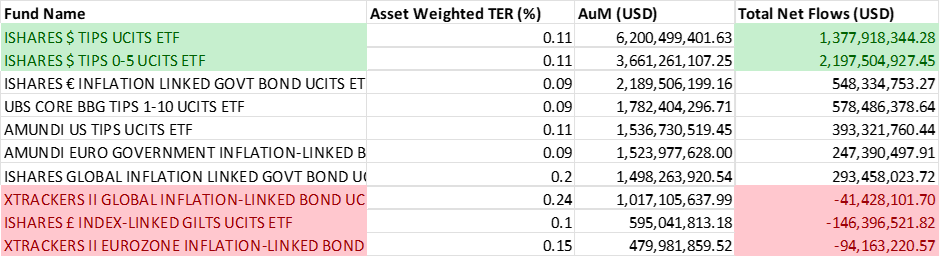
So, what does data on recent fund flows tell us? Let’s start with a fairly esoteric asset class: inflation-linked securities. These have become increasingly popular as inflation rates in both the UK and the US have risen markedly, largely due to higher energy prices. What’s really interesting, though, is that money is pouring into US Treasury inflation-linked securities and ETFs which track them. The numbers below, from ETFBook, show fund flows for 2026 through to the end of September 2026. Short-duration TIPS are the winners, UK linkers the losers. I find that peculiar as I sense that short duration UK index linkers are actually quite compelling at the moment.
Fund manager Invesco also tracks ETF flows, and their latest report for September shows that Fixed-income ETFs attracted $9.7bn in September, 23% of all inflows into ETFs. That inflow is despite a global bond sell-off that pushed long-dated government bond yields to multi-decade highs. Government bond ETFs led demand ($4.3bn), followed by cash management strategies ($2.4bn).
Even more curiously, Invesco reports that Bitcoin logged YTD flows of $1.2bn. Assets held by European Bitcoin ETPs are now just shy of $10bn. Gold ETCs continued to attract demand in September despite falling prices, while European Bitcoin ETPs have gathered $1.2bn year-to-date, taking total assets to just under $10bn. Gold, I understand, less than bitcoin.
Looking more broadly at equities, data from Morningstar shows that European open-end funds and ETFs in the last quarter attracted EUR 204.3 billion in the strongest quarterly intake in five years. Year-to-date flows reached EUR 603.7 billion, already approaching the full-year total for 2025. According to Invesco for September this bullish trend continued: Equity ETFs attracted $28.7bn in September, with global and All-World exposures accounting for half of flows ($14.3bn).
However, Morningstar says that demand for US core equities slowed sharply, with core US equity ETFs attracting just $1.7bn as investors diversified away from the increasingly concentrated US market. This trailed European core equities, which attracted $3.3bn. Europe has now recorded three consecutive months of inflows.
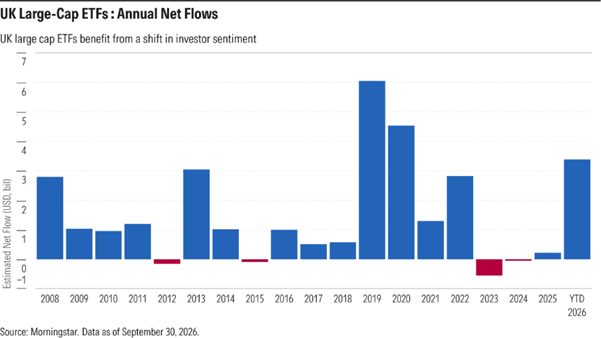
One last very positive insight: UK large-cap ETFs have attracted $3.38bn in estimated net inflows in 2026, their strongest annual total since 2020, according to Morningstar data. Michael Born, Analyst at Morningstar, reckons that “Investors are looking at the UK with fresh eyes. The FTSE 100 has outperformed the MSCI World over the five years to September 2026 in Sterling terms, while higher defence spending, a bull cycle in commodity prices and a rerating of banks and insurers have been key market drivers since 2022. The UK market is naturally exposed to many of these themes. Flows into passive funds typically follow performance, but they also reflect investors looking to diversify away from US mega-cap technology and broaden their equity exposure. Most of the money has gone into market-cap-weighted trackers, meaning investors are backing many of the companies that have led the UK market’s recovery, including HSBC, Shell and Rolls-Royce. Still, the challenges facing UK active funds remain, with the UK Large-Cap category as a whole seeing aggregate outflows of $7bn over the year to August 2026.”
Which funds for Japanese equities?
Japanese equities have had a strong year to date; most Japanese equity benchmarks are showing returns well over 20%, and Japanese equities currently have the highest year-to-date returns of any major geography, including the US. The AI boom has definitely come to Japan.
The downside is that on many technical measures, many Japanese equity indices like the Nikkei 225 and the TOPIX look overbought. But some managers think there is still upside.
Strong earnings growth among Japanese listed companies supports a TOPIX target of 4,500 to 4,700 versus its current 4,104, reckons Asset Management One International (AMOI), part of one of Japan’s largest fund managers with $540 billion in assets under management. AMOI says strong earnings reported earlier this summer by Japanese companies have led analysts to upgrade their forecasts and make a new target for the index plausible even without any material rerating of the Japanese market. Japanese companies are now receiving 10 analyst upgrades for every downgrade compared to less than five analyst upgrades for every upgrade (see graph below) during the same period last year.
The recent earnings season for Japanese companies saw solid earnings growth amongst a range of sectors including automobiles, financials, trading companies and chemicals as well as the more closely watched semiconductor‑related sectors. Consensus forecasts for Japanese companies see earnings growth of 17.5%* for 2026 (fiscal year) and 11.4% for 2027.
AMOI says that while uncertainty surrounds the geopolitical environment, it maintains a positive stance based on several structural pillars: Japan’s sustained emergence from deflation, continued progress on corporate governance reform, and an increasingly investment‑oriented corporate sector. Despite forecasts of strong earnings growth, Japanese shares still trade at substantial discounts to other major stock markets, which is why many value investors focus on Japan.
If Japanese stocks have much further to run, which mutual funds or unit trusts should you invest in ? I tend to prefer investment trusts, but in reality most mainstream investors use unit trusts – which one is best positioned in this very competitive and arguably oversupplied Japanese equity niche? Research firms Parala Capital and Tricio Advisors have built a framework around a process called AlphaPredictor Insights that assesses how funds are likely to react to broader economic changes, i.e., how equity managers might benefit or lose if interest rates change sharply. They’ve just released a report looking at Japanese equity funds. Their framework forecasts investment asset behaviour across the business cycle and adapts rapidly to changing market conditions. They report that :
“Top quartile managers like Polar Capital Japan Value and Aviva Japan Equity Growth capitalize on positive sensitivities to rising rates and yields to generate peer-leading macro Alphas.
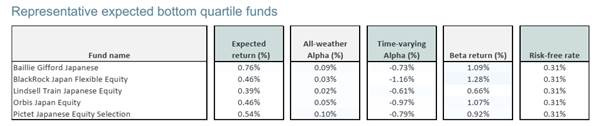
In contrast, bottom quartile funds such as Lindsell Train Japanese Equity and Baillie Gifford Japanese suffer acute performance drags due to deep negative rate sensitivities in a rising rate environment”.
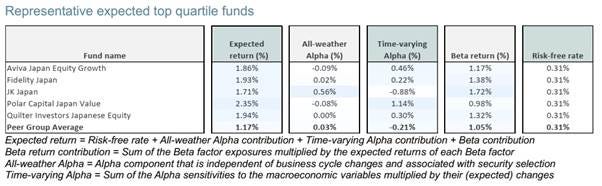
Aviva, Fidelity and Quilter Investors: These funds generate high expected returns primarily from stronger total Beta return contributions and time-varying Alphas, offsetting weak stock selection skill.
Polar Capital: Achieves the highest total expected return in the peer group, powered by strong time-varying Alpha that overcomes a minor stock selection drag.
JK Japan: Delivers strong overall expected performance supported by pure stock picking skill and high broad market exposure, despite facing macroeconomic Alpha headwinds
You can also explore our AlphaPredictor® Knowledge Centre here: https://www.tricio-advisors.com/alphapredictor-resources
New issue of Triple Point retail bonds
Direct lending specialist Triple Point has opened applications (closing in late November) for a second tranche of its Secured Fixed Income retail bonds, listed on the London Stock Exchange, following a successful first issue in March; the bonds are part of a wider £1 billion listed bond program.
The bond gives private investors access to the UK growth story, and the proceeds used will provide UK SMEs and businesses with the secured, flexible lending they need to grow. The borrower, Secured Fixed Income, was established in 2015 to address the financing needs of UK corporates and SMEs, and the proceeds of this issue will support a diversified portfolio of loans across SME debt finance, corporate leasing, funds finance, infrastructure, property development and speciality finance, typically backed by first-ranking security over property, business assets or loan portfolios. The issuer’s net loan book has grown from £48 million to £107 million since FY2022, backed by a network of more than 1,100 introducers.
- The £14.15 million raised in the first issue was fully deployed within a month of completion, and loans funded from it include a Shariah-compliant facility for the halal car finance provider Ayan Capital, a financing package for Red Sky Group’s acquisition of the sausage producer Delenco Foods, and development finance for 31 apartments in Fulham.
- Lending is underwritten through a committee-led credit process, with 95% of leases and loans secured, approximately 1.1x asset coverage and a historical loss rate of 0.5% for the year ended 31 March 2026, and the issuer has an eight-year track record of paying interest and principal in full and on time, having issued over £355 million of debt to date.
- The bonds pay a fixed 7.75% over three years, with interest paid twice yearly for investors seeking regular income, whereas the debut paid 7.5% compounded annually with interest paid only at maturity.
- The bonds are expected to be listed on the Main Market of the London Stock Exchange on or around 30 November, and the offer closes at 12 noon on 23 November.
For context, the three-year UK gilt pays around 4.88%, so you’re getting nearly 3% above risk-free rates.
New rival to Personal Assets and Capital Gearing Trust takes shape
A very old investment trust founded in 1868 has just been reborn as a multi-asset defensive fund that may appeal to investors in Capital Gearing and Personal Assets. Under its new management team from Dowgate Wealth, it has adopted a new investment strategy that explicitly aims to protect assets from a more inflationary world of excessive government spending and monetary debasement. Its closest peer is probably Personal Assets Trust, although its large holdings in inflation-linked bonds also echo Capital Gearing’s. From an asset allocation perspective, it bears distinct reminders of the Permanent Portfolio approach pioneered by Harry Browne.
The Company says that it seeks to preserve and grow shareholders’ purchasing power over the long term through a diversified, multi-asset investment strategy. The portfolio may invest in global equities, monetary metals, and Bitcoin (via regulated exchange-traded products (ETPs) as well as inflation-linked securities, with allocations actively managed in response to changing market conditions and economic environments. See the full portfolio here.
The fund aims to achieve positive returns above inflation by owning scarce, inflation-resilient assets. Or as the manager puts it: “In our view, we are now in a battle between fiscal and monetary policy. In our view, Fiscal policy dominates, leading to heightened inflation going forward”.
In practical terms, that means significant allocations to gold and precious metals, plus Bitcoin (approximately 30% and 5%, respectively). The manager also has a strategic equity pillar of around 39%, versus a mid‑term target of 60%. The fund holds 24% tactically in short‑dated, index‑linked securities. The equities basket typically includes Airbus, Amazon, GTT, Amadeus, and Veolia.
The Investment Company is still a small fund in its early days, but I think it could be very interesting, not least because it’s a main-market listed vehicle with heavy exposure to gold and bitcoin.
Its most direct peer is Personal Assets Trust, which has a long track record for its strategy and a very loyal investor base, with an AuM of £1.7 bn. That fund runs a portfolio with 67% exposure to UK-denominated assets: around 40% in equities, 9% in gold, and over 40% in UK and US government securities (14.6% in UK inflation-linked bonds). Personal Assets appears to have no Bitcoin exposure, whereas the Investment Company holds around 5%. Personal Assets’ ongoing charges are around 0.67%, whereas the Investment Company charges 0.75% up to £500m.
Capital Gearing’s portfolio is 22% equities, 12% corporate credit, 16% conventional government bonds, and 49% inflation-linked bonds, with no gold or bitcoin exposure. The £815m fund charges 0.58% annually.
So, although Capital Gearing and Personal Assets are similar, they differ in key ways. Capital Gearing is much more focused on inflation-linked securities, while Personal Assets has much smaller gold exposure and no Bitcoin.
The key challenge for the new-look Investment Company remains scale: the summer placing and subscription raised approximately £7.16m initially, increasing to c£7.5m including the retail offer, resulting in a fund size of c£10m. That said, Dowgate has done an impressive job expanding the Onward Opportunities trust in the micro- and small-cap space, which now has assets of around £55m.
Fund details for the Investment Company:
· Ben McKeown – Lead Fund Manager
· Latest investment Deck here
· Strategy: Protect and grow long‑term capital via a diversified portfolio of strategic, real assets and inflation‑hedged investments. Core pillars: Strategic Equities, Foundational Reserves and Inflation-Protected Instruments. These assets can protect against currency debasement amid budgetary irresponsibility, geo-economic rivalry, and persistent inflation. Aim to deliver equity‑like returns over the long-term while improving resilience during market volatility and broader economic shifts
· Fees: Ratcheted 0.75% of NAV up to £500m; 0.5% of NAV thereafter
· Portfolio: Strategic Equities 39% (20 to 30 equities with high IP), Gold and PM 32%, Bitcoin 5%, index linked bonds 24%. Currency exposure: US dollar based assets at 62%.
David Stevenson
Twitter: @advinvestor
This article is for educational purposes only. It is not a recommendation to buy or sell shares or other investments. Do your own research before buying or selling any investment or seek professional financial advice.