
Are investors underestimating the AI memory boom, and have battered bond markets finally created opportunities for income seekers? David Stevenson weighs the case for DRAM stocks and Cordiant Digital Infrastructure, before looking at attractive yields in UK bonds and the different ways investors can gain exposure to a potential revival in silver.

In this month’s funds article, we ask whether small LLMs will drive the AI boom or whether we’re too sceptical and underestimating the huge gains available to DRAM suppliers. We also revisit a core compounding infrastructure fund that keeps turning in solid numbers and offers a play on digital infrastructure that isn’t AI-focused. We also ponder the huge losses on gilts suffered by private investors but contemplate the current attractive yields on many sterling bonds. And last but not least, we spin through how to invest in a future silver revival.
AI and DRAM stocks
I have no great deep insights beyond what you’ve probably already read about whether AI is a bubble waiting to burst – or whether we are still in the foothills of an enormous revolution.
I can see arguments on both sides, and this month I thought I’d offer two opposing takes on the same huge global trend. First, my worry about AI isn’t that it’s pointless or a bubble, but that frontier labs’ AI models might end up a tad superfluous. One key trend to watch out for is the rise of small language models rather than big, well-known frontier LLMs. These have many advantages: they are small, can run on local devices, are cheap, and don’t require legions of huge data centres.
They might not be as fast or quite as powerful as the frontier lab LLMs, but for many uses they are ‘just enough’. Or so you could presume based on work from a team at Stanford University that conducted a recent academic study. This study compared the performance of small language models (SLMs) with LLMs from well-known names using huge data centres. You can see the results yourself on arXiv: arxiv.org/abs/2511.07885, by Saad-Falson et al. (2026). They benchmarked small language models (SLMs) that ran locally on high-end desktop hardware: Qwen 3, Gemma 3, GPT-OSS, and Granite 4.0, run on Nvidia or Apple M4-class chips. The competition were cloud-based frontier LLMs (ChatGPT-5, Claude Sonnet 4.5, Gemini 2.5 Pro), tracking performance from 2023 through October 2025. The key results are very worrying for the likes of OpenAI and Anthropic. On chat tasks, the best-performing SLM matched or beat the LLM in 98.6% of cases across domains. On reasoning tasks (quite tough) SLMs matched or beat LLMs in 62.5% of cases. Weighted across a realistic mix of chat and reasoning workloads, SLMs were reported as good or better in roughly 81% of cases, with LLMs retaining a clear edge mainly in areas like engineering, life sciences, and agentic tasks. Crucially, SLMs were said to run at 50–85% lower energy/compute cost than LLMs on equivalent tasks. Last but by no means least, reasoning performance was reported as improving sharply over time — from roughly 50% success across difficulty levels in 2023 to 85–99% on easier/mid-tier reasoning tasks by late 2025, still trailing LLMs mainly on the hardest problems.
According to Chris Woods, chief strategist over at investment bank Jefferies, who writes the GREED & Fear letters,
“the message from the Stanford study … is that enterprise systems are decentralising. That suggests companies, in the reaction against tokenmaxxing, are restructuring AI budgets away from centralized “cloud endpoints” towards so-called “on premises” SLMs. While banks already have to be “on premises” for obvious data security reasons, it would seem to GREED & fear that every company will also want to be “on-prem” for the same data security reasons, if they can afford it. For such reasons hyperscaler-funded data centers risk becoming the most “capital-destructive stranded assets” in the history of technology. None of this means that AI is not here to stay, nor that the demand for compute will keep rising. But it does mean that the AI story will be due for a big reset at some point in the not-so-distant future. GREED & fear will be amazed if the four hyperscalers really spend US$990bn on capex in 2027 which is the current estimate of the consensus.”
A countervailing argument is that all this scepticism is bunk and that bottlenecks for the AI capex rollout will remain, especially for the components going into the data centres sprouting up everywhere. And the core bottleneck remains memory chips, a sector dominated by three players: Micron Technology, Samsung and SK Hynix. If you believe the bears, a massive ramp-up in supply of cheaper new chips is coming, much of it from China, and that memory chip margins will crash. Maybe, but that ramp-up may take at least a few years, and in the meantime these memory chip manufacturers are raking in cash.
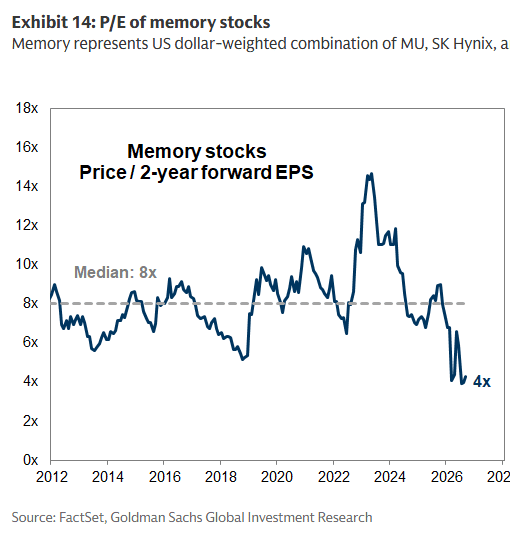
Looking at DRAM stock valuations, memory stocks currently trade at a 2-year forward P/E of 4x. Based on current S&P Global consensus estimates (as of late Sept 2026), the main DRAM makers are trading on strikingly cheap forward multiples relative to their earnings growth, since the memory upcycle is expected to keep compressing P/Es into 2027. Is this an obvious bargain or are these earnings about to crumble as Chinese competition comes on line?
| Company | Price (local currency) | FY2026 consensus EPS | FY2026 fwd P/E | FY2027 consensus EPS | FY2027 fwd P/E |
|---|---|---|---|---|---|
| Micron Technology (MU) | $1,082.28 | $73.60 (FY end Aug) | 14.7x | $159.49 | 6.8x |
| SK Hynix (000660.KS) | ₩1,862,000 | ₩354,200 | 5.3x | ₩472,530 | 3.9x |
| Samsung Electronics (005930.KS) | ₩276,500 | ₩48,144 | 5.7x | ₩70,500 | 3.9x |
| Nanya Technology (2408.TW) | NT$525 | NT$67.64 | 7.8x | NT$100.45 | 5.2x |
| Simple average | 8.4x | 5.0x |
Notes: The average is a simple (unweighted) mean across the four names; Samsung and SK Hynix, the two largest, are both around 4-6x, while Micron trades at a premium (14.7x FY26), reflecting the fact that its FY26 print captures less of the HBM/AI upcycle than FY27.
Still positive on Cordiant Digital Infrastructure
I’ve long been a fan – and own shares – in the LSE-listed digital infrastructure fund, Cordiant Digital. Its portfolio comprises a diversified, Europe-specific mix of assets, including 1,440 towers, 14,272km of fibre, and 24 data centres with 29MW of IT capacity. The company owns six platform assets: CRA (Czech Republic), Hudson (New York), Emitel (Poland), Speed Fibre (Ireland), Belgian Tower Company (Belgium), and Datacenter United (Belgium). Crucially, the portfolio was acquired at an average 10.3x trailing EV/EBITDA, which is very low compared with most publicly listed peers. Despite that low entry price, the fund has produced some impressive results: the 73% NAV total return since inception (11.3% annualised) has been primarily earnings-led, with comparatively little contribution from multiple expansion.
Results to date have been steady and fairly predictable. My view is that over the last five years it has established itself as a steady fund with a modest, covered dividend, investing in an exciting sector that includes data centres, broadcast assets, and mobile phone towers in Europe (mostly Eastern Europe). Its discount is far too wide, even below 20%, for a fund with its track record.
Earlier this month Cordiant released the first-quarter (Q1) trading update for the financial year ending 31 March 2027. The main headline is that portfolio revenue grew 20.2% and EBITDA 2.0% on the prior comparable period, on a constant currency basis. The slower EBITDA growth relative to revenue was attributed to project revenue phasing and customer churn, with management expecting momentum to build through the year as new contracts commence. Portfolio revenue increased 20.2% YoY on a constant-currency basis to £106.6m, while EBITDA increased 2.0% to £43.6m. Looking at the last 12 months to end-June 2026, portfolio revenues were £415.7m (versus £394.6m for the 12 months to end-March 2026), and portfolio normalised EBITDA was £176.9m (versus £174.9m).
At the asset level, Emitel reported revenue of PLN 176.7m (£36.1m) and EBITDA of PLN 120.5m (£24.6m) for the quarter, up 1.5% and 2.2%, respectively. CRA reported revenue of CZK 710.6m (£25.4m) and EBITDA of CZK 338.2m (£12.1m), with EBITDA down 2.7% due to project phasing and a customer provision. Speed Fibre’s revenue and EBITDA grew strongly, supported by the ECL acquisition, with revenue up 87.3% to €42.0m (£36.5m) and EBITDA up 6.3% to €7.2m (£6.2m). DCU reported revenue of €10.3m (£9.0m) and EBITDA of €3.4m (£2.9m), up 1.2% and 10.3% respectively. Hudson’s revenue increased 1.8% to $5.9m (£4.4m), but EBITDA loss widened to $(0.9)m (£(0.7)m) due to a customer bankruptcy. The target dividend of 4.45p is 1.6x covered by adjusted funds from operations (AFFO) after scheduled debt repayments.
Most investment trust analysts were impressed by these steady numbers. According t fund researchers at Investec “ CORD continues to make good strategic progress supported by a stable and resilient portfolio. The company has a compelling pipeline of potential investment, driven by AI demand, Prague Gateway and further portfolio expansion. “Analysts at Panmure Liberum were even more effusive declaring that their own estimates are for 9.6% net asset value compound annual growth in the next three years, and an average annual NAV total return of 11.5%. “We believe CORD should be valued at a premium to NAV given consistently strong performance, conservative valuation, and embedded sum of the parts value not captured by NAV. We apply a 5% premium to the 12M NAV per share forecast to derive a target price of 171p, corresponding to 8p below our mid-case sum-of-the-parts valuation”. My own view is equally positive, and I have added more stock to my existing position in CORD in the last few days. The results were classic Cordiant: nothing spectacular, just steady progress, and that’s with only 1% exposure to AI, which can be seen either as an opportunity – or an insurance policy if AI produces a crash. I also think that the discount will narrow over time to single digits and in the meantime, I am happy to sit tight.
Gilt-mageddon: look on the bright side
Private investors have seen the value of the gilt holdings fall by £2.8billion or 38% since prices started to fall in summer 2020. Private investors in the UK have seen the value of their gilt holdings fall by an estimated £2.8billion, down from the £7.2billion they held in gilts when prices started to fall at the start of Q3 2020, Bowmore Asset Management research shows.
Over the same period UK pension funds and insurance companies have seen an estimated £267.7billion wiped off the capital value of the £704.5billion they held in gilts. Gilt prices have fallen by an average of approximately 38% since they peaked at the end of Q2 2020. Including income investors are down by approximately 28% over the same period. Prices for gilts have taken another tumble this year partly because of inflation caused by the USA’s war with Iran, scepticism about the ability of the UK Government to keep spending under control may also have been a contributing factor. Russia’s invasion of Ukraine precipitated a sharp collapse in global bond prices, which led to a sustained rise in inflation as energy prices soared. Weak gilt prices have also been exacerbated by the explosion in public spending during COVID and a weak UK economy.
It’s not all bad news though. This multi year bear market has started to produce rea opportunities. According to Jonathan Webster-Smith, Chief Investment Officer of Bowmore Asset Management: “Given the fall in prices of UK debt, we have recently brought some low coupon gilts maturing early in 2028 and 2029. They are offering yields of over 4% and the short-dated nature means that they will benefit from the pull to maturity. If held to maturity, the gilts are scheduled to redeem at par, although their market value may fluctuate before maturity. In that situation gains on qualifying gilts are generally exempt from Capital Gains Tax. For short dated gilts, that you intend to hold to maturity, there is the reassurance that the UK government has never defaulted on its bonds”.
The backdrop to the UK gilts market is a wider global bond sell-off. The US 10-year Treasury yield has climbed to around 5.2%, more than a full percentage point above a year ago, while the UK 10-year gilt sits near 5.35%, close to a two-decade high. US Treasury buybacks have done little to contain the rise in yields, which have remained closely correlated with elevated oil prices since the Iran conflict began.
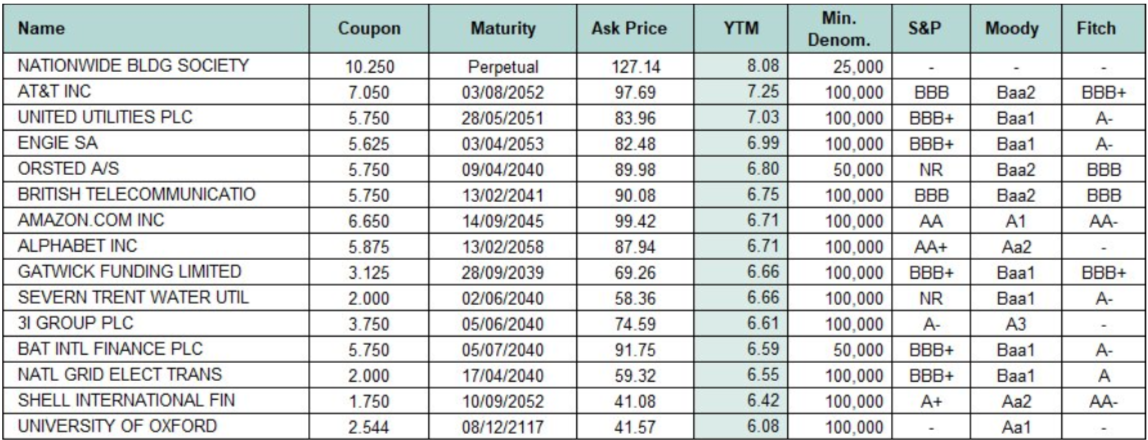
The Fed has raised rates to 3.75%-4.00%, its first hike since 2023, with markets currently expecting three more over the next year. In the UK, markets see an 80% chance of a Bank of England hike in November, the first of roughly four priced in over the coming year. With markets already pricing in materially higher rates, today’s yields, the highest in almost 20 years, offer an attractive opportunity. The table below from wealth advisory firm Killik and Co highlights a series of high-yielding UK sterling corporate bonds available on most broking platforms. I think yields to maturity in the 7% region make many bonds look quite interesting again. Any sustained push above 7.5% would open up real opportunities to add to a bond portfolio.
Investing in Silver: the options
My overall long-term view is that I am overweight gold, which I think will break through $10,000 an ounce by the end of the decade, powered by the next wave of monetary and fiscal debasement. In the short term, by contrast I think gold could suffer over the next few weeks and months as the US Fed tries to sound hawkish on rates. But eventually rate cuts will come, as Trump has requested, without any parallel attempt to narrow the US fiscal deficit. My own hunch is that we’ll see a US version of yield curve control, where the Fed/Treasury tries to hold down long-term government bond yields to help curb the cost of debt servicing. If we don’t get YCC (yield curve control), we may get monetary intervention, or other forms of financial repression, which could include another form of QE.
Whatever the ‘innovation’, concerns about monetary debasement are unlikely to go away, and investors will still seek, at some stage, a safe-haven asset that isn’t the dollar (which could be much weaker). Step forward gold, and its sibling silver, which effectively operates as a leveraged version of gold; i.e., if gold goes up a bit, silver might go up more. And vice versa.
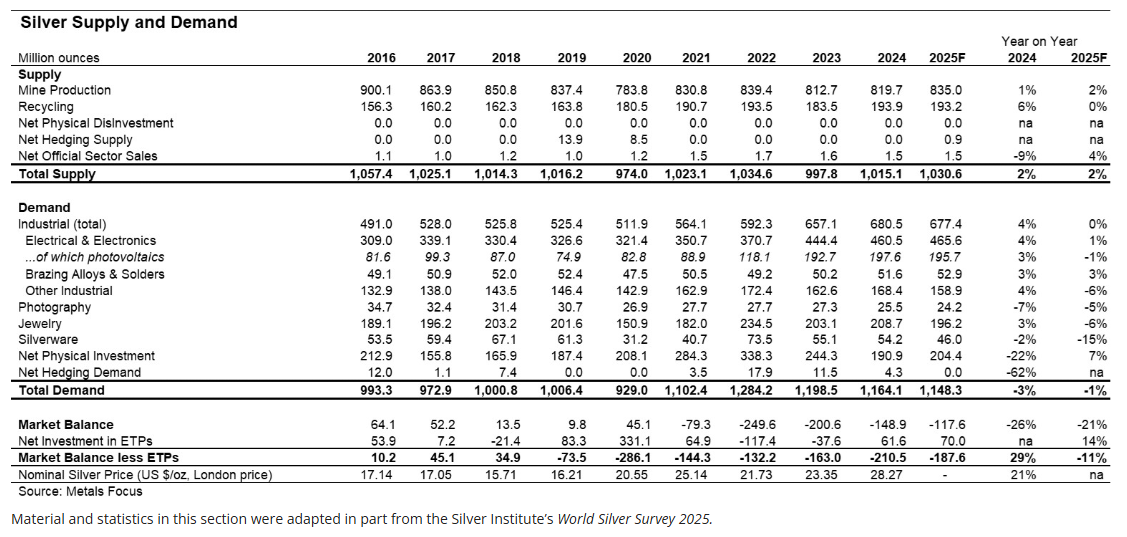
But silver isn’t driven only by its relationship to gold. Silver has industrial uses, increasingly in electronics and the infrastructure build-out around net zero. Its price is also increasingly determined by what happens in Asia. At this point, we encounter another driver: the physical shortage of silver supply. The Silver Institute provides a very useful table here:
https://silverinstitute.org/silver-supply-demand/
Investment Options
If you buy into my thesis – and plenty of readers won’t, thinking silver too speculative and vulnerable to short term volatility – what are your options?
Most traders tend to invest in highly leveraged structures such as leveraged Exchange Traded Products that amplify daily returns by anything from 2 to 5 times (upside and downside. These are mainly short term trading products (though not always, if the medium term trend is your friend): popular products include, WisdomTree Silver 2x Daily Leveraged (LSE: LSIL / German line 4RUE; 0.98% TER), WisdomTree Silver 3x Daily Leveraged (LSE: 3SIL / 3LSI; 0.99% TER), and Leverage Shares 3x Long Silver (LSE: SLV3 in USD / 3SLE in GBP; plus, a -3x short, 3SSL). All are swap-based (synthetic) and collateralised.
Given that I accept that there might be short-term weakness, and certainly volatility, I wouldn’t be that interested in an ETP. A more mainstream alternative might be to buy silver miner equities. These carry operating leverage: with all-in sustaining costs (AISC) largely fixed, a rise in the silver price flows disproportionately to profit. In the US, First Majestic (NYSE/TSX: AG) is the highest-beta major, along with Pan American Silver (NYSE/TSX: PAAS), Hecla Mining (NYSE: HL), and Fortuna Mining (NYSE: FSM; TSX: FVI).
In the UK, two high-profile vehicles stand out: Fresnillo (LSE: FRES, FTSE 100), the world’s largest primary silver miner, and Hochschild Mining (LSE: HOC, FTSE 250). Fresnillo is the world’s largest primary silver producer with sector-low AISC (c. $17/oz average). Its share price reached an all-time high of 4,472p on 26 January 2026, tracking silver, then fell hard with the metal (down 5.4% in a single session as silver slumped in a later 2026 sell-off, when the metal briefly halved from its January record). Hochschild (HOC, FTSE 250) offers similar Peru/Argentina/Brazil-weighted exposure, with FY2025 revenue of $1.2bn and AISC around $20/oz in 2024. Note both also carry significant gold exposure
Arguably the simplest and least risky way to buy silver exposure is through Wheaton Precious Metals (NYSE/TSX: WPM; LSE: WPM), which offers commodity-price leverage with fixed contractual purchase costs, insulating margins from cost inflation. It has structurally lower volatility than miners yet has historically outperformed both bullion and miners over long horizons. Its Antamina silver stream with BHP (Antamina silver) is, according to BHP, “the most valuable streaming transaction to date based on Upfront Consideration received.” Typically Wheaton buys a percentage of future metal production for an upfront payment plus a low fixed delivery cost – this gives it price leverage while capping cost-inflation risk. Crucially, silver was around 36% of 2025 revenue (the rest largely gold).
David Stevenson
Twitter: @advinvestor
This article is for educational purposes only. It is not a recommendation to buy or sell shares or other investments. Do your own research before buying or selling any investment or seek professional financial advice.


An example of a reasonable alternative interpretation could add another useful perspective.