

Investing is difficult, and the choices that feel safest or most comfortable often do the most damage to returns. This article takes a step back to look at the bigger picture of portfolio dynamics.
Why safe choices can hurt performance
When your strongest stocks give you opportunities to trim positions, reduce volatility, or take profits, it can feel like prudent risk management. But this often creates three problems:
- Portfolio weight shifts from leading holdings into weaker positions.
- Profitability depends more heavily on maintaining a high win rate.
- Investors can become trapped in a cycle of stock picking and market calls, chasing the illusion of consistently high accuracy.
Investors get stuck on this treadmill, pursuing the elusive goal of a high win rate instead of focusing on stronger overall returns.
“Selling your winners and holding your losers is like cutting the flowers and watering the weeds.”
— Peter Lynch
It is not about being right. It is about how right you are when you are right.
Back your winners
In practice, the opposite of trimming your strongest positions is often what drives meaningful portfolio performance. Letting winners run—and, where appropriate, adding to them as they prove themselves—creates the conditions for occasional outliers and home runs.
Cut your losers
Investors find this much harder. The desire to be right makes it tempting to rescue losing positions by putting more money into stocks that have already shown the original thesis was poorly timed or simply wrong. In most cases, that only increases exposure to weaker investments.
Spotting portfolio leaks
A review of your investment history can quickly reveal where your portfolio is leaking value. These outcomes typically fall into four categories:
- Small winner
- Small loser
- Big winner
- Big loser
To achieve asymmetrical returns, focus on avoiding the big losers and giving the big winners room to grow.
How to avoid big losers
Starve the losers.
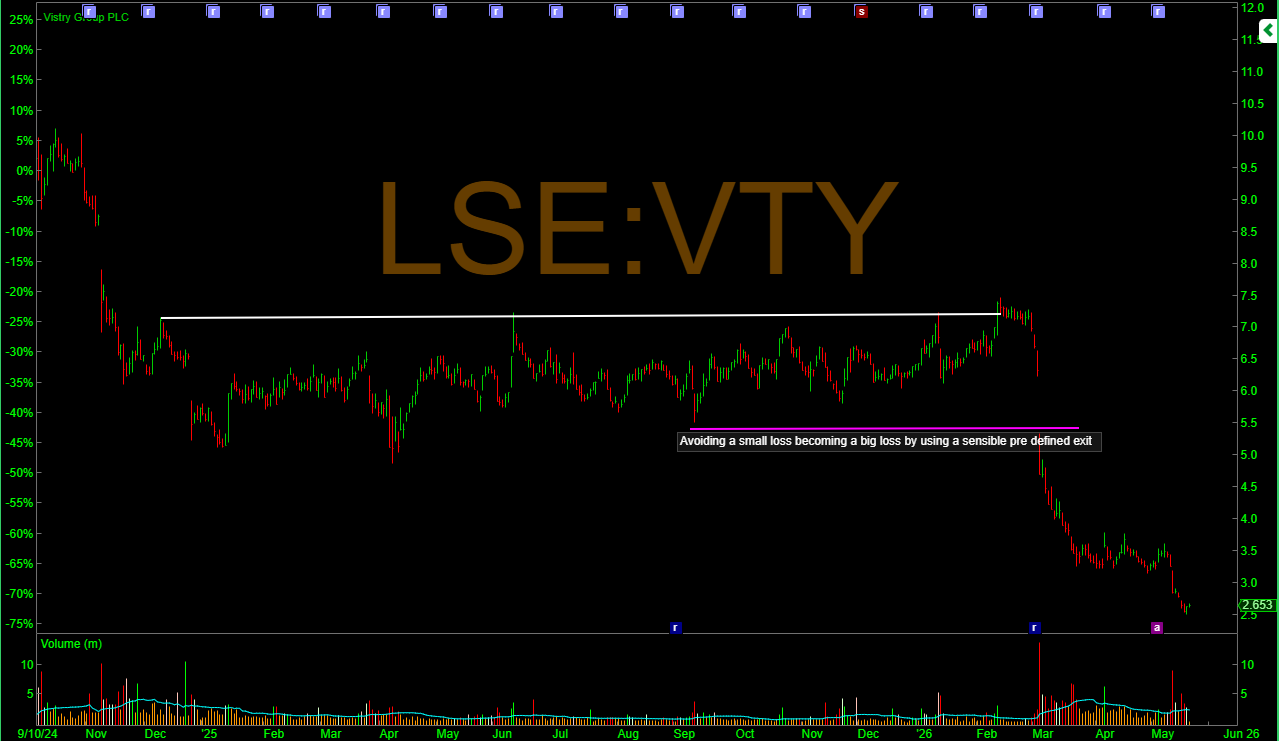
Set your exit price and position size in advance so you decide how much a mistake will cost. Do not add more money to a stock that has already proved you wrong by averaging down, because that increases your exposure to your weakest investments. If a stock only becomes attractive after a sharp fall, that is often confirmation that it was a poor investment to begin with.
A Small Loss
How to achieve big winners
Feed the winners.
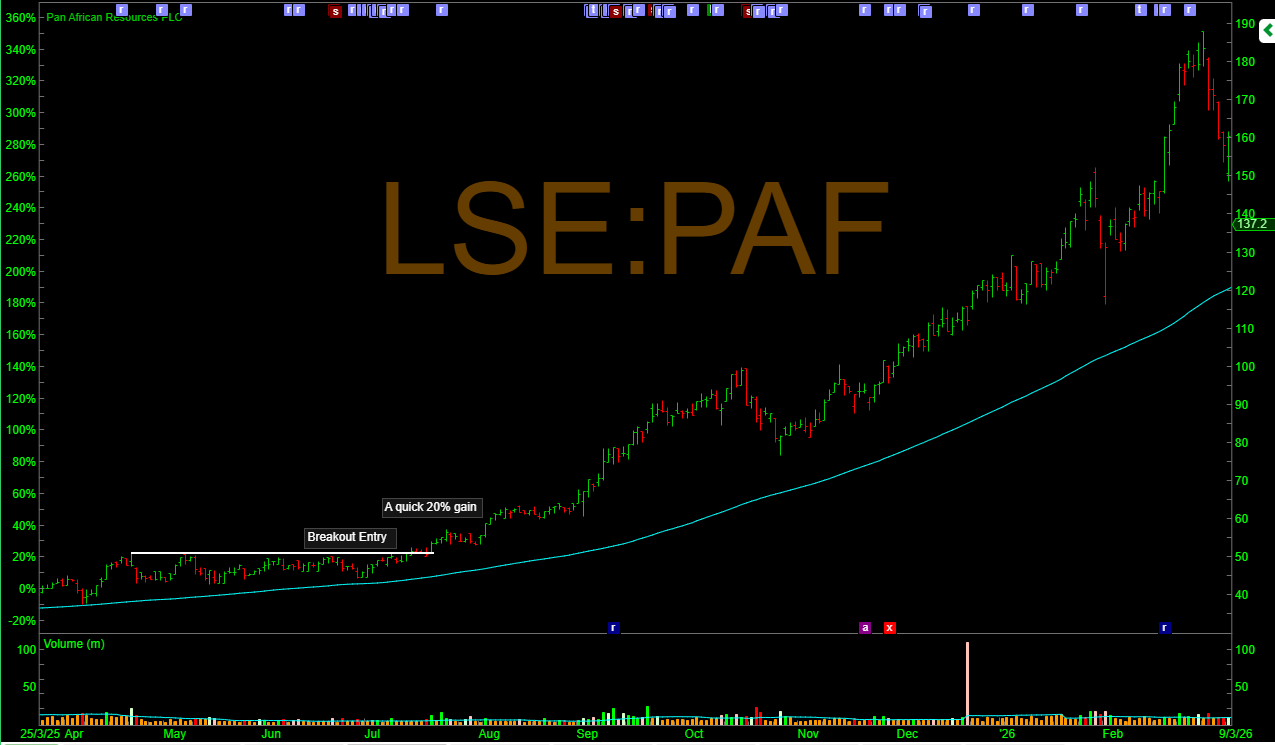
The only way to achieve big winners is to let your strongest positions run. You can amplify that effect by adding to them early as the trend strengthens. Investors often celebrate a quick 20% gain, only to watch the same stock keep compounding into a major outlier. If a stock gives you the chance to add at a higher price, that often confirms it was a sound investment.
A quick 20% gain at the cost of a big winner
Managing the whipsaw
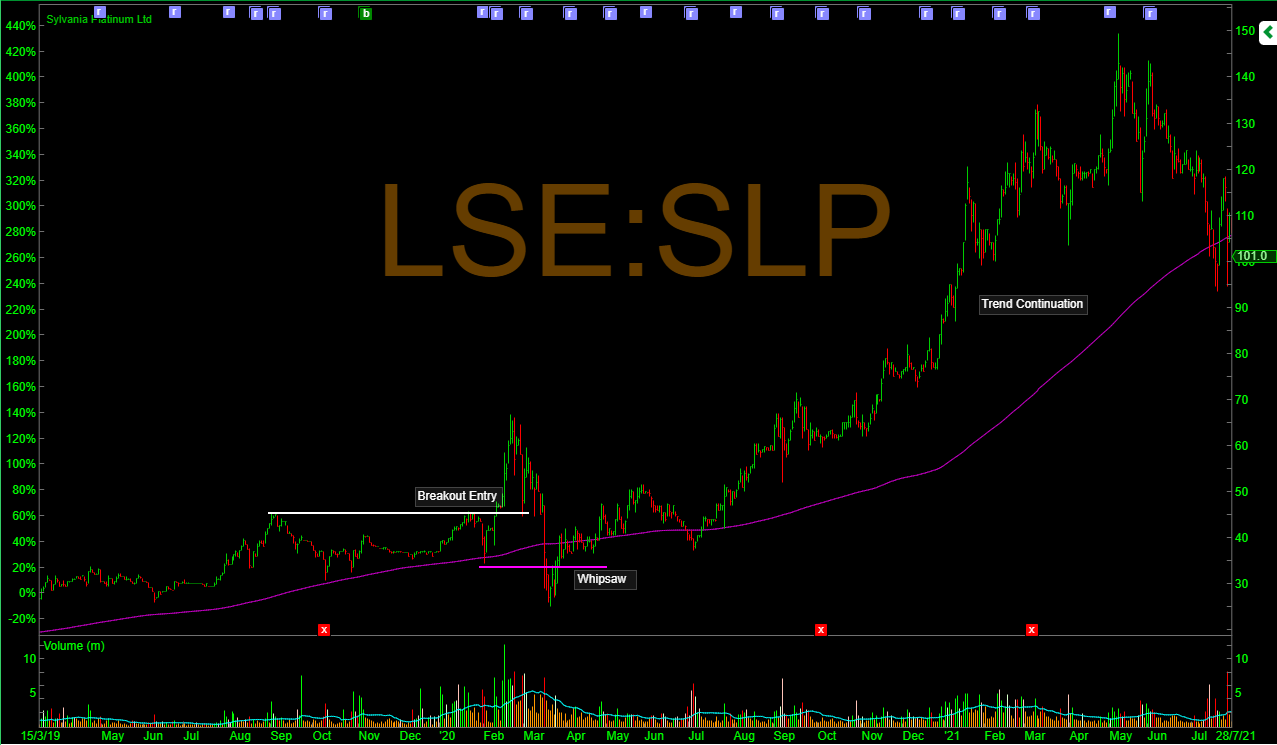
Whipsaws are an unavoidable part of risk management. If you use rules to protect capital, you will sometimes sell near the low before a stock recovers or add to a strong position only to see it reverse and hit your exit.
This trade-off becomes more noticeable when:
- Your strategy operates close to short-term price action and market noise.
- You apply tighter trade management rules to capture outliers while limiting downside.
- You react to every move instead of giving the position enough room to work.
The key is balance. Swing and momentum strategies tend to sit closer to the noise, while value investing, active investing, position trading, and trend following usually operate further from it. Know the lane you work in, then shape your framework to reduce unnecessary whipsaws while still allowing for asymmetrical returns.
Accepting the occasional whipsaw
A whipsaw is often the first step in a grail hunt. Build your methodology so it remains an occasional cost of doing business, not a recurring pattern.
You will be wrong on many investments, whether you quote Warren Buffett or Paul Tudor Jones. Even the best investors may only be right about half the time. The goal is not to eliminate mistakes but to keep them manageable.
This is why position sizing matters. Accepting the cost of a wrong exit in advance is psychologically difficult, but it is essential. Losses also tend to come in clusters, which makes discipline even harder. When you size a position before you invest, you are choosing your own pain threshold.
It is also difficult to watch an unrealised profit disappear in a whipsaw, only to see the stock recover without you. But that is the unavoidable price of discipline, and that discipline is what keeps you in the game.
A whipsaw. Correct action taken by exiting to protect from a potential big loser.
Finding traction
The investing journey often progresses through a series of recognisable stages:
- Consistently losing money
- Breaking even
- Generating steady gains
- Outperforming when conditions allow
To reach break-even, you first need to plug the leaks in your portfolio. In practice, that usually comes down to two priorities:
- Cut small losers before they become big ones.
- Keep whipsaws under control so trades are not closed too early.
The time frame spiral
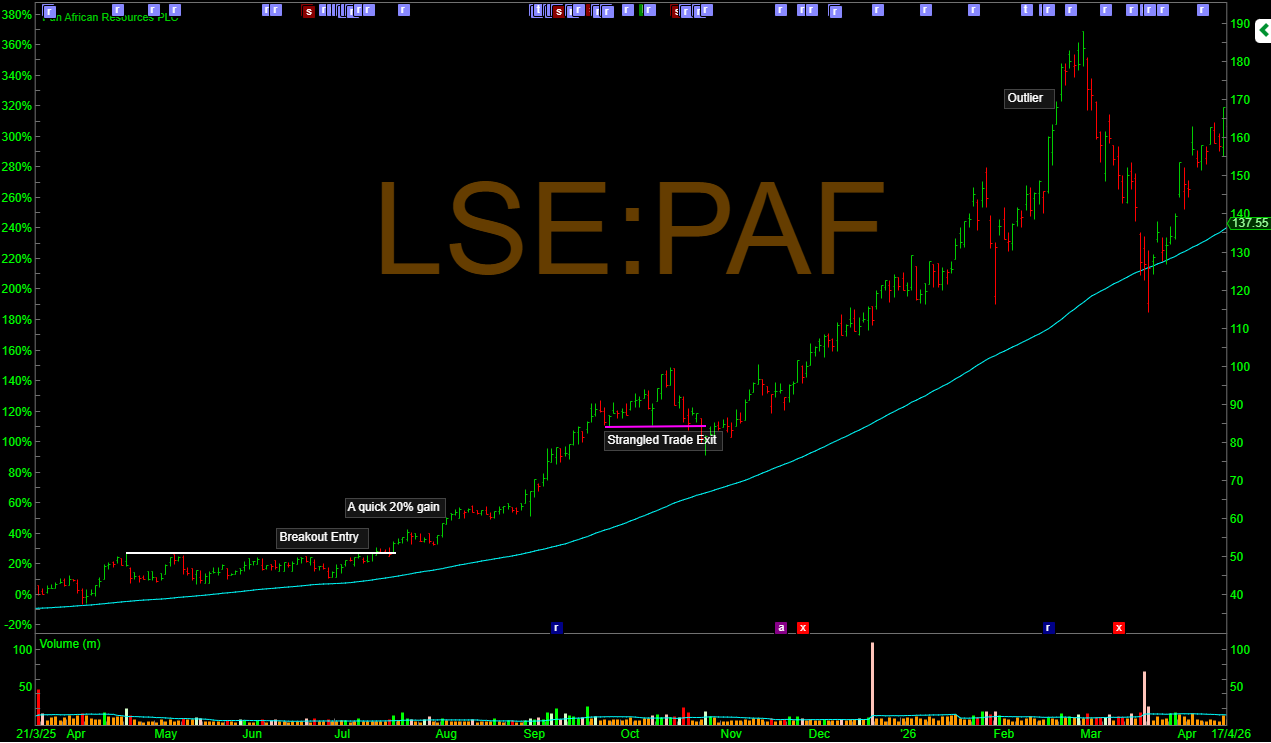
Too many whipsaws can signal that you are strangling trades by moving your stop loss into the noise of a shorter time frame. I think of this as the time frame spiral.
Strangled trade exit by jumping onto a faster time frame trail method
Funding losers with winners
A bad habit that may help you reach break-even, but makes sustained gains much harder, is funding losing investments by selling your strongest holdings. In effect, this means strangling your winners to support your losers.
Moving from break-even to steady gains is about refining your methodology. We hear “do more research” all the time, but researching a stock is not the same as having a profitable investing process. Research can improve your ideas, but it is not a substitute for risk management.
My Portfolio Dynamics
Once I found my groove and stopped repeating the mistakes above, my portfolio behaviour became much easier to understand.
When markets weaken
- In a typical pullback, I usually tread water around break-even.
- In a correction, I tend to move into drawdown.
- In a bear market, my methodology moves me to high cash.
When markets strengthen
- In a healthy market environment, I am systematically building into positions while limiting downside risk.
- In an exceptional market, I will be fully invested through progressive exposure and positioned to outperform.
This framework helps me stay flexible and adapt my exposure to changing conditions.
In a nutshell
I want my portfolio to be led by its best holdings. Positions that are working should earn their weight through price appreciation, and I should be willing to add to them at higher prices once the original risk has been reduced through a trailing exit.
A larger position naturally brings more gap risk, but it also provides more cushion when gains have already compounded over time. That is a good problem to have.
Weaker holdings should never become an anchor on portfolio performance. If they move higher, they can earn their weight. If they move lower, they should eventually hit the exit and remain no more than a paper cut.
Jason Needham
@TradingBasesUK
This article is for educational purposes only. It is not a recommendation to buy or sell shares or other investments. Do your own research before buying or selling any investment or seek professional financial advice.


Some really good advice on how to manage your portfolio. It’s an area that generally doesn’t get enough thought but it’s an essential ingredient to making money over the long term.
Thanks for these useful pointers Jase.
Wise words indeed. Common sense, but something many investors ignore. These disciplines will help keep us profitable in the markets for many years to come.
I’ve been following Jase’s articles in Sharescope for a number of years now, and have learned a hell of a lot from them.
Many thanks & keep up the good work Jase!
A mini masterclass in position management thanks! It stuff like this that makes the difference when applied consistently. I can recommend Jason’s strategies for approaching the market, they have served me well personally.
Gold dust on trend following in a single article – great piece Jase.
It was actually one of your articles on Sharescope ~4 years ago that resonated a lot and got me into trend following. Since then – no more style drift or haemorrhaging funds, just steady progress. It’s also a reason I’m still on SharePoint as its charting lends well to the methodology (for most part!)
Great article. Very useful cheers.
Another excellent article. I have been following Jase for about 5 years now. His website tradingbases.co.uk is a mine of information and will help anyone struggling with the stock market become a very competent trader/investor.
I’ve been watching Jase’s videos for a long while and there is always some little golden nugget in them. All his previous articles on here are well worth your time to read. This article and the others before it are just a small insight into what Jase can offer to help you become a better informed and more importantly a disciplined investor in an easy and structured way. Thank you Jase for all the time you spend helping others to improve.
I have always learned from the best and that has been Jase, so it comes as no surprise that he produces another excellent article.
Top stuff from Jason and Sharescope.
I consider this and Jason’s previous articles as recommended reading for beginners and experienced investors, alike.
My stock selection and portfolio management have improved significantly since starting to follow his methodology a couple of years ago.
Great article cheers, your risk management and trend following articles are gold dust and really helped me with understanding the importance of creating a methodology and process.
Great advice as always!! Learning the details of the principles in the article from Jase has led me from randomly buying ‘value’ stocks, or chasing news with random position sizes, to implementing his methodology, which has led me to become consistently profitable since I joined the group in 2019.
Read the article, follow it up by checking out his videos and get involved. It was the best trading decision I ever made!!
As a group, Jase’s members offer some fantastic ideas, not just on trades but also on technical concepts to improve your overall trading. Sharepad’s an excellent product, but some limitations and workarounds have to be put in place, which could easily be resolved with some additional features added to your charting package. Would be great to see Sharepad take this on board and take the product to another level!!!
Another cracking article from Jason – thanks!
Excellent article
Thanks Jason another great article. Managing portfolio positions is one of a number of key skills I have learnt at tradingbases.co.uk which helps investors. Jason shares daily analysis and videos of growth stocks using Sharescope. Sharescope is a fantastic data platform for either new or experienced private traders, although it could be enhanced further by continuously improving the clarity of the charts.
OK, first things first. I’m in my late seventies and have been following Jason’s methodology using Sharepad for maybe ten years. I’m still here and my portfolio is doing fine, so I hope that speaks for itself. As for Jason, he’s been running Trading Bases since surviving the Great Financial Crash of 2008 when trading became his only source of income. His methodology relies on seeing the price point and deciding whether it should go up. If it doesn’t, he won’t make money. The name Trading Bases refers to where stocks are at a pivot point and where they will begin to rise. They are in a ‘base’ or ‘cup and handle’.
The easiest way to see all this is by means of a chart. Hence, Jason has been using Sharescope for charting since its first appearance as a Microsoft “.exe” program. His relentless focus on honing his methodology has depended on improving his Sharescope charting (and spreadsheet skills). Every night, using Sharescope, Trading Bases members are treated to a walk-through of the day’s markets and movements. This adds up to, effectively, hundreds of hours of Sharescope tuition annually (principally the charting functions). In addition, there is a chat room where members of Trading Bases can help each other with questions or query the man himself.
Jason has written a number of articles on this site and I strongly advise working through them from the first up to this one. If Jason continues his symbiotic relationship with Sharescope for his charting, I think you will benefit from it, as have I.
Must be the most comprehensive article I’ve read about longevity in trading. And I’ve made all the mistakes mentioned!
A very good concise article on the basics of building and maintaining a portfolio based on risk management. It highlights the important tools everyone needs to target the important parts of buying, holding and selling shares.
Well worth looking into “Trading Bases ” in more detail to see if it helps you – it did / does for me.