In Part II of his trading timeframe series, Michael Taylor explains how to categorise trades as M2M or T2H before entry – and why that decision is critical to discipline and performance. He also highlights the costly mistake of converting short-term trades into long-term holds, and how to avoid it.

In my last article we looked at Part I of my trading timeframes series. If you’ve not read it – check it out here before continuing this article.
How to categorise trades before entry
This is the critical bit. You need to decide whether a trade is M2M or T2H before you enter. Not after it goes against you. Not when you’re sitting on a profit and getting greedy. Before.
You are at your most objective before you enter a trade. That way, by sticking to your plan, you ensure your trades and following objective decisions.
Here’s how I think about it:
M2M trades are:
- Event-driven (RNS, results, sector news)
- Technically opportunistic (tight base breakouts)
- Catalyst driven (you expect the move to happen quickly)
- Tactical rather than strategic
T2H trades are:
- Trend-following (stage two uptrends)
- Fundamentally supported (growing earnings, rerating occurring)
- Structurally positioned (multi-month base breakouts, sector tailwinds)
- Strategic rather than tactical
If I’m looking at a stock that’s just released a solid set of results, beating expectations, and gapping up, that’s likely an M2M trade if I don’t know much of the story and I’m just looking to take a quick scalp. I might hold it for a few days to capture momentum, but I’m not building a position for the next six months.
If I’m watching a stock that’s broken out of a three-year base on growing earnings where I know the story is disliked and ignored, and I expect the earnings growth to continue, that’s a T2H candidate. I’m prepared to sit with it through the noise.
It’s worth noting that some M2Ms will continue even after you sell them.
Here’s a very nice M2M trade that just didn’t stop.
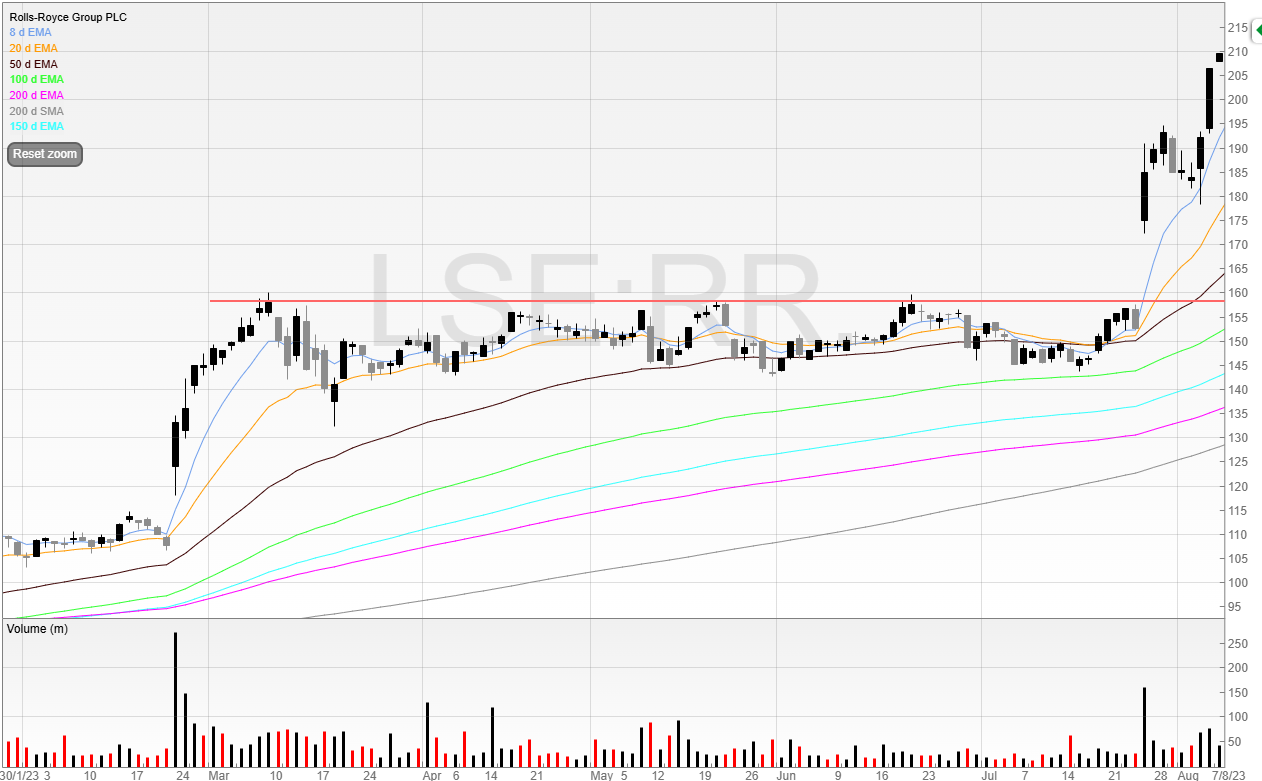
Rolls-Royce (RR.) broke out of a tight base on an unexpected earnings beat.
I was very happy to take a few pence out of this given the size of the stock and liquidity available.
Now look at what happened afterwards..
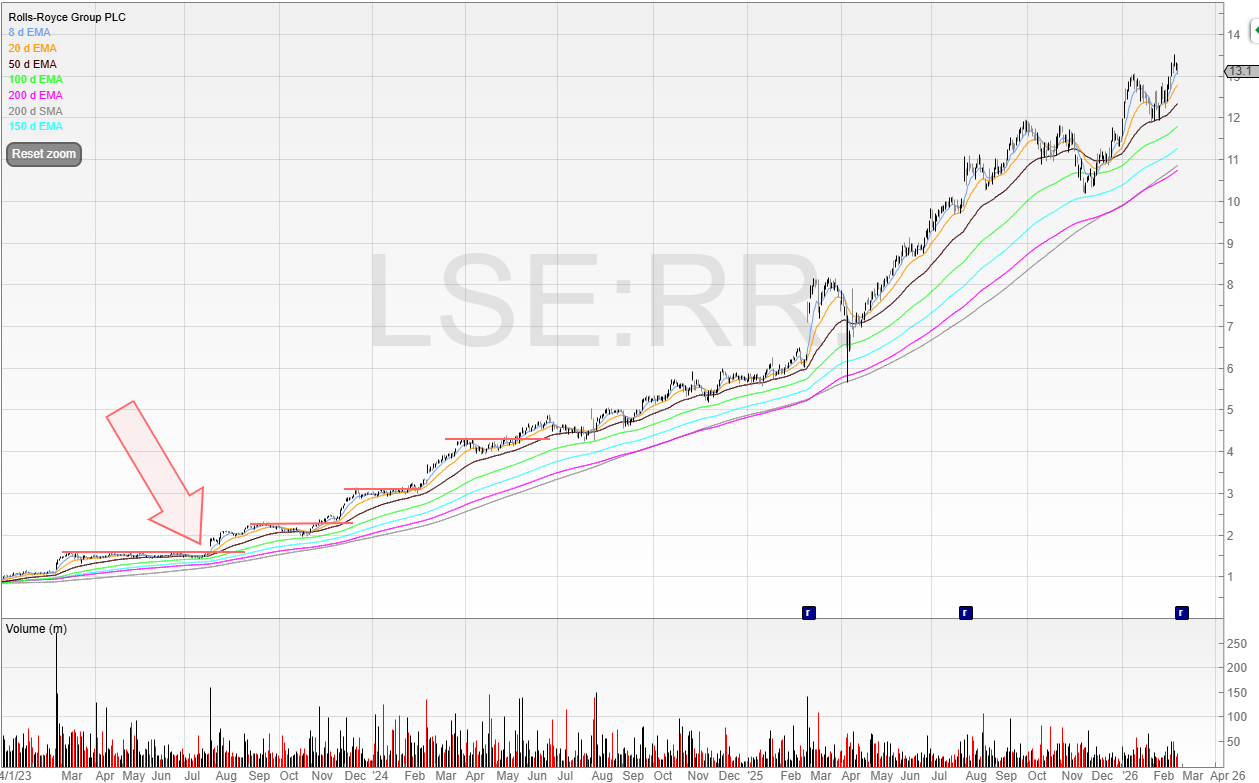
This is going to happen. It’s just part of trading. What it shouldn’t do is convince you to make the biggest mistake…
The biggest mistake: converting M2M to T2H
This is how people lose money. They enter what should be an M2M trade, it goes wrong, and rather than taking the loss, they convince themselves it’s actually a T2H position.
“I’ll just hold it long-term” is the trader’s most dangerous lie.
If you bought a stock for a short-term catalyst and that catalyst failed, the trade is invalidated. Holding it and hoping is not a successful strategy.
I’ve done this. We all have. You buy something expecting a quick 5% move, it drops 8% instead, and suddenly you’re telling yourself it’s cheap and you believe in the company long-term. This is rubbish. You didn’t do the work to justify a T2H position and instead you’re just refusing to take the loss.
The correct action is to cut the trade, take the loss, and move on. If you genuinely think it’s a good long-term buy after doing proper analysis, you can always re-enter later. But don’t confuse refusal to accept being wrong with conviction.
Logging your trades correctly
In your trading journal, you should mark each trade as M2M or T2H at entry. This creates accountability. When you review your trades later, you can see whether you stuck to your plan.
If you logged a trade as M2M but held it for three months, something went wrong. Either your entry criteria were flawed, or you lacked the discipline to execute properly. Both are problems that need addressing.
Over time, you’ll also see which style works better for you. Some traders are excellent at M2M trades but lack the patience for T2H. Others are hopeless at short-term trading but have a knack for spotting long-term winners. There’s no right answer. The important thing is knowing what works for you and focusing your efforts there.
Position size and portfolio balance
I typically run a mix of M2M and T2H positions. This gives me both short-term income and long-term capital appreciation potential.
My M2M trades might turn over every week or two. I’m constantly looking for new setups, taking quick profits, cutting small losses. This is where I generate cash flow.
My T2H positions are the larger winners. These are the trades that can turn a good year into a great year. But they require patience and time to research to assess the odds.
The balance between the two depends on market conditions. In choppy, range-bound markets, I lean more towards M2M trades. In strong trending markets, I increase my T2H exposure.
But the key is never letting one category dominate to the point where you’re either over-trading (all M2M) or under-trading (all T2H). Both have their place.
Final thoughts
Trading would be easier if every position was the same. Buy, hold, sell. But the reality is more nuanced. Different market conditions, different setups, and different stocks all require different approaches.
Understanding whether you’re swinging for a single or a home run before you step up to the plate is fundamental. It determines your stop placement, your position size, your exit strategy, and your risk management.
Most importantly, it stops you from that fatal conversion where an M2M loss becomes a T2H disaster. Know the trade. Execute the trade. Move on.
The market doesn’t care about your justifications. It only cares about the price. Someone once told me that “the price is always right”, and I am inclined to agree.
Michael Taylor
Get Michael’s trade ideas: https://newsletter.buythebullmarket.com/
Free educational content: @shiftingshares
This article is for educational purposes only. It is not a recommendation to buy or sell shares or other investments. Do your own research before buying or selling any investment or seek professional financial advice.
This article is for educational purposes only. It is not a recommendation to buy or sell shares or other investments. Do your own research before buying or selling any investment or seek professional financial advice.