
David Stevenson examines how the UK takeover boom is creating opportunities for active fund managers, makes the contrarian case for gold and gold miners, and considers a potentially undervalued renewable energy wind-down.

The monthly funds focus looks at how the UK market is experiencing peak M&A activity, how this is helping mid- to small-cap opportunistic UK investment trusts, why gold and gold-mining equities might be the big contrarian bet at the moment, plus a potentially undervalued wind-down opportunity in the renewables space. And Nvidia’s stock is really cheap (perhaps for a good reason, or not?)
The UK market vanishes before our eyes
The UK stock market is turning into the Incredible Shrinking Market, with IPOs at historically low levels and M&A activity at heightened levels. Charles Hall, head of research at broker Peel Hunt, has been collecting historic data on M&A activity, detailed in the table below: 2024 saw the highest overall volume of takeovers with 45 completed deals, but 2026 is catching up fast. Takeovers on the AIM market have steadily declined from a high of 19 in 2023 down to just 4 in 2026, while, by contrast, FTSE 100 mega-cap takeovers have hit a multi-year high in 2026 with 5 deals. FTSE 250 companies remain a massive target for acquisition, peaking heavily across 2024 and 2025.
M&A activity by year and sector

It may be summertime, but July has been remarkably busy so far. Counting new bids announced this month, there have been at least six fresh takeover approaches for London-listed companies, plus a handful of sweetened offers on existing situations.
The new bids: Mitie agreed a recommended £3.1 billion cash takeover by OCS Group, days after Swiss engineering group ABB agreed a £4.1 billion deal for Bath-based valve maker Rotork. On the same day as the Rotork deal, Gooch & Housego, the photonics specialist, accepted a £346 million offer from US private equity firm Arlington Capital, and pawnbroker Ramsdens agreed a £200 million takeover by Nasdaq-listed FirstCash. There’s also a bid for System1 this month, alongside increased offers for SEGRO, EasyJet and Ramsdens. On top of that, AEW UK REIT confirmed it is considering a possible offer for Alternative Income REIT.
For context on the year as a whole, Mitie is the eleventh proposed transaction in the UK this year with a price tag above £1 billion, and the average premium across the 36 live or completed deals stands at 43 per cent. According to Russ Mould at AJ Bell, the total value of live or completed bids for UK-listed companies could reach £69.3 billion if they all complete, and Bloomberg noted the market is losing the equivalent of more than $2 billion a week to takeovers of London-listed companies.
Why does this matter? Put simply, there’s never been a better time to be an active UK equities fund manager focused on mid- to small-cap stocks. Investment trusts in this space, ranging from Fidelity Special Values to Odyssean, Onward Oppos, and Rockwood, are seeing takeovers emerge almost weekly. Across the niche of UK mid- to small-cap funds, year-to-date returns are averaging between 9% and 12%.
Investment trusts in H1 2026
According to the investment trust industry association, the AIC, the Technology & Technology Innovation sector was the top-performing investment trust sector in the first half of 2026, according to data from the Association of Investment Companies (AIC). The sector produced a share price total return of 50% in the six months to the end of June 2026, while the average investment trust delivered a share price total return of 9.4%. The Asia Pacific sector generated the second highest return of 33%, whilst the Global Emerging Markets sector came third with a return of 31%.

A contrarian take on gold and gold mining equities
Investing in gold and gold mining equities requires nerves of steel at the moment. All the technical measures focused on the price of gold look terrible now: the 20 and 200 day moving averages have been decisively breached, implying a death cross, and gold is struggling to stay above $4000 an ounce. If that level is breached, I think we could easily see a push towards $3200.
The causes of this price weakness aren’t difficult to fathom. One can easily point to gold ETF flows and say that the narrative around fiscal debasement has collapsed and private investors are selling. But the real driver is that bond investors think that interest rates will have to rise, pushing up positive real rates, which is a sure-fire signal to sell gold, i.e higher real interest rates suppress demand for gold.
No one knows for sure what will happen next, but my hunch is that real rates will start to decline next year as the AI mania starts to unwind and the new chair of the US Fed, Kevin Warsh, gets his way and interest rates start to decline. I think that once the global predicament facing central banks becomes clear – how do they deal with rampant fiscal deficits by populist governments – the fiscal debasement will kick in again. In that scenario, gold prices might start rising again. Other market observers such as Yardeni Research argue that gold prices are yoked to rising equity valuations and that as the Roaring Twenties thesis plays out, gold prices will rise. I’m not entirely convinced by this second argument, though the data points do back it up.
Regardless, I remain optimistic about gold for the long term, although I think there is a real risk in the short term that prices might breach the $4000 level and then head to $3200. I believe that will be reversed for the reasons above, and if that does happen, then gold prices will rise, the value of gold mining equities will climb even faster, and silver prices rocket.
On the topic of gold mining equities, I’d note an interesting piece of research from JPMorgan analyst Patrick Jones and team, looking at EMEA gold miners, especially the larger-market-cap ones. The core argument is that the 35-45% pullback since the start of the Iran-US conflict has created “a compelling entry point”, with AngloGold and Fresnillo the bank’s top picks alongside Gold Fields newly placed on Positive Catalyst Watch. The bullishness comes despite the bank’s own commodities team slashing its year-end 2026 gold target to roughly $4,500/oz from $6,300/oz, which forces gold price forecast cuts of 8% and 15% for 2026 and 2027 respectively, to around $4,400/oz and $4,300/oz.
The key point, though, is this: EMEA Gold Miners are pricing in a long-term gold price of only ~$3,200-3,800/oz – roughly 10% below spot (~$4,050) and ~15-25% below JPM Commodities’ YE’26 forecast of ~$4,500/oz to the upside.

Some other useful points from the report:
– Central bank buying is back again as prices fall. Central banks in China and Poland are buying the pullback, with China adding nearly 15 tonnes in June, its largest monthly purchase since October 2023.
– The relationship between gold prices and real interest rates is back in the saddle, in a bad way at the moment. As real rates rise, gold falls. But this could very easily reverse, especially if the US Fed starts to lower interest rates next year.
– Some of the miners can make a lot of money even at the current, lower prices. Gold Fields (ex Tarkwa) sits cheapest at $3,300/oz while Fresnillo, at $3,850/oz, carries a premium reflecting its silver exposure. The conclusion: “risk/reward for gold miners is skewed to the upside in our view”.
In terms of equities, although I think the large cap gold miners are interesting, I still much prefer riskier, low-cost junior gold and silver miners. Silver miners will be even more leveraged (on the downside as well as the upside) to gold prices. My three preferred vehicles remain the Charteris Gold and Precious Metals fund, VanEck Junior Gold Miners ETF (ticker GJGB), and Golden Prospect Precious Metals investment trust.
On that last fund, Golden Prospect, there’s exciting news that there has been a much-needed shake-up. Back in March, portfolio managers Keith Watson and Robert Crayfourd upped sticks from CQS Manulife. After a brief hiatus, the board has just announced that it has agreed terms to appoint the excellent team at Baker Steel Capital Managers LLP as Investment Manager and AIFM (led by Mark Burridge and Trevor Steel), with the appointment expected to commence in 3Q26.
GPM has also announced an enhanced 6% per annum dividend policy and a possible migration to the Main Market. The new fees are 0.9% of the average MC and NAV (capped at NAV) up to £250m, and 0.8% above, vs 1.25% of NAV up to £20m and 1% above under the existing arrangements. GPM has negotiated improved terms over the current management arrangements with CQS, with reduced fees, a shorter notice period, a waiver to offset the CQS notice period and a cost contribution (details below).
From what I understand, the strategy will remain focused on smaller-cap gold and precious-metals mining-listed equities – and I think Baker Steel will do an excellent job. I rate the Baker Steel team highly and think that they can bring real deep expertise to gold and silver mining equity selection. The discount has tightened to 5.5%, and I’d expect the shares to re-rate as the Baker Steel team makes its mark.
One final point: if gold prices do rebound in bullish fashion, how might the funds I mentioned behave? Looking at my three favourite funds, in the chart below, I’ve looked at the recent gold bull rally and then mapped out how these three funds performed against the gold price in black. I’ve focused on the long ramp-up in prices over the last few years. The black line is the spot gold price, the blue line is the small investment trust Golden Prospect, the green line is the VanEck Junior Gold Miners ETF, and the red line is the Charteris Precious Metals Unit Trust Fund (which is very long silver). Notice how all have outperformed the spot price, with Golden Prospect ahead most of the time but both GJGB, the RTF and Charteris caught up towards the end of this up cycle.

VH Global Energy Infrastructure Trust (ENRG)
By and large, many renewable funds have been a real disappointment in recent years. Revenues haven’t been as high as everyone expected, volatility is much greater, dividends in some cases are uncovered, and far too many funds have ended up subscale and forced to run a managed wind-down process.
VH Global Energy Infrastructure reached this position last year: it commenced a managed wind-down of its portfolio in late August, to be delivered over a three-year period. During this realisation process, ENRG will continue to pay quarterly dividends and currently targets a total of 5.80p for 2025, although the quarterly rate will depend on income generated. Crucially for a fund that is funding more development-based projects, the manager – who is incentivised to realise as much as possible from selling assets – is focusing on completing the remaining construction assets and turning them into operational assets (which is now largely complete).
Back in March, investors were updated on these WMD plans – with a NAV declared of 102.28p for the last Q4 of 2025 – the manager noting that the M&A landscape for deals was looking positive. It noted that several assets, including US midstream and Australian hybrid assets, among others, continue to attract strong interest from institutional investors. Analysts at Jefferies report that
“… the positive market backdrop for US terminal storage assets and the Brazilian hydro facility was reconfirmed, and the submission of non-binding indicative offers for the Brazilian solar portfolio began in Q1, suggesting an update reflecting market interest could be reflected in the upcoming Q1 NAV. ENRG has also provided a clearer timeline on the sale process of its European renewable portfolio, which is expected to commence between late 2026 and early 2027. As all processes have been initiated or are expected to commence before the end of H1 2027, we remain confident in the three-year timeline proposed for the wind-down.”
Talking to quite a few institutional players in this infra funds space, there’s a growing sense that ENRG might well deliver successfully on the 3-year MWD process and return not too far off the stated NAV, especially if buyer interest is as high as many analysts suspect.
Crucially, the geographic diversity of assets in markets with much less uncertainty than the UK is a real plus – my own sense is that the Brazilian hydro assets might surprise on the upside, as will the US energy terminal assets: these two assets comprise 55% of the total NAV. The smaller Australian solar PV/battery, UK flex power and Brazilian solar PV assets might be a tougher sell (comprising 33% of the net assets).
In the meantime, the dividend is not far from being fully covered, generating around 7.7% per annum. I think a realistic target – and nothing more than that – is a capital return of, say, 90p (possibly a tad higher), plus investors will also get those dividends for at least the next year. That might equate to a total return over the next two to three years of around 25 to 30p per share, based on a current share price of around 73p.
Obviously, there are lots of things that can go wrong with managed wind downs, not least the cost base, which eats into returns as the fund gets smaller. As I said, I also think the smaller assets will be a more difficult sell and could hang around for a few years, depressing the share price. So, this is not without risks, which is why it’s not on any of my buy or watch lists, but I do think this interesting situation deserves more detailed research.
Nvidia’s stock price is really cheap
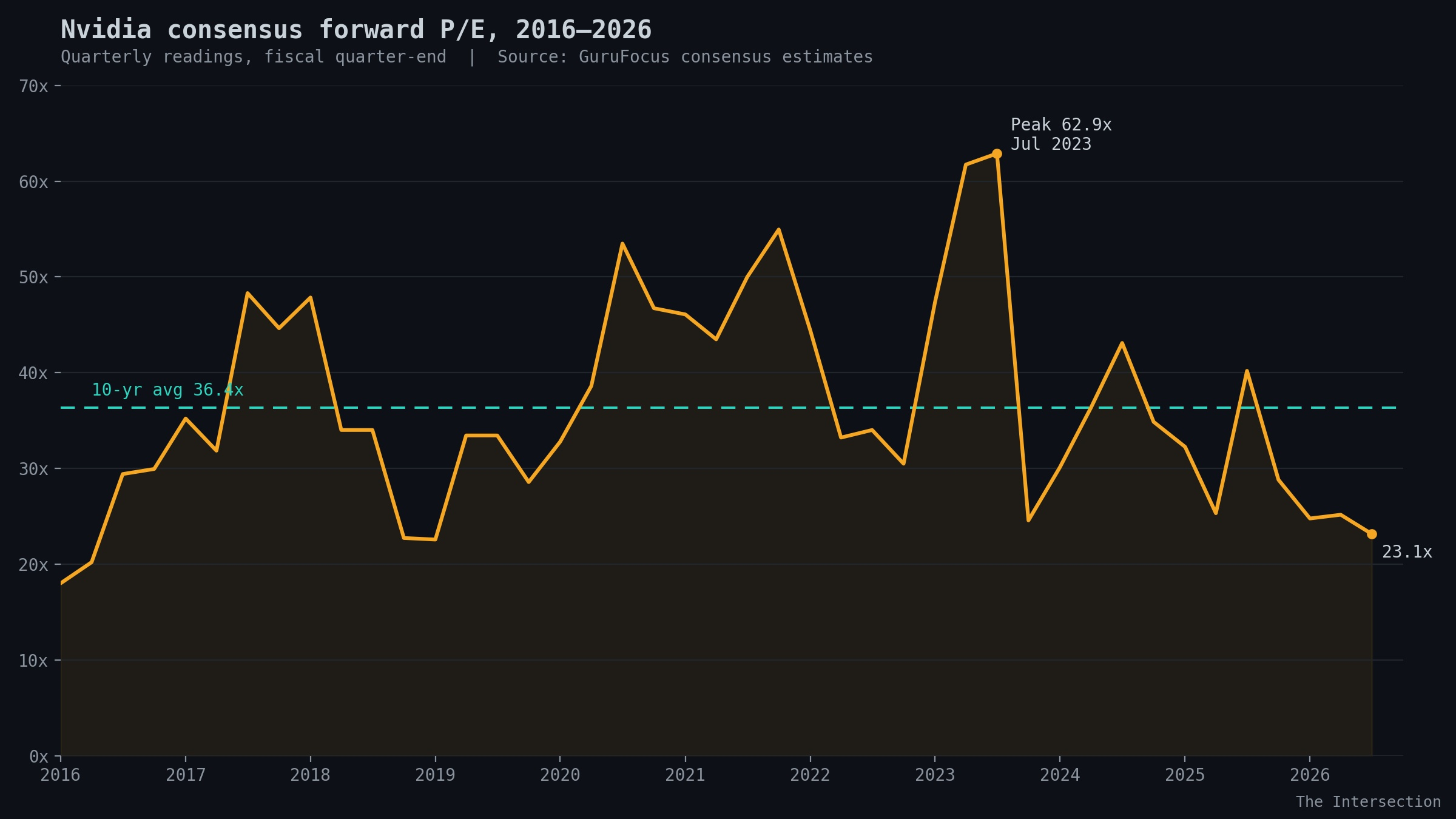
AI may or may not be in a bubble, and Nvidia may or may not be the King of AI, but I’d simply draw your attention to the chart below, which shows the forward price-to-earnings multiple for the stock over the last ten years. Nvidia currently trades at around 23 times forecast earnings with a low of 18 times earnings in January 2016 and a 10-year average of 36 times earnings. Now, bears will say that the whole chip sector is massively super cyclical and that these ‘low’ valuations are always evident just before an almighty price collapse as overcapacity prompts price declines and earnings falls. But what if Nvidia isn’t that cyclical and that its chips continue to sell as quickly as they are manufactured?
David Stevenson
Twitter: @advinvestor
This article is for educational purposes only. It is not a recommendation to buy or sell shares or other investments. Do your own research before buying or selling any investment or seek professional financial advice.




Gold: a fall of 25% from ATH was scary; but already $/TrOz back up to $4250. As DS says, falling Int Rate in 2027 will help. More important is Financial Repression: Govts have to reduce Debt & FR is the way: hold Int Rate at 3% with Inflation at 4% and Magic: slowly real value of $/£/¥ falls.
Gold price is not a hedge against Inflation but is against debasement of fiat currency. Hold 10% of AUM as insurance.