Bruce returns from his BGEO investor day in Tbilisi, Georgia. Plus a look at a couple of house builders GLE and VTY, and FinTechs FCH and LINV.
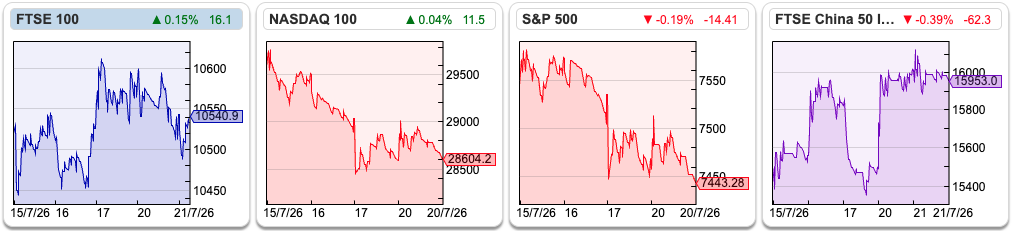
The FTSE 100 was flat over the last 5 trading days, at 10,540. The Nasdaq100 and S&P500 were down -2.3% and -1% respectively. Meanwhile the FTSE China 50 was up strongly by over +3%, though UK and Chinese indices are still the worst performing global indices since late Feb, when Trump began attacking Iran. Brent crude was up +2% over the last 5 trading days, though still below $90 per barrel. That compares to EGAS (European Natural Gas) which was up +12% over the same period and up +84% since late February. I’ve been too cautious, raising cash as I was expecting markets to struggle if the Straits of Hormuz were effectively closed to shipping and we had another inflation spike. So far that hasn’t happened, I will begin putting money to work in September.
A big thank you to Jamie for stepping in while I was away at BGEO’s investor day in Tbilisi. As someone who covered UK banks from 2000-2012 it was rather a surreal experience to go to a bank investor day for a bank whose share price had increased in value by 10x since early 2022. It was all very good natured, and particularly valuable to hold the event in Georgia, so that international investors could see for themselves how vibrant the economy is. If anything, there’s a risk of overheating, many Russians who escaped Putin’s war are living and working in Tbilisi. They’ve also been joined by visitors from the Gulf, with many direct flights from Bahrain, Kuwait and Dubai.
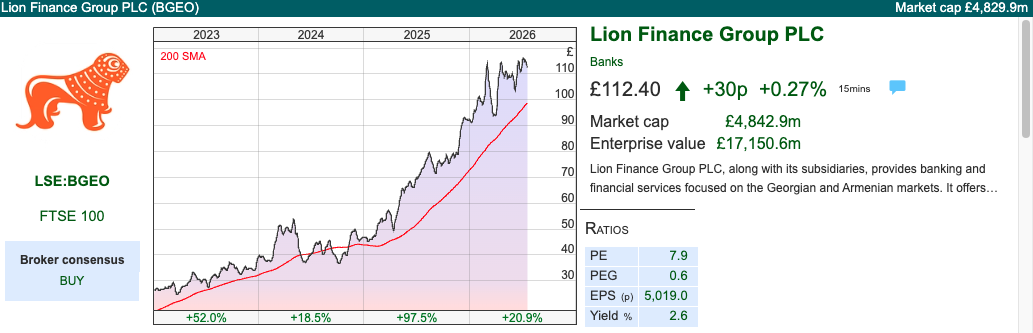
Fortunately Lion Finance has a loans/deposit ratio just below 1x and a core equity tier 1 capital ratio of just under 18%. That means it is in much better shape compared to UK banks in 2007-8 and should be able to withstand a slowdown and rise in bad debts from the low levels that it has been reporting (c. 30bp). Management presented a compelling investment case, taking their technology and processes and applying them to the Armenia, where they bought an Armenian bank for $300m at the start of 2024 (hence the change of name from Bank of Georgia Group to Lion Finance). On my flight back to London, I sat next to an IT entreprenuer from Singapore who had moved to Tbilisi and who thought the city compared favourably to the Asian city state. BGEO has become an uncomfortably large position for me, but on other than that, I can’t see much reason for concern.
I also climbed +5000m Mount Kazbegi (in Georgian Mqinvartsveri, which means literally “freezing cold peak” with a friend from The Alpine Ski Club. The route up starts from the Georgian village of Stepantsminda, up via the Gergeti church built overlooking the valley. After sleeping at the Bethlemi Hut (3600m) the route then crosses over the ridge into the Russia above 4000m (apparently the FSB don’t seem to mind, certainly there was no one up there to check my passport.)
Photo by Slava Auchynnikau on Unsplash

This week I look at affordable builder MJ Gleeson, where Cavendish have increased their revenue forecast by 10% without that benefit dropping through to their PBT or EPS forecasts. And Funding Circle which has been enjoying very strong growth.
MJ Gleeson FY June Trading Update
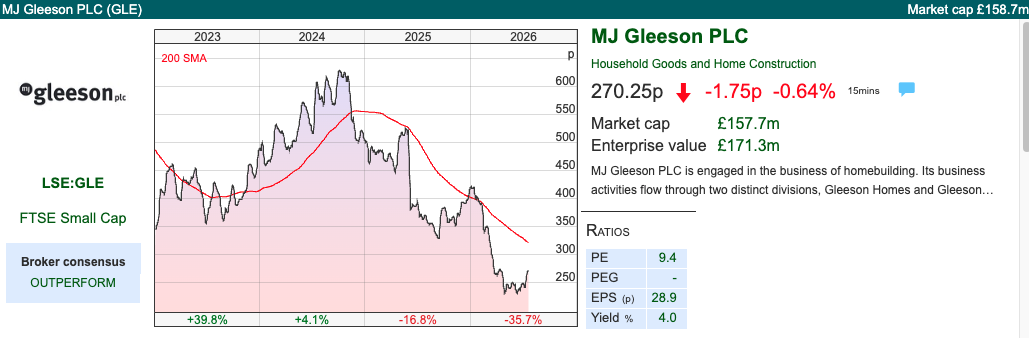
This builder of affordable homes across the Midlands and North of England has Harwood as their largest shareholder (just over 10%). The relationship goes back to the financial crisis, when the shares fell almost -90%, and Christopher Mills joined the Board in early 2009 executing a classic activist turnaround strategy. The share price recovered from around 60p in early 2009 to just under £10 before the pandemic hit. We’re now a 270p, with the shares down -36% YTD.
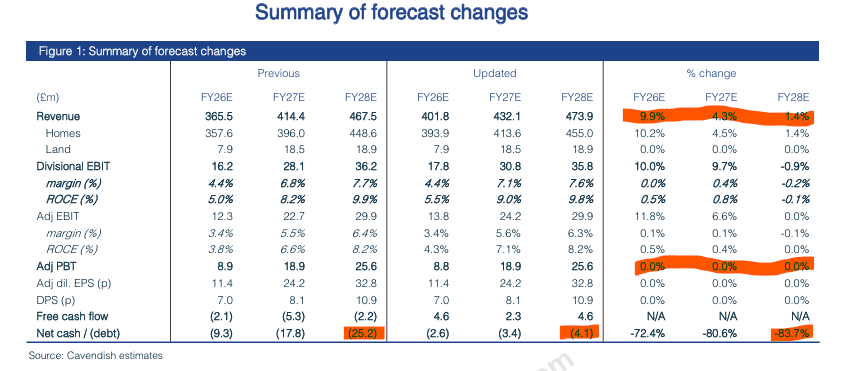
What caught my eye is that the share price has now recovered through the 64/16 day moving average. Following a FY Jun trading update on the 10th July Cavendish, their NOMAD, have upgraded their revenue forecasts by 10% FY Jun 2026F and +4% the following year. There are no meaningful changes to PBT, as higher interest costs have eaten into the improvement. The most significant change is to the broker’s cash forecast: a more cautious approach to land investment moves free cash flow positive across the forecast period, Cavendish now expect net debt to remain in the low single digits (previous net debt forecast was for £25m FY Jun 2028F).
I don’t have access to all the assumptions in their model, but on the face of it, higher revenue, dramatically reduced net debt and no changes to PBT or EPS imply that the broker has room to move EPS forecasts higher at some point.
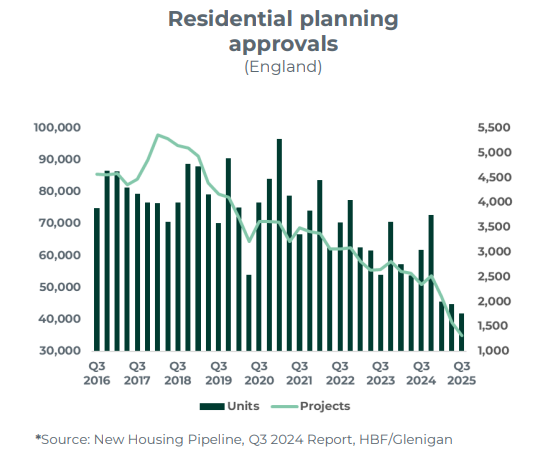
The RNS says that Gleeson Homes completed sales of 1,968 homes, +10% versus the prior year. In addition, the group says that the impact on build cost inflation from the conflict in the Middle East has been less severe than anticipated. They do warn about continued inflationary pressure, and of course, a “myriad of regulatory and tax burdens recently imposed”, which are likely to impact near term margin recovery. Worth noting though that within GLE, is the capital light business Gleeson Land, which identifies sites, enters into option agreements with landowners, and guides them through the complex, frustrating UK planning system. Once planning permission is secured, they sell the consented land to other developers. Gleeson Land’s revenue contribution is expected to more than double to £18m (just under 5% of group revenue), so regulatory burdens and planning permission bottlenecks are also creating an opportunity for GLE, though at the moment that’s not enough to offset the negative trend. They put up this chart in their H1 results analyst pack in February showing units and projects have been on a decade long decline, despite both major political parties wanting to build more houses.
Outlook: The forward order book increased marginally to 848 plots (30 June 2025: 845 plots), which doesn’t sound very exciting for near term prospects. Gleeson Homes also works in partnership with Housing Associations, and secured five further partnership deals for 254 homes in H2 (8 in total, covering 384 homes). They say this is creditable in a challenging market with Housing Association struggling for funding. Andy Burnham, the new Prime Minister, has talked about by-passing Housing Association balance sheets, by creating a National Housing Bank to fund local authorities to build houses. As an “affordable” housing volume builder, Gleeson could be well placed to benefit from the change in policy.

ShareScope’s quality indicators look unexciting at the moment (3 year average CashRoCI around 1%, 3 year EBIT margin 10%) – but using Sharescope to look back over the years EBIT margin peaked at 25% a decade ago.
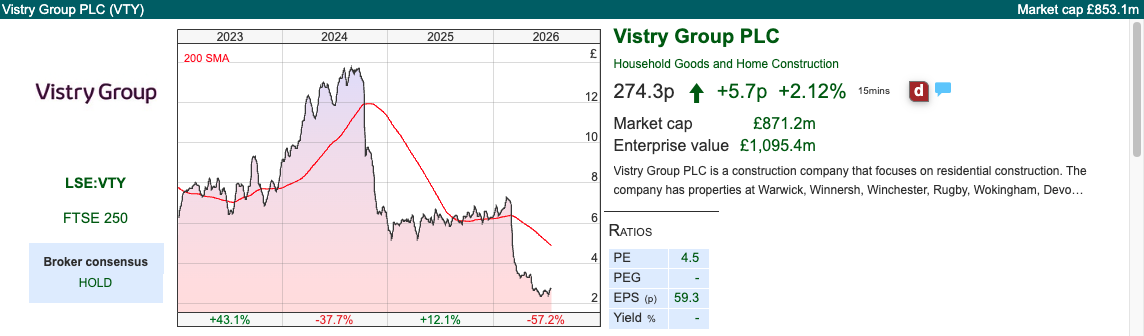
Comparison with Vistry and Crest Nicholson: There’s a good discussion between Paul Hill and Paul Scott on YouTube on house builders. Even more upside could be available buying distressed house builders like Vistry and Crest Nicholson. Adam Daniels, the new Chief Exec of Vistry who has been in the role 3 months bought £100K of shares at 260p, after the group reported in a 8th July RNS significant progress on cash generation. They mention significant short interest in VTY, so Paul and Paul acknowledge the turnaround potential but the less problematic GLE, which should also benefit from the £39bn government social housing fund over 10 years.
Valuation: As they have different balance sheets, I think EV/EBITDA is a better way to compare housebuilders. Vistry trades on below 3x forecast Dec 2026F EV/EBITDA, whereas GLE is on 6x Jun 2027F, which translates to a PER of 11x and 0.5x P/NAV the same year for Gleeson.
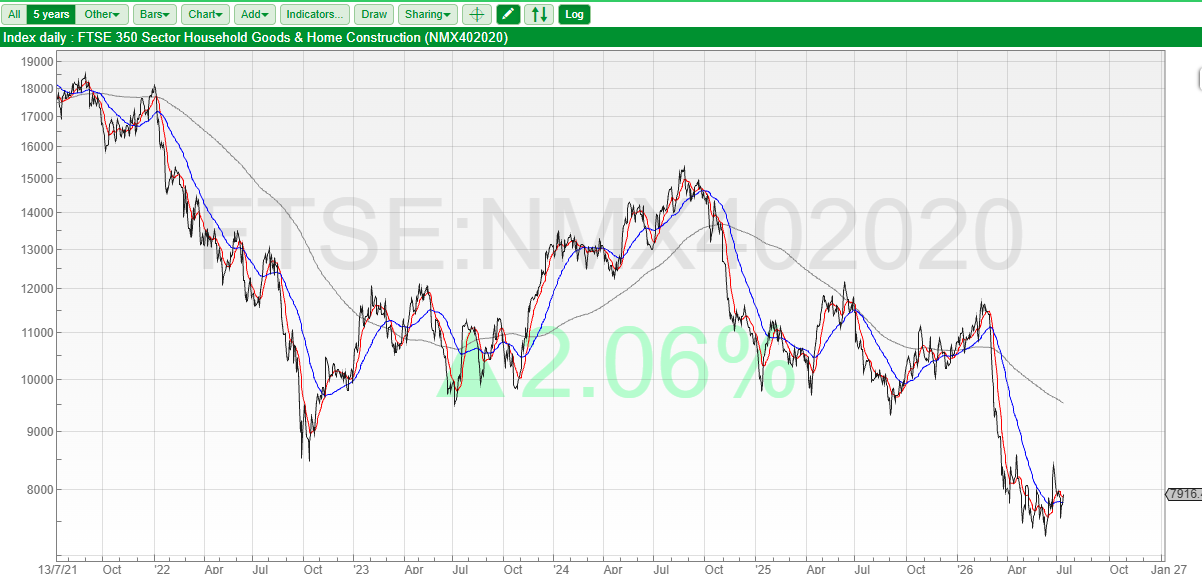
Opinion: The chart above shows that the whole Household Goods and Home Construction sector has been hit badly since Putin’s invasion of Ukraine, but I was intrigued by the MJ Gleeson investment case mentioned by Richard Staveley at Rockwood. The rule of thumb with cyclical sectors, like house builders, is that you buy the groups when margins are depressed and they look unattractive on conventional valuation ratios, rather than when margins are peaking and they look “cheap”. It’s been a difficult few years, but I’m flagging this now, as it seems to me housebuilders could enjoy significant upside when the circle turns.
Funding Circle FY June Trading Update
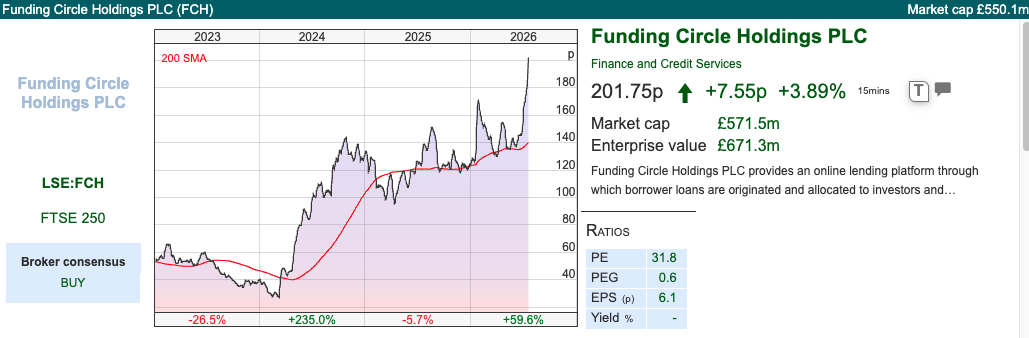
This Fintech has been growing rapidly with H1 June revenue +50% to £138m, and PBT almost quadrupling to £23m versus H1 last year. This half’s PBT is also greater than FY 2025, which was £20m. Unrestricted cash balances were £136m (just under a quarter of the market cap).
Although FCH management call themselves a “platform”, I think that is a triumph of marketing over reality. Funding Circle lacks the network effects of a true financial platform (eg a payments network like Visa or a stock exchange like the LSE). In a true platform, adding more participants to one side of the platform creates value on the other side (that is, wider adoption by merchants -> more cardholders, and more cardholders -> wider adoption by merchants). Dominance becomes self-reinforcing, so marketing costs are low.
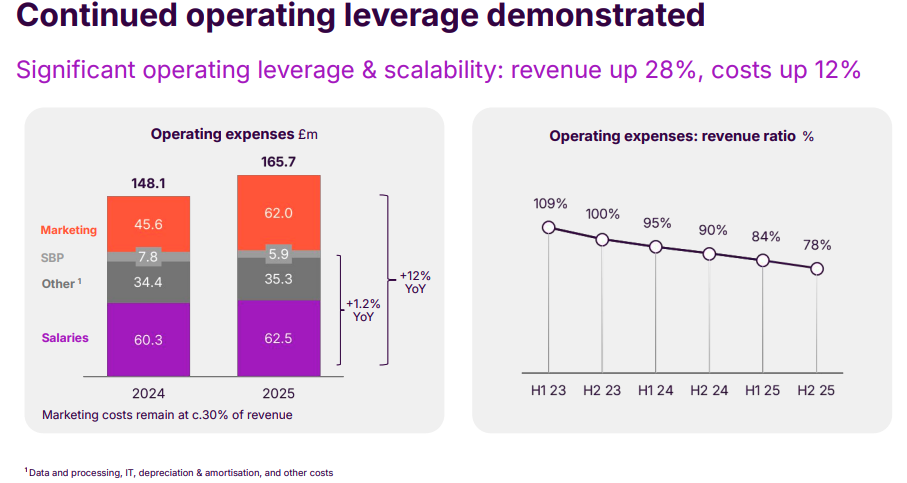
In the same way Fund Managers with low marginal costs on growing Assets under Management (AuM) are not true platforms. There is some operating leverage, though as the business grows, as the chart on the right from Funding Circle’s FY 2025 results shows. Worth remembering though, Funding Circle has been going a decade and a half and is still spending around 30% of revenue on marketing in order to attract new SME borrowers. If they enjoyed true platform economics, they’d be attracting customers without that level of marketing spend.
Funding Circle currently has AuM of £3.3bn – the risk is that if credit quality deteriorates, the institutions providing the capital might be come more cautious. At the moment, we are in a positive phase of the cycle, and FCH say that they are “firmly on track” to achieve FY 2026F guidance. Revenue of £235m implies +15% FY growth and PBT of £35m implies growth of +75%.

Management say that their addressable market is £80bn of SME debt (26x larger than current AuM) and £1.3 trillion of SME B2B payments. I don’t think that largest figure is meaningful, FCH is offering FlexiPay and Cards, which are credit products, but its not a B2B payments group, like Stripe.
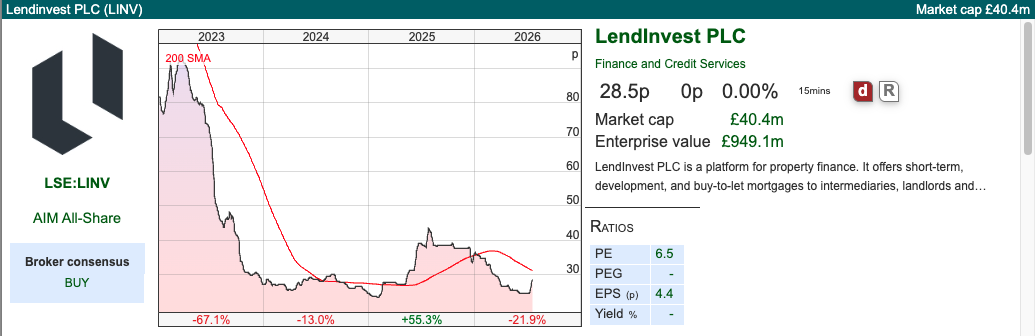
Comparison with LendInvest: LendInvest, the Buy-To-Let FinTech, released FY Mar 2026 results last weeks. FY Mar 2026 revenues were up +12% to £39m, and £2.3m PBT versus a FY loss last year. LendInvest originates via mortgage market intermediaries, then packages up the loans into Residential Mortage Backed Securities (RMBS).
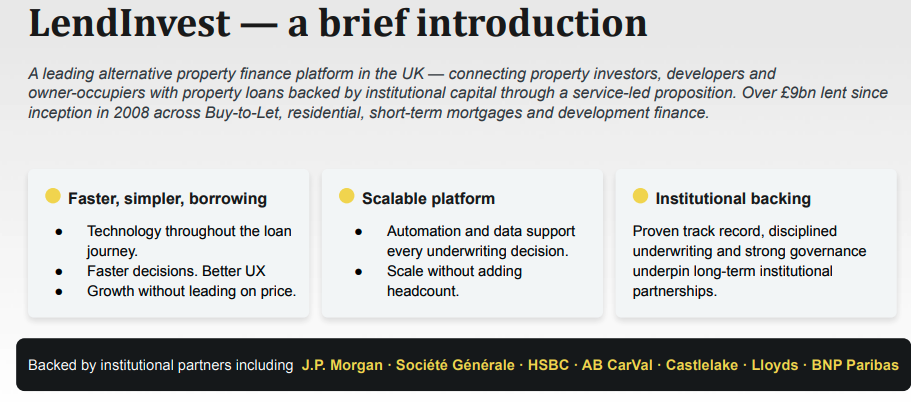
As most of LendInvest RMBS are highly rated by the credit rating agencies, the buyers tend to be banks and insurance companies, whereas private credit managers and specialist hedge funds are buying FCH’s SME credit. It’s a similar idea though, finding borrowers to lend to, but not keeping the debt on their own balance sheets. Like FCH, LINV also claim to be a platform, which seems dubious to me because they don’t enjoy the two sided network effects of a true platform. This was a 2021 IPO, and fell almost -90% in the following years, but now they’re generating profits could be worth a look?
Valuation: FCH shares are trading on a PER of 14x Dec 2027 and 2.4x sales. For comparison, FCH came to market in 2018 on a 15x p/sales ratio, it seems amazing to me that professional fund managers are so generous at valuing IPOs. There’s an ongoing share buyback (£25m announced at the FY) which should also support the share price. FCH have spent £72m to buy back 18% of their shares since they IPO’ed in 2018, when they raised £300m at 440p.
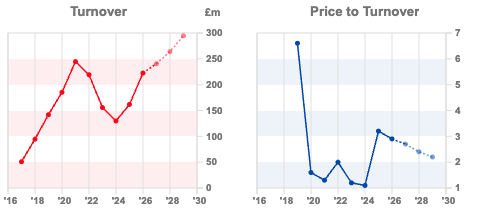
LINV are on a much lower rating: 8.2x PER Mar 2027F and 0.8x sales the same year.
Opinion: I own FCH, having bought when they announced that they would reverse their expansion into the USA, the shares are up by more than 4x. Effectively Funding Circle a digital “front end” to channel private credit into SME financing. I think it’s a good business, demonstrating operational gearing as it grows; but it’s not a true platform. Similar to the housebuilders, there could be more upside in the lower quality groups in the sector (eg LINV) but also higher risk of failure. I don’t feel the need to take more risk at the moment, so will avoid the likes of LINV and VTY for now.
Bruce Packard
@bruce_packard
Notes
Bruce owns shares in BGEO and FCH
This article is for educational purposes only. It is not a recommendation to buy or sell shares or other investments. Do your own research before buying or selling any investment or seek professional financial advice.




Bi-Weekly Market Commentary | 22/07/2026 | GLE, VTY, FCH, LINV | Peak performance in the Caucasus
Bruce returns from his BGEO investor day in Tbilisi, Georgia. Plus a look at a couple of house builders GLE and VTY, and FinTechs FCH and LINV.
The FTSE 100 was flat over the last 5 trading days, at 10,540. The Nasdaq100 and S&P500 were down -2.3% and -1% respectively. Meanwhile the FTSE China 50 was up strongly by over +3%, though UK and Chinese indices are still the worst performing global indices since late Feb, when Trump began attacking Iran. Brent crude was up +2% over the last 5 trading days, though still below $90 per barrel. That compares to EGAS (European Natural Gas) which was up +12% over the same period and up +84% since late February. I’ve been too cautious, raising cash as I was expecting markets to struggle if the Straits of Hormuz were effectively closed to shipping and we had another inflation spike. So far that hasn’t happened, I will begin putting money to work in September.
A big thank you to Jamie for stepping in while I was away at BGEO’s investor day in Tbilisi. As someone who covered UK banks from 2000-2012 it was rather a surreal experience to go to a bank investor day for a bank whose share price had increased in value by 10x since early 2022. It was all very good natured, and particularly valuable to hold the event in Georgia, so that international investors could see for themselves how vibrant the economy is. If anything, there’s a risk of overheating, many Russians who escaped Putin’s war are living and working in Tbilisi. They’ve also been joined by visitors from the Gulf, with many direct flights from Bahrain, Kuwait and Dubai.
Fortunately Lion Finance has a loans/deposit ratio just below 1x and a core equity tier 1 capital ratio of just under 18%. That means it is in much better shape compared to UK banks in 2007-8 and should be able to withstand a slowdown and rise in bad debts from the low levels that it has been reporting (c. 30bp). Management presented a compelling investment case, taking their technology and processes and applying them to the Armenia, where they bought an Armenian bank for $300m at the start of 2024 (hence the change of name from Bank of Georgia Group to Lion Finance). On my flight back to London, I sat next to an IT entreprenuer from Singapore who had moved to Tbilisi and who thought the city compared favourably to the Asian city state. BGEO has become an uncomfortably large position for me, but on other than that, I can’t see much reason for concern.
I also climbed +5000m Mount Kazbegi (in Georgian Mqinvartsveri, which means literally “freezing cold peak” with a friend from The Alpine Ski Club. The route up starts from the Georgian village of Stepantsminda, up via the Gergeti church built overlooking the valley. After sleeping at the Bethlemi Hut (3600m) the route then crosses over the ridge into the Russia above 4000m (apparently the FSB don’t seem to mind, certainly there was no one up there to check my passport.)
Photo by Slava Auchynnikau on Unsplash
This week I look at affordable builder MJ Gleeson, where Cavendish have increased their revenue forecast by 10% without that benefit dropping through to their PBT or EPS forecasts. And Funding Circle which has been enjoying very strong growth.
MJ Gleeson FY June Trading Update
This builder of affordable homes across the Midlands and North of England has Harwood as their largest shareholder (just over 10%). The relationship goes back to the financial crisis, when the shares fell almost -90%, and Christopher Mills joined the Board in early 2009 executing a classic activist turnaround strategy. The share price recovered from around 60p in early 2009 to just under £10 before the pandemic hit. We’re now a 270p, with the shares down -36% YTD.
What caught my eye is that the share price has now recovered through the 64/16 day moving average. Following a FY Jun trading update on the 10th July Cavendish, their NOMAD, have upgraded their revenue forecasts by 10% FY Jun 2026F and +4% the following year. There are no meaningful changes to PBT, as higher interest costs have eaten into the improvement. The most significant change is to the broker’s cash forecast: a more cautious approach to land investment moves free cash flow positive across the forecast period, Cavendish now expect net debt to remain in the low single digits (previous net debt forecast was for £25m FY Jun 2028F).
I don’t have access to all the assumptions in their model, but on the face of it, higher revenue, dramatically reduced net debt and no changes to PBT or EPS imply that the broker has room to move EPS forecasts higher at some point.
The RNS says that Gleeson Homes completed sales of 1,968 homes, +10% versus the prior year. In addition, the group says that the impact on build cost inflation from the conflict in the Middle East has been less severe than anticipated. They do warn about continued inflationary pressure, and of course, a “myriad of regulatory and tax burdens recently imposed”, which are likely to impact near term margin recovery. Worth noting though that within GLE, is the capital light business Gleeson Land, which identifies sites, enters into option agreements with landowners, and guides them through the complex, frustrating UK planning system. Once planning permission is secured, they sell the consented land to other developers. Gleeson Land’s revenue contribution is expected to more than double to £18m (just under 5% of group revenue), so regulatory burdens and planning permission bottlenecks are also creating an opportunity for GLE, though at the moment that’s not enough to offset the negative trend. They put up this chart in their H1 results analyst pack in February showing units and projects have been on a decade long decline, despite both major political parties wanting to build more houses.
Outlook: The forward order book increased marginally to 848 plots (30 June 2025: 845 plots), which doesn’t sound very exciting for near term prospects. Gleeson Homes also works in partnership with Housing Associations, and secured five further partnership deals for 254 homes in H2 (8 in total, covering 384 homes). They say this is creditable in a challenging market with Housing Association struggling for funding. Andy Burnham, the new Prime Minister, has talked about by-passing Housing Association balance sheets, by creating a National Housing Bank to fund local authorities to build houses. As an “affordable” housing volume builder, Gleeson could be well placed to benefit from the change in policy.
ShareScope’s quality indicators look unexciting at the moment (3 year average CashRoCI around 1%, 3 year EBIT margin 10%) – but using Sharescope to look back over the years EBIT margin peaked at 25% a decade ago.
Comparison with Vistry and Crest Nicholson: There’s a good discussion between Paul Hill and Paul Scott on YouTube on house builders. Even more upside could be available buying distressed house builders like Vistry and Crest Nicholson. Adam Daniels, the new Chief Exec of Vistry who has been in the role 3 months bought £100K of shares at 260p, after the group reported in a 8th July RNS significant progress on cash generation. They mention significant short interest in VTY, so Paul and Paul acknowledge the turnaround potential but the less problematic GLE, which should also benefit from the £39bn government social housing fund over 10 years.
Valuation: As they have different balance sheets, I think EV/EBITDA is a better way to compare housebuilders. Vistry trades on below 3x forecast Dec 2026F EV/EBITDA, whereas GLE is on 6x Jun 2027F, which translates to a PER of 11x and 0.5x P/NAV the same year for Gleeson.
Opinion: The chart above shows that the whole Household Goods and Home Construction sector has been hit badly since Putin’s invasion of Ukraine, but I was intrigued by the MJ Gleeson investment case mentioned by Richard Staveley at Rockwood. The rule of thumb with cyclical sectors, like house builders, is that you buy the groups when margins are depressed and they look unattractive on conventional valuation ratios, rather than when margins are peaking and they look “cheap”. It’s been a difficult few years, but I’m flagging this now, as it seems to me housebuilders could enjoy significant upside when the circle turns.
Funding Circle FY June Trading Update
This Fintech has been growing rapidly with H1 June revenue +50% to £138m, and PBT almost quadrupling to £23m versus H1 last year. This half’s PBT is also greater than FY 2025, which was £20m. Unrestricted cash balances were £136m (just under a quarter of the market cap).
Although FCH management call themselves a “platform”, I think that is a triumph of marketing over reality. Funding Circle lacks the network effects of a true financial platform (eg a payments network like Visa or a stock exchange like the LSE). In a true platform, adding more participants to one side of the platform creates value on the other side (that is, wider adoption by merchants -> more cardholders, and more cardholders -> wider adoption by merchants). Dominance becomes self-reinforcing, so marketing costs are low.
In the same way Fund Managers with low marginal costs on growing Assets under Management (AuM) are not true platforms. There is some operating leverage, though as the business grows, as the chart on the right from Funding Circle’s FY 2025 results shows. Worth remembering though, Funding Circle has been going a decade and a half and is still spending around 30% of revenue on marketing in order to attract new SME borrowers. If they enjoyed true platform economics, they’d be attracting customers without that level of marketing spend.
Funding Circle currently has AuM of £3.3bn – the risk is that if credit quality deteriorates, the institutions providing the capital might be come more cautious. At the moment, we are in a positive phase of the cycle, and FCH say that they are “firmly on track” to achieve FY 2026F guidance. Revenue of £235m implies +15% FY growth and PBT of £35m implies growth of +75%.
Management say that their addressable market is £80bn of SME debt (26x larger than current AuM) and £1.3 trillion of SME B2B payments. I don’t think that largest figure is meaningful, FCH is offering FlexiPay and Cards, which are credit products, but its not a B2B payments group, like Stripe.
Comparison with LendInvest: LendInvest, the Buy-To-Let FinTech, released FY Mar 2026 results last weeks. FY Mar 2026 revenues were up +12% to £39m, and £2.3m PBT versus a FY loss last year. LendInvest originates via mortgage market intermediaries, then packages up the loans into Residential Mortage Backed Securities (RMBS).
As most of LendInvest RMBS are highly rated by the credit rating agencies, the buyers tend to be banks and insurance companies, whereas private credit managers and specialist hedge funds are buying FCH’s SME credit. It’s a similar idea though, finding borrowers to lend to, but not keeping the debt on their own balance sheets. Like FCH, LINV also claim to be a platform, which seems dubious to me because they don’t enjoy the two sided network effects of a true platform. This was a 2021 IPO, and fell almost -90% in the following years, but now they’re generating profits could be worth a look?
Valuation: FCH shares are trading on a PER of 14x Dec 2027 and 2.4x sales. For comparison, FCH came to market in 2018 on a 15x p/sales ratio, it seems amazing to me that professional fund managers are so generous at valuing IPOs. There’s an ongoing share buyback (£25m announced at the FY) which should also support the share price. FCH have spent £72m to buy back 18% of their shares since they IPO’ed in 2018, when they raised £300m at 440p.
LINV are on a much lower rating: 8.2x PER Mar 2027F and 0.8x sales the same year.
Opinion: I own FCH, having bought when they announced that they would reverse their expansion into the USA, the shares are up by more than 4x. Effectively Funding Circle a digital “front end” to channel private credit into SME financing. I think it’s a good business, demonstrating operational gearing as it grows; but it’s not a true platform. Similar to the housebuilders, there could be more upside in the lower quality groups in the sector (eg LINV) but also higher risk of failure. I don’t feel the need to take more risk at the moment, so will avoid the likes of LINV and VTY for now.
Bruce Packard
@bruce_packard
Notes
Bruce owns shares in BGEO and FCH
This article is for educational purposes only. It is not a recommendation to buy or sell shares or other investments. Do your own research before buying or selling any investment or seek professional financial advice.