Although the shares of Keystone Law remain below their peak achieved five years ago, the dividend has since more than doubled. Maynard Paton studies the legal group’s ‘platform’ service, attractive financials and shareholder-friendly leadership.

Even the simplest of ShareScope screens can provide many useful ideas for your next portfolio winner.
Today’s screen is very straightforward — the primary criteria employed identify those companies where their shares are down but their dividend is up during the last five years.
The gist of this filtering is to pinpoint businesses that may be performing a lot better than their share price suggests.
To narrow the field down further, the screen also seeks companies that carry net cash and are listed with a GBP-denominated quote:
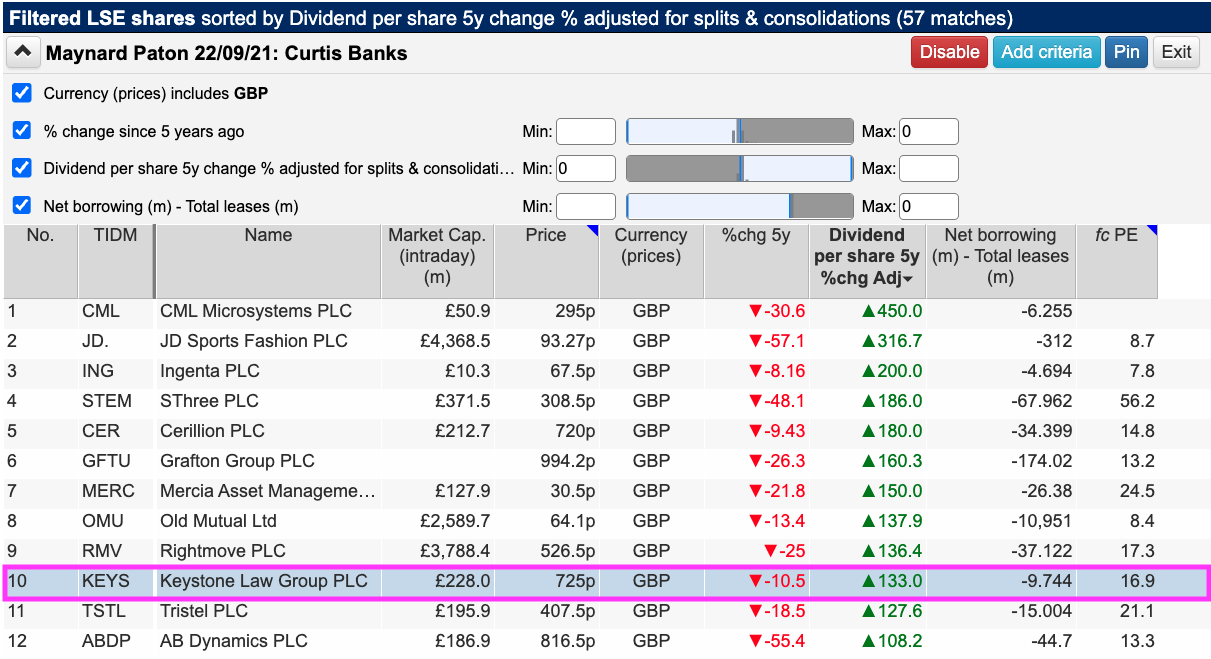
(You can run this screen for yourself by selecting the “Maynard Paton 22/09/21: Curtis Banks” filter within ShareScope’s knowledgeable Filter Library. My instructions show you how.)
This time the screen returned 57 matches, including Camellia, FRP Advisory and SThree.
I selected Keystone Law because the company’s dividend had more than doubled during the last five years while the latest annual report revealed a chief executive with a £65 million shareholding and a remuneration policy of not paying director bonuses.
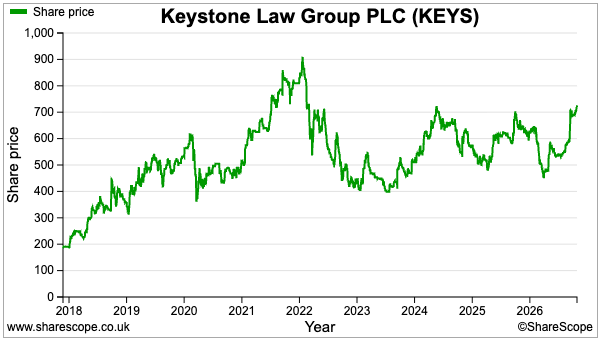
Sure enough, Keystone’s share price remains below the highs achieved five years ago:
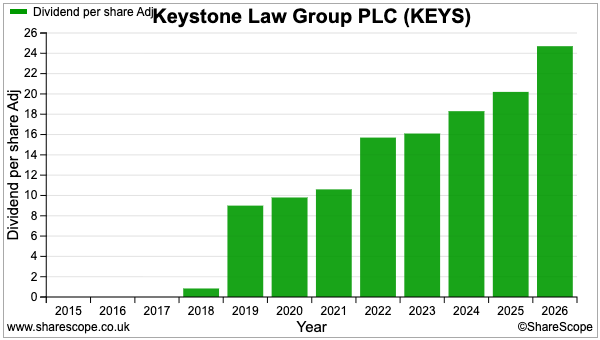
The ordinary dividend has meanwhile been lifted every year since 2018:
Let’s take a closer look.
Introducing Keystone Law
“But in 1999, Asia had crashed and Hong Kong… was just not quite such a great place to be.
And so I came back to the UK and I worked as a consultant for various organisations here and there. I was really looking for an organisation such as Keystone to work with, but I could not find it.
I suppose a lot of businesses are created this way: somebody looks for the service, can’t find it, they decide to make it themselves. And that’s exactly what I did.”
So recounted James Knight during this interview about why he decided to establish what was then called Lawyers Direct during 2002.
After previously working as a commercial solicitor in Oman, Dubai and Hong Kong, Mr Knight returned to the UK and wished to practice law without the office bureaucracy and daily commute associated with traditional legal workplaces.
Conceived initially as a ‘virtual’ law firm, Mr Knight’s operation soon evolved to provide various back-office services to self-employed lawyers, who in turn could then spend more time helping their own clients.
The early years were not plain sailing. Mr Knight recalled:
“The first three years were the toughest. You’ve got nothing really coming in, or if there is, it’s not coming into your own pocket. But also, when you try and do something that is manifestly different in a profession that hasn’t really changed in about 400 years, then you are met with quite a lot of detractors.”
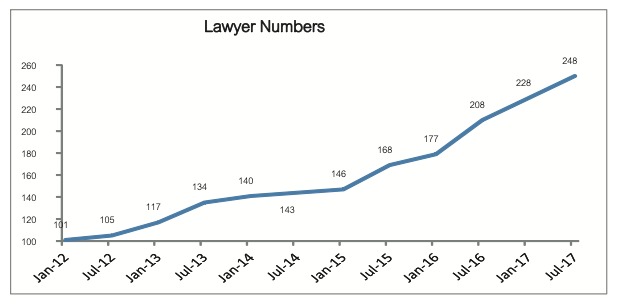
By 2009 Mr Knight’s pioneering concept of a legal-services ‘platform’ was becoming established, with 55 lawyers on the books and a name change to the more sophisticated Keystone Law. Lawyer numbers exceeded 100 by 2012 and private-equity money was taken during 2014 to accelerate the expansion.
Keystone’s flotation document shows lawyer numbers reaching 248 by 2017:
The flotation document also explained the uplift to Keystone’s popularity, noting that “challenger firms” entering the UK ‘mid-market’ of legal services had “eroded the share of work” delivered by traditional law partnerships.
According to the flotation document, traditional law partnerships in turn demanded “greater effort from those in senior associate and junior partner roles to deliver more revenue per head and drive business development whilst still retaining a high level of managerial responsibility.”
The upshot was to create a “significant number of dissatisfied experienced lawyers in conventional mid-market firms who wished to find better ways to service their clients, while maintaining or increasing their own remuneration.”
Enter Keystone, whose ‘platform’ services removed the “challenges and frustrations from a traditional law-firm model.”
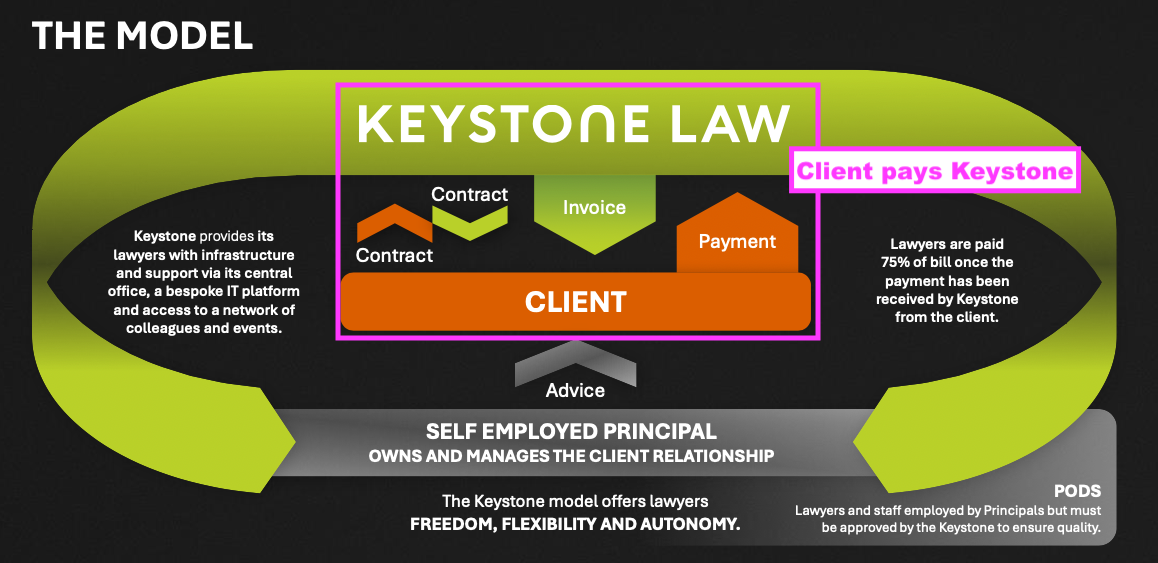
Lawyers join Keystone with their personal client base and, in exchange for approximately 25% of their fees, Keystone supplies the IT, finance, marketing, training, compliance and insurance to support a self-employed legal practice.
Note that the clients pay Keystone direct and the lawyers receive their 75% once Keystone has been paid:
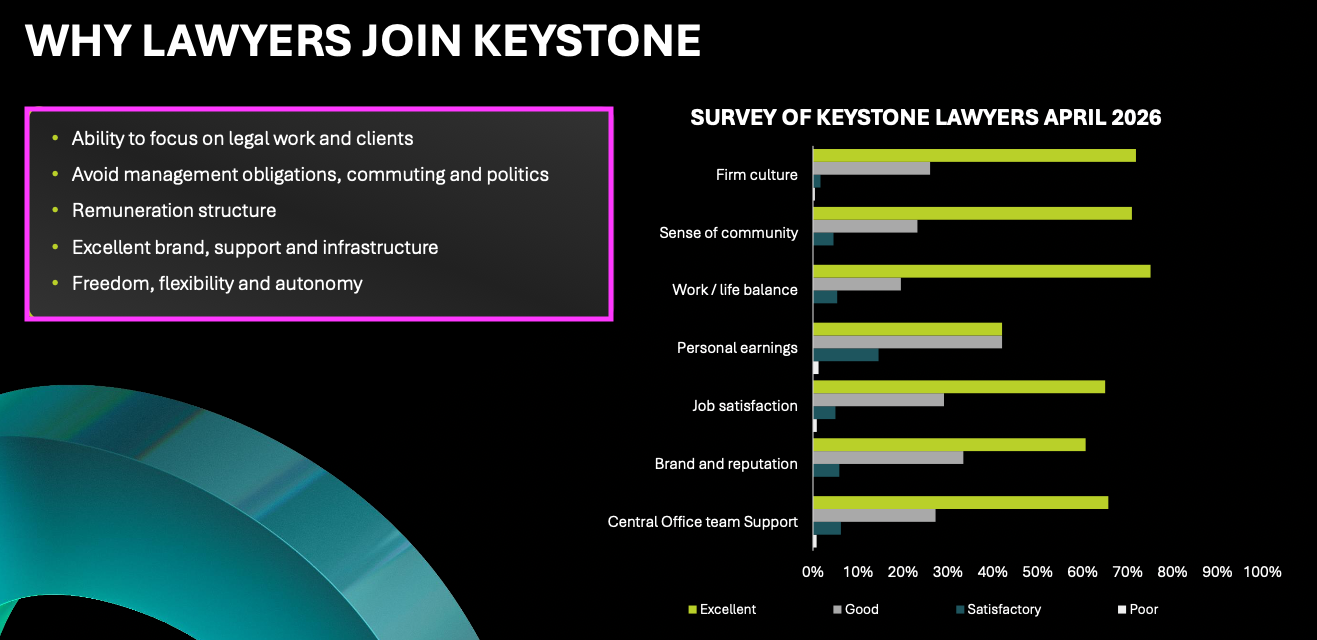
Keystone claims its lawyers earn more for the same work via Keystone than they would in a conventional law firm, and lawyer numbers standing at close to 500 (who in turn employ a further 160-plus associates)…
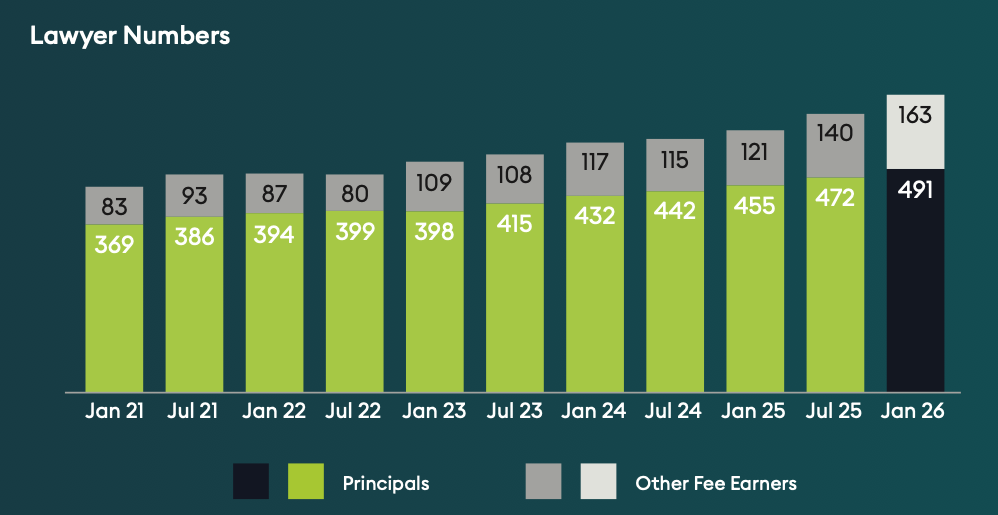
…suggest no shortage of seasoned lawyers wishing to “avoid management obligations, commuting and politics“:
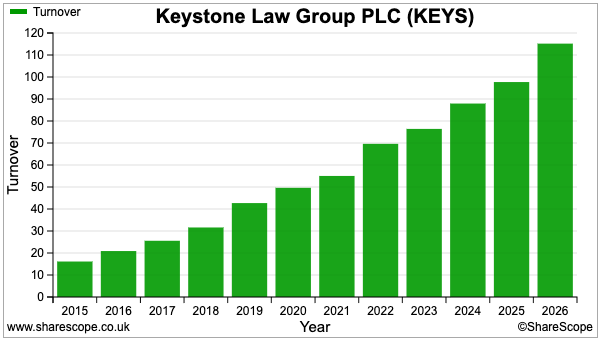
The advancing number of lawyers utilising Keystone has led to this superb revenue chart, which shows the group’s top line surging seven-fold to £115 million between 2015 and 2026:
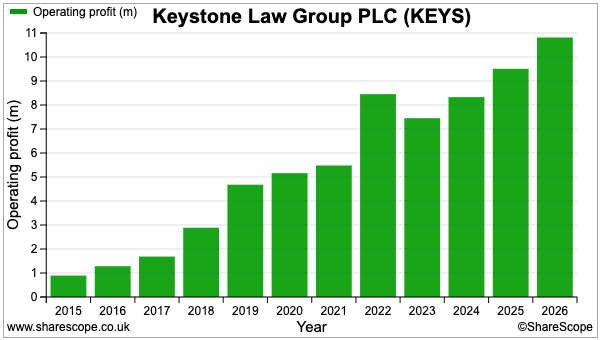
Overlook a presentation change to the accounts for 2023, and operating profit has followed a similarly positive trend from less than £1 million to almost £11 million:
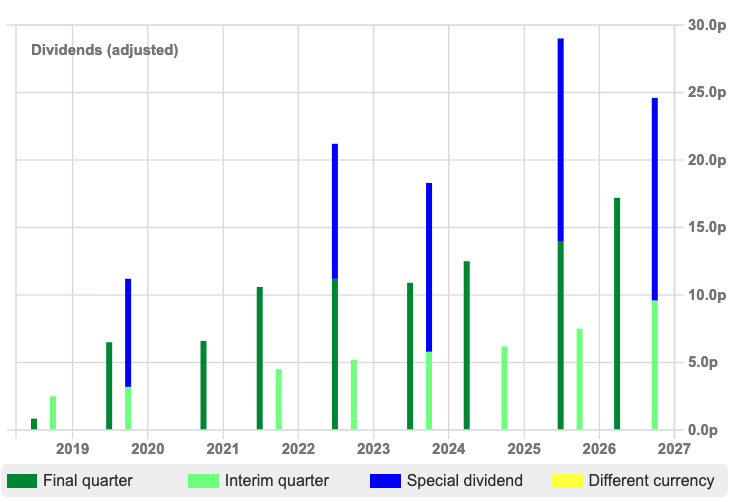
That earlier ordinary-dividend chart omits no less than five special dividends, which aggregate to 60.5p per share and are shown on this next chart in blue:
The shares joined AIM during 2017 at 160p and, as the earlier price chart showed, reached a 910p high during 2022. The recent 725p supports a £228 million market cap.
Lawyers and employees
Keystone’s impressive progress has not been driven solely by recruiting new self-employed lawyers.
Underlining the group’s claim that its model “empowers our lawyers to focus exclusively on the development and delivery of client legal work“, the lawyers have been able to generate more income from their own practices.
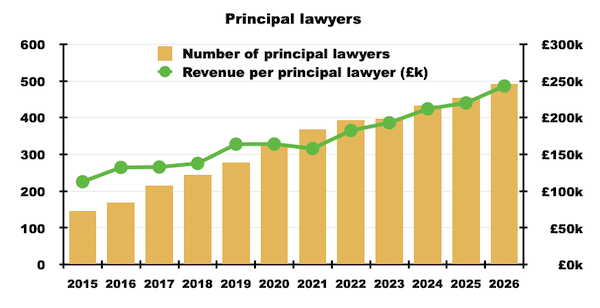
My chart below shows revenue per ‘principal’ lawyer (i.e. the self-employed lawyer who owns the practice) more than doubling to £243,000 since 2015:
Note that Keystone is not dependent on a particular subset of lawyers — no single principal lawyer generates more than 5% of group revenue. Furthermore, revenue is spread across a variety of legal matters:
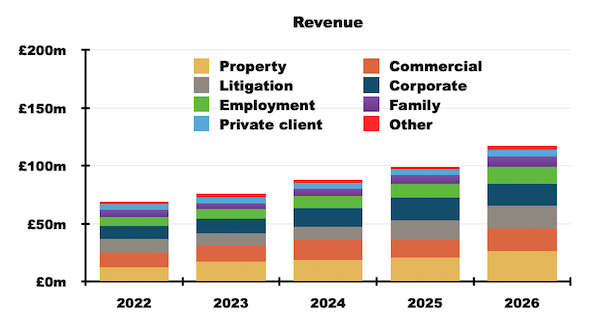
I should add that Keystone has minimal exposure to “high risk, low value” legal areas such as ‘volume’ property conveyancing and ‘volume’ personal-injury claims.
The encouraging improvements to lawyer productivity is probably due to Keystone’s rigorous recruitment criteria. Not every applicant passes the group’s “thorough interview process” and since 2021, only 530 of the 1,560 lawyers applying to join were made an offer. Of those 530, 356 then accepted:
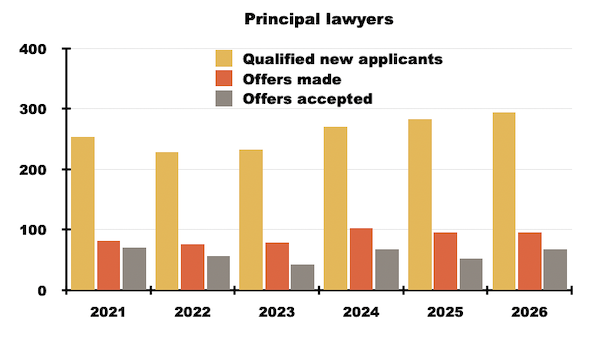
Keystone admits 10% of new joiners are unable to bring enough clients with them, and they typically leave the group within twelve months.
But those joiners who do bring enough clients tend to stay for some time. Just 5% of Keystone’s principal lawyers typically leave every year, mainly due to retirement. The average age of the principal lawyers is 53.
Productivity among Keystone’s own employees is very high. Revenue per employee exceeds £1 million:
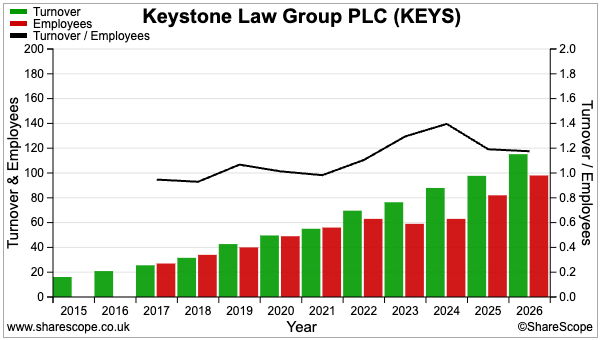
Keystone’s revenue reflects the work undertaken by the self-employed lawyers, and perhaps a a fairer assessment of employee productivity uses gross profit — which is calculated after the lawyers have taken their 75%:
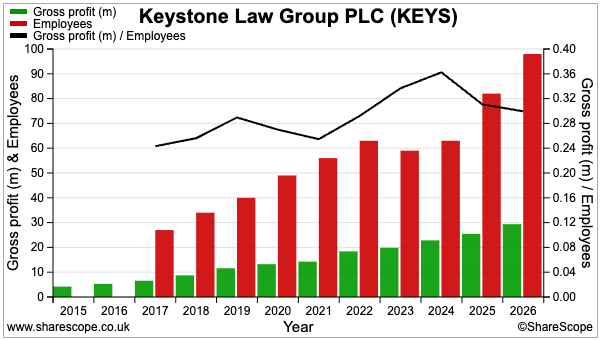
Gross profit per employee at approximately £300,000 is still impressive, and leaves plenty of leeway for shareholder profits with the average Keystone salary at £69,000:
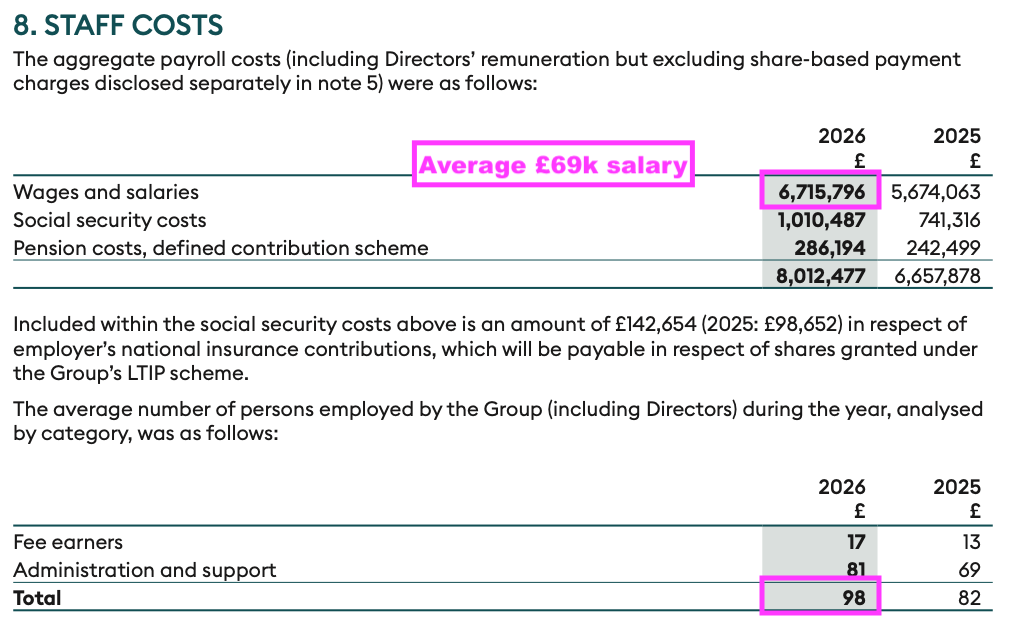
Mind you, employee productivity on both revenue and gross-profit measures has somewhat stagnated of late. I am therefore unsure as to whether Keystone operates a truly ‘scalable’ platform as the group claims.
The evidence from recent years suggests greater income from the self-employed lawyers is counterbalanced somewhat by hiring more head-office staff and paying increased salaries.
Financials
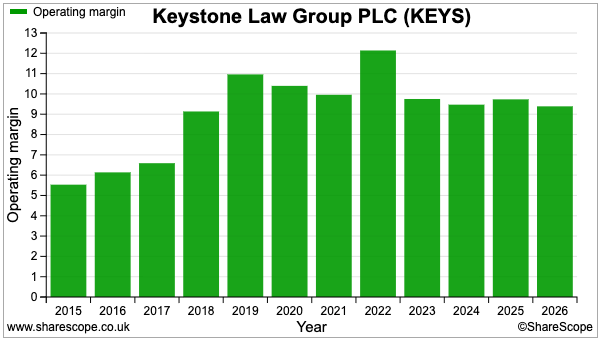
Keystone hiring more staff and paying increased salaries is reflected by the group’s static margin. Operating profit as a proportion of revenue has fluctuated between 9% and 10% since 2023:
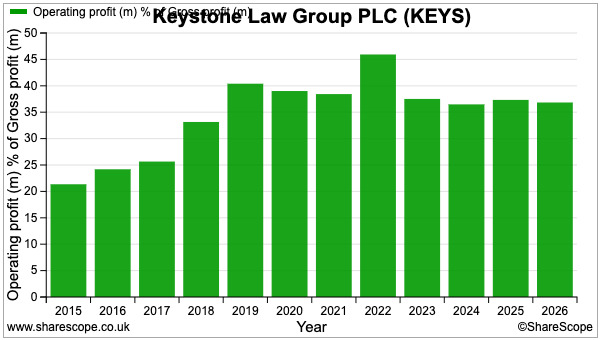
Gross profit may also support a fairer assessment of Keystone’s margin, and operating profit as a proportion of what’s left after the lawyers have taken their 75% is a very healthy — but still static — 35%:
Be aware that ShareScope interprets Keystone’s profits extremely conservatively.
The group’s income statement shows a ‘trade receivables impairment’ and a ‘corresponding reduction in trade payables’:
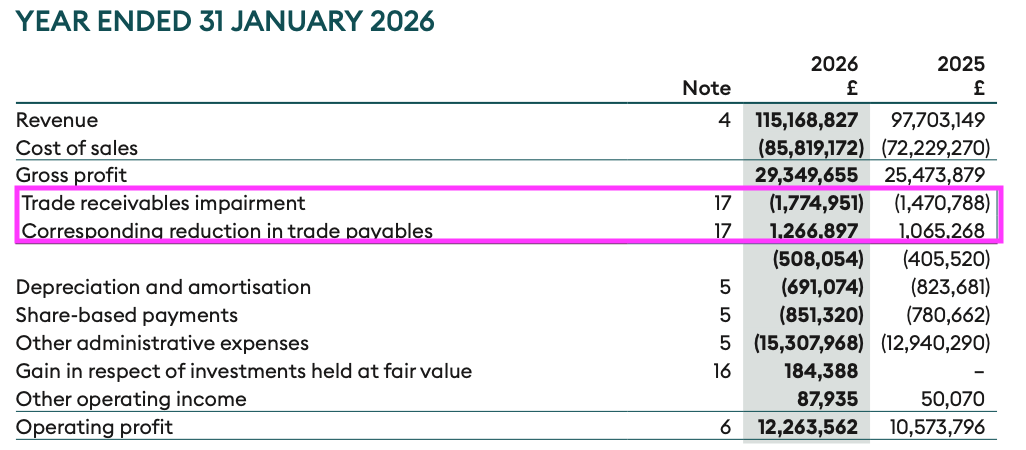
The ‘trade receivables impairment’ reflects losses due to clients not paying their bills, while the ‘corresponding reduction in trade payables’ shows the accounting gain due to the associated reduction to the 75% owed to the self-employed lawyers.
ShareScope reports operating profit including the bill write-offs, but deems the associated gain due to the reduced lawyer payments as ‘other income’:
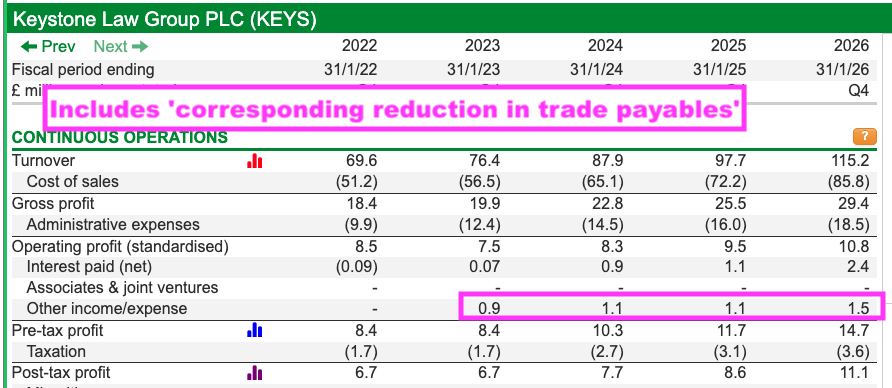
Given Keystone’s lawyers are paid only if Keystone is paid, I would accept Keystone’s accounting format and calculate operating profit including both figures.
The upshot is that, at least in my view, Keystone’s operating profit has been under-reported by ShareScope since the group started presenting ‘trade receivables impairment’ and ‘corresponding reduction in trade payables’ during 2023.
This accounting intricacy does not impact Keystone’s earnings or balance sheet, which combine to show an incredible return on shareholders’ equity.
Since 2019, annual earnings have increased by £7.3 million despite only an extra £5.3 million being added to the balance sheet:
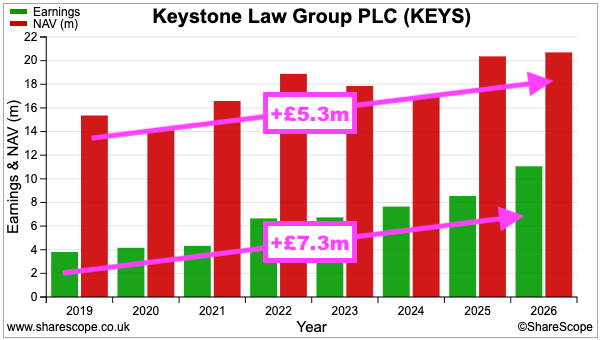
If only all quoted companies could effectively invest their retained profits at a rate exceeding 100%!
Keystone’s balance sheet is comprised mostly of payments owed by clients less the 75% of those payments owed to the self-employed lawyers:
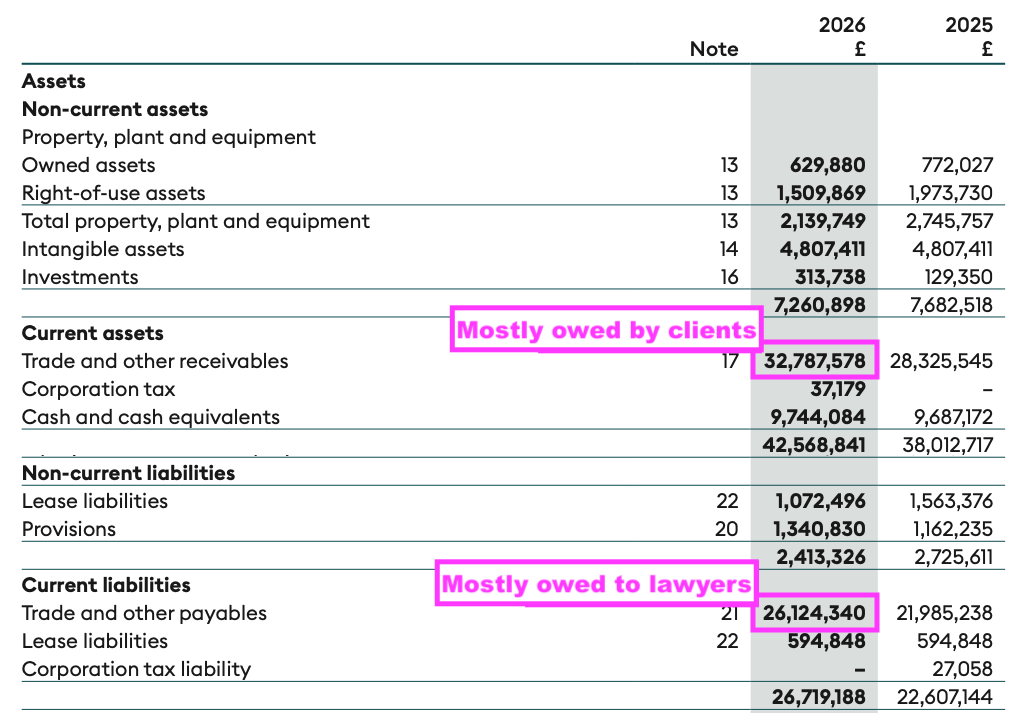
The accounts indicate many clients are extremely reluctant to pay their bills:
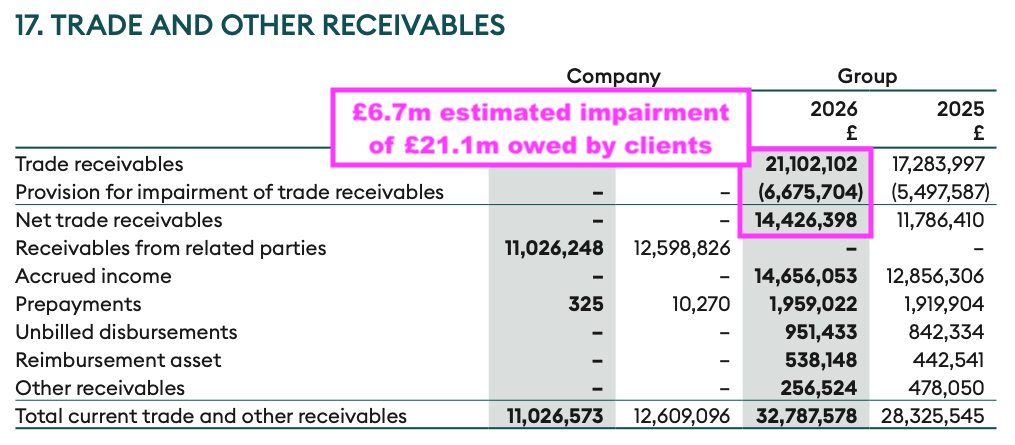
Of the £21.1 million invoiced to clients at the 2026 year end, some £6.7 million — or 32%! — was expected not to be collected. I now understand why Keystone pays the self-employed lawyers after the group has been paid!
Cash conversion appears very acceptable. Free cash as a proportion of reported earnings has averaged more than 90% since the flotation:
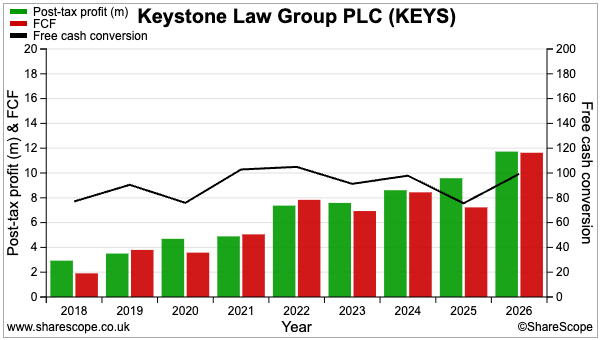
The cash-conversion dip during 2025 reflected the costs of a new head office and the timing of tax payments.
The 2017 flotation raised £9 million and cleared the group’s borrowings:
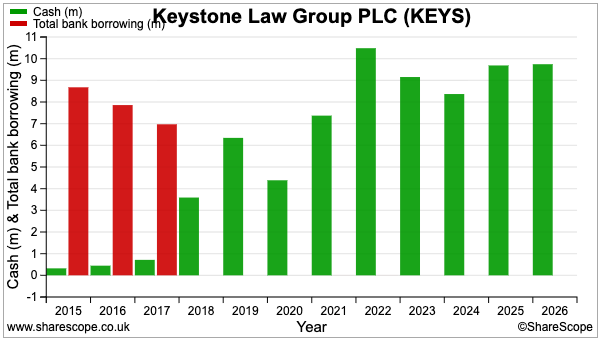
Year-end cash last stood at almost £10 million despite more than £48 million paid as dividends as a quoted company.
The most intriguing entry within Keystone’s 2026 accounts is the £3 million interest received:
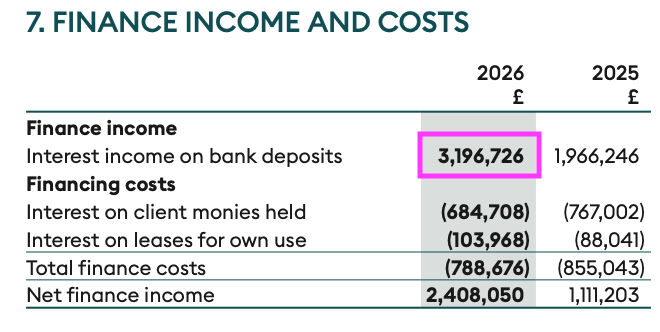
Keystone clearly did not earn £3 million interest purely from its own near-£10 million bank balance.
The group instead earned the bulk of that £3 million from segregated money held on behalf of clients to administer matters such as property transactions, compensation settlements and inheritance distributions.
Last year’s £3 million interest supported a very significant 22% of pre-tax profit. And yet Keystone does not explicitly confirm the client-account source of its interest within its annual reports — which is very poor form.
Keystone’s bumper interest receipts now look under threat. Earlier this year the Ministry of Justice launched a consultation that proposed the government taking at least 50% (and possibly up to 100%) of interest received on client balances “as a way for the legal sector to contribute more to the justice system it relies on“.
Management claimed during this recent webinar that “everyone responded, from the industry, negatively to the proposal” although recent broker notes are “building in a decreasing interest income over the coming three years“.
The absence of client-money disclosure aside, Keystone’s post-flotation accounts do appear very sound with no complications from acquisitions, exceptional items and restatements.
I must add that presenting the accounts to the nearest £1 — instead of the usual nearest £1,000 or £100,000 — implies a very welcome level of bookkeeping precision.
Boardroom
Founder James Knight encouragingly remains on the board as chief executive. His annual-report biography says he concentrates on Keystone’s “business development, marketing and other drivers of growth“:

ShareScope shows Mr Knight retaining a 28% shareholding valued at £65 million:
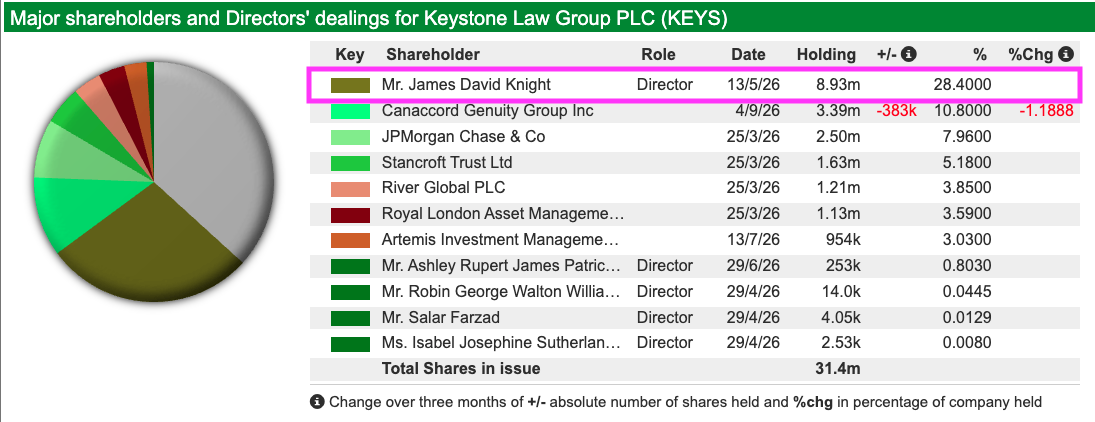
Mr Knight reduced his ownership by only 10% at the flotation and has since sold a further 22%. His largest disposal took place during 2021 and raised £9 million at 630p, while his latest sale was conducted during 2024 and raised £250,000 at 651p.
Mr Knight’s sizeable stake ought to give him an ‘owner’s mindset’, and I believe his shareholding plus the aforementioned record of dividend advances and special payouts are not coincidental.
Mr Knight has in fact collected £2.4 million through ordinary dividends during the last twelve months and the other week pocketed £1.3 million via the latest special payout.
I would therefore not quibble with Mr Knight’s £368,000 salary (up 3% a year since the flotation) nor with his very modest £10,000 annual pension benefit:
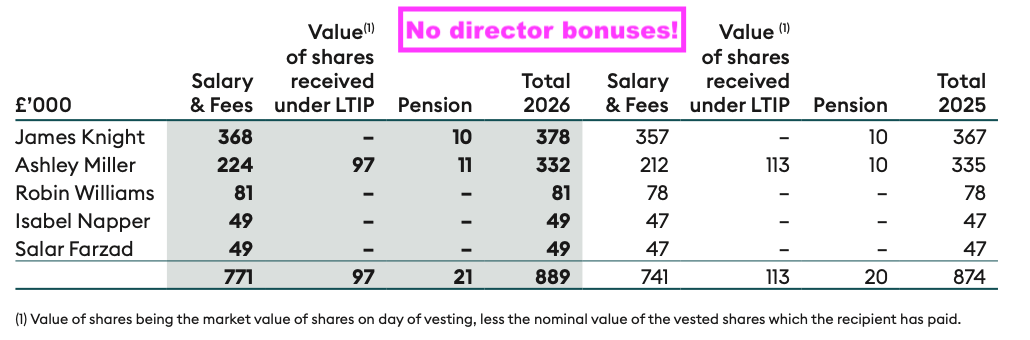
Notably, neither Mr Knight nor his finance director are paid bonuses — a highly commendable policy, especially given Keystone’s impressive profit progress.
But the finance director does enjoy an LTIP, although the exact vesting targets are sadly not disclosed. The LTIP appears under control, with total staff awards potentially diluting the present share count by just 2%.
Mr Knight is 59 years old and I would like to think he will continue to lead Keystone for some time.
Valuation and verdict
September’s interim results revealed a very positive six months:
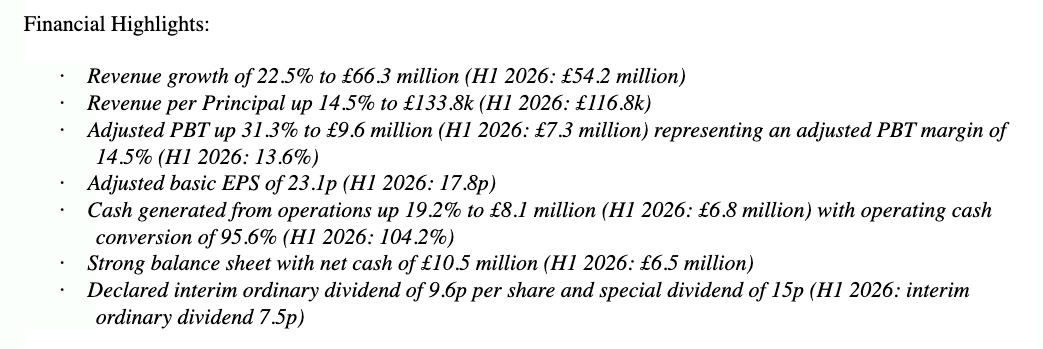
Mr Knight said the “excellent financial performance” was supported by “strong demand across the business, continued recruitment of high-calibre lawyers and disciplined investment in our platform” , which had all “further strengthened our market-leading position.”
First-half revenue per principal lawyer gaining 14.5% alongside a “positive start” to the second half prompted Mr Knight to predict “2027 revenue comfortably ahead and profits materially ahead of current market expectations“.
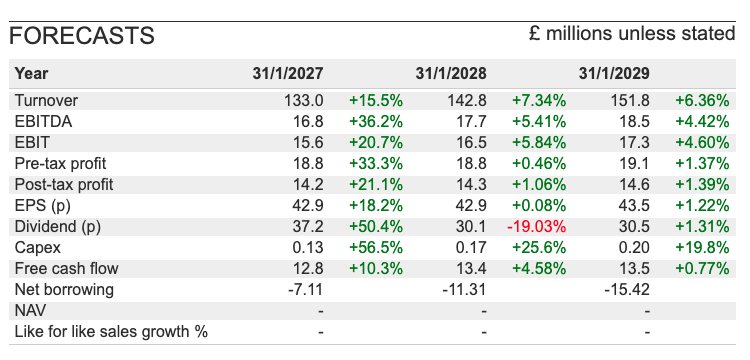
Prior to the results, brokers had projected revenue of £123 million and a pre-tax profit of almost £16 million for 2027. ShareScope now shows revenue of £133 million and a pre-tax profit of almost £19 million:
September’s profit upgrade followed statements lifting profit guidance by varying degrees during September 2024, February 2025, September 2025, February 2026 and April 2026. During the same time, forecasts for 2027 pre-tax profit have advanced by £6 million:
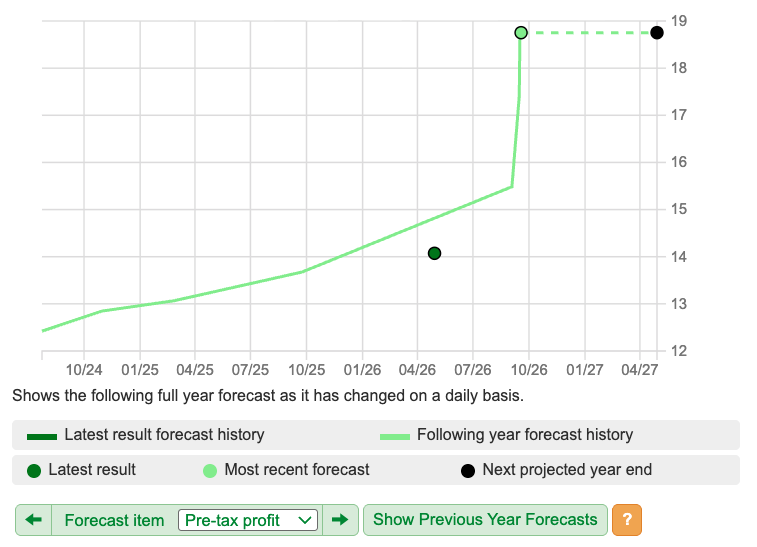
The welcome run of profit upgrades do make the consensus 2028 and 2029 projections of low single-digit growth appear extremely cautious.
For now though, the 725p shares trade at 17x forecast 2027 earnings. The present multiple is less than half of that witnessed when the price peaked during 2022:
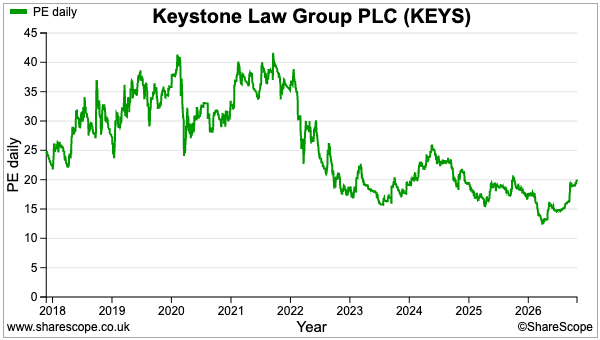
The P/E history above explains why Keystone shares are down during the last five years despite the positive financial progress… the market during 2021 simply over-valued the potential at a hefty 40x earnings.
ShareScope’s reported 2027 dividend forecast includes the welcome 15p per share special declared within the recent interims, but I assume the 30.1p per share prediction for 2028 is for the ordinary payout only.
A 4.2% ordinary income is therefore possible for the year after next, but do note Keystone has to date declared total dividends equivalent to 90% of aggregate earnings since the flotation.
Applying that 90% to the predicted 2027 earnings of 42p per share gives a blended ordinary/special payout of 38p per share, which supports an arguable 5.2% income assuming the rate of specials continues.
The aforementioned run of profit upgrades tells me the specials are more than likely to continue, meaning Keystone can be summarised as a ‘quality’ income idea that offers owner-friendly leadership, very respectable accounts, self-motivated revenue-earners alongside considerable growth potential — Keystone’s legal-services market is worth £14 billion a year.
Downsides include Ministry of Justice interference with interest receipts and static profit margins not demonstrating a truly ‘scalable’ model.
Plus there is the dreaded question about the impact of AI. Mr Knight reckons clients dealing with complex transactions, high-value assets or sensitive family matters are very unlikely to take legal advice from a computer. Courts meanwhile are “plagued” by AI errors.
All told, I can’t really fault Keystone and must rank the company among the best I have reviewed for ShareScope. I am pleased I could identify the shares using a very simple screen and I am a buyer at the right price.
Until next time, I wish you safe and healthy investing with ShareScope.
Maynard Paton
Disclosure: Maynard does not own shares in Keystone Law.
This article is for educational purposes only. It is not a recommendation to buy or sell shares or other investments. Do your own research before buying or selling any investment or seek professional financial advice.