
A screen for high margins and high ROEs identifies the attractions of FRP Advisory. Maynard Paton studies the insolvency specialist’s growth history, employee productivity, founder leadership and modest rating.
Today I have revisited a ShareScope screen that applies two ratios favoured by ‘quality’ investors — operating margin and return on equity (ROE).
The exact criteria I re-used were:
- An operating margin (latest and ten-year average) of 20% or more, and;
- An ROE (latest and ten-year average) of 20% or more.
Any business with a margin and ROE of at least 20% is probably quite special.
To narrow the field down further, I also sought companies that carried net cash (i.e. net borrowings excluding IFRS 16 finance leases of less than zero):
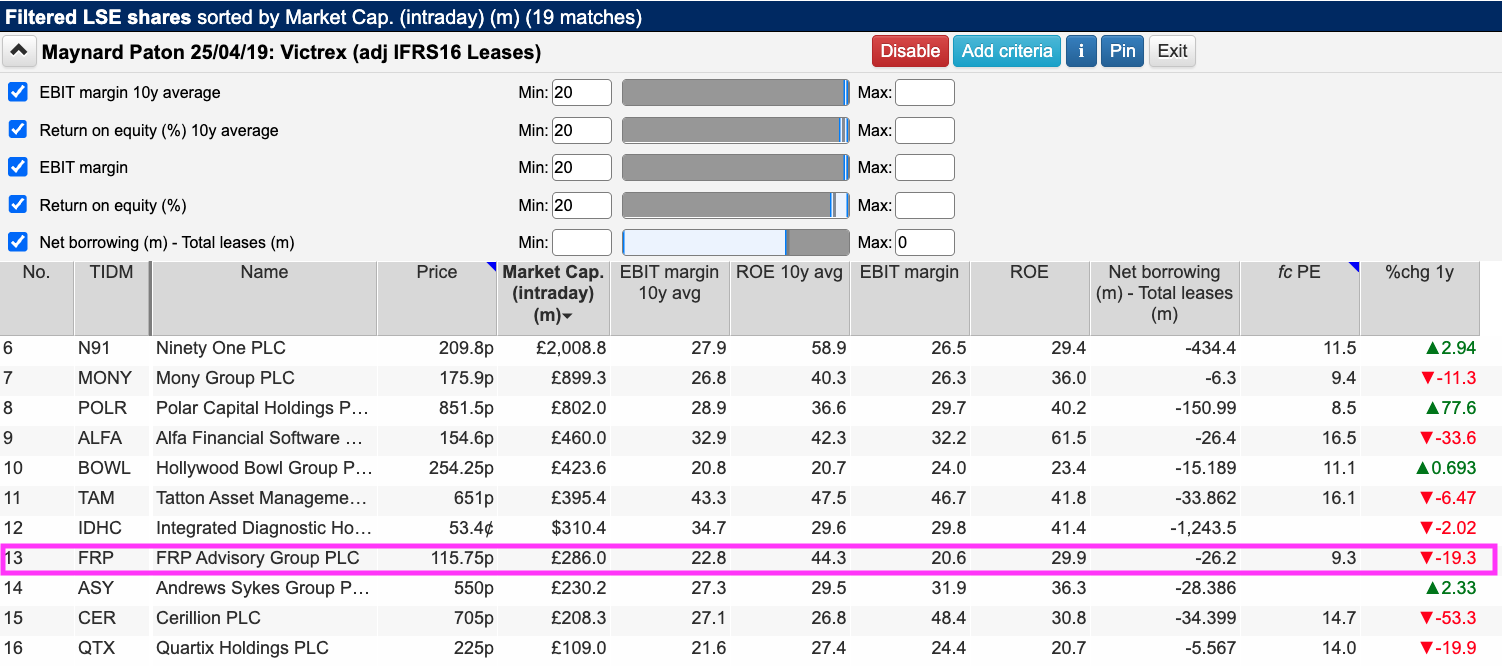
(You can run this screen for yourself by selecting the “Maynard Paton 25/04/19: Victrex” filter within ShareScope’s fantastic Filter Library. My instructions show you how.)
This time the filter returned 19 matches, including AJ Bell, Alfa Financial Software and Hollywood Bowl. I selected FRP Advisory primarily because the shares have declined 19% during the last twelve months and now trade on a P/E of less than 10x.
Let’s take a closer look.
Introducing FRP Advisory
“FRP came about primarily due to opportune timing… The organisation we were working for at the time was failing, but we recognised that our division… was successful. It had achieved critical mass and was run by a group of really good people. We saw the opportunity to take that forward and, most importantly, to ensure that our 200 colleagues would not be made redundant.”
So recounted Geoff Rowley during this interview about how he and Jeremy French founded FRP Advisory following the collapse of their employer during 2010.
Their employer was accountancy firm Vantis, and the pair led an £11 million management buy-out of the failed group’s ‘business recovery services’ division.
Those ‘business recovery services’ handled all types of corporate insolvencies, including administrations, liquidations, voluntary arrangements, receiverships and bankruptcies… which is somewhat ironic given Vantis went bust.
Mr French explained how what went wrong at Vantis helped FRP establish a different operating and ownership structure:
“We had the benefit of seeing how not to do some things… We’d come from a plc background, where information is only shared up to a certain level. That shaped our formulation of FRP Advisory because it made us realise the importance of transparency. What we came up with was a partnership owned by all of [our] partners – not just a few – right from the beginning.”
The next decade then witnessed Rowley and French increase FRP’s partner count from 29 to 50 through recruitments, promotions and four small acquisitions.
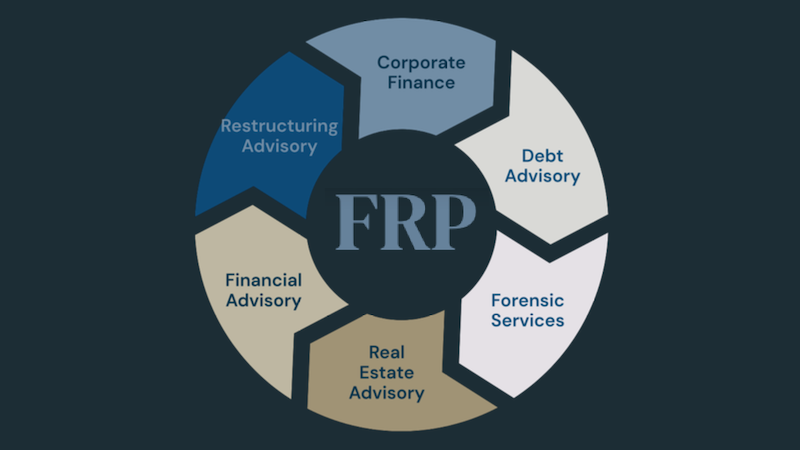
The expansion broadened the group’s insolvency activities to include wider corporate-finance consulting, debt-advisory services, forensic-accounting work and pension-scheme guidance.
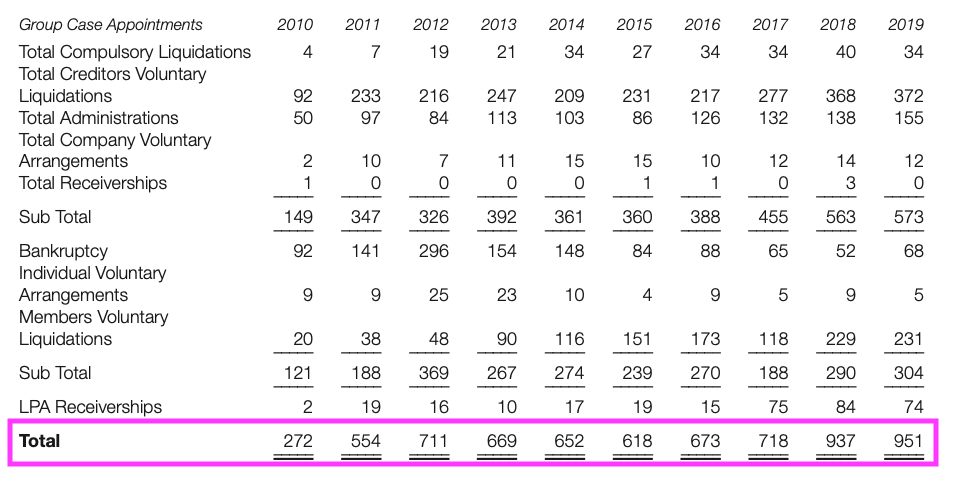
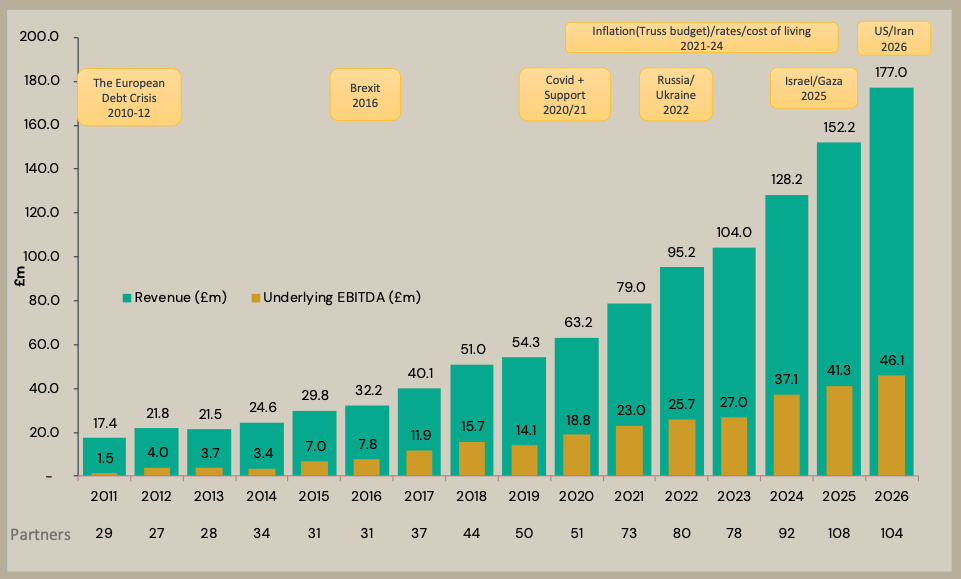
FRP’s early partnership structure certainly appeared successful. Insolvency appointments trended higher between 2010 and 2019…
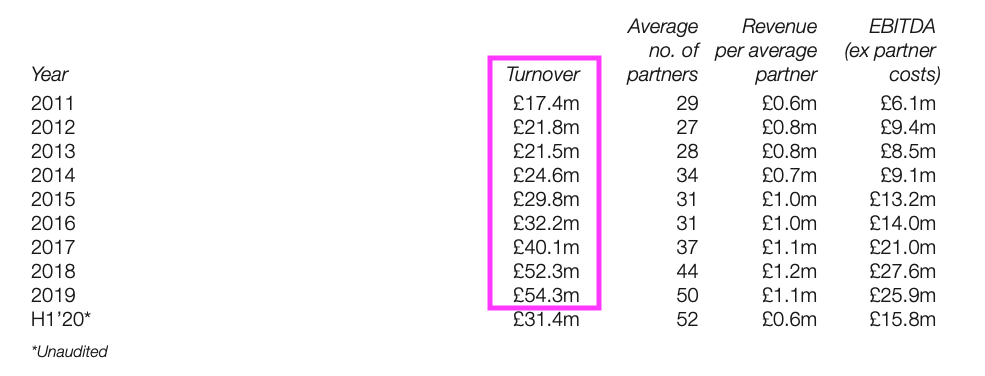
…which led to revenue advancing from £17 million to £54 million:
Insolvency services can be very lucrative. Only authorised insolvency practitioners (IPs) can undertake such work, and prospective IPs typically require three years of practical insolvency-handling experience before becoming formally qualified through the JIEB exams. IPs must also satisfy a professional body that they are a ‘fit and proper’ person.
Government statistics show only 1,500 or so IPs are currently active and competition among them may therefore be limited. IP fees are generally paid from the proceeds of the insolvent company’s assets and rank second only to secured creditors in payment priority.
FRP’s insolvency work is won through group partners actively cultivating a referral network of banks, other lenders and law firms, and ensuring the group maintains ‘panel representation’ with those organisations for appointment shortlisting.
FRP says its presence on lender panels in particular is supported by the group’s “continued focus on clear, pragmatic and high-quality advice” alongside the “breadth of our service offering“.
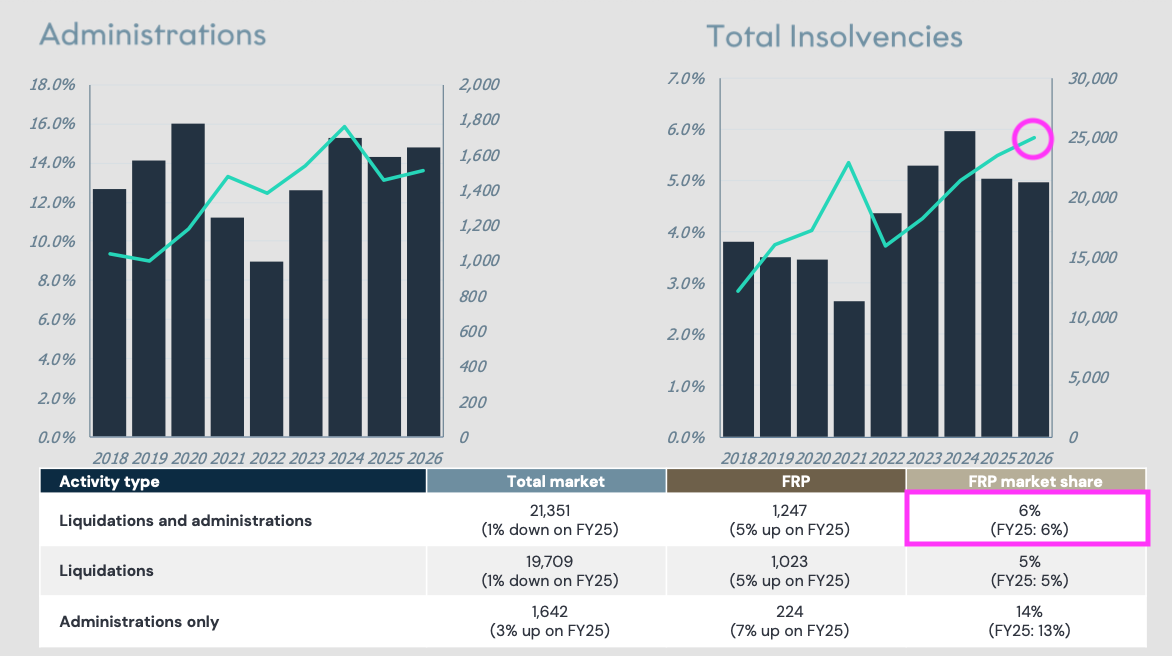
FRP’s latest results claimed a 6% market share of all liquidation and administration work:
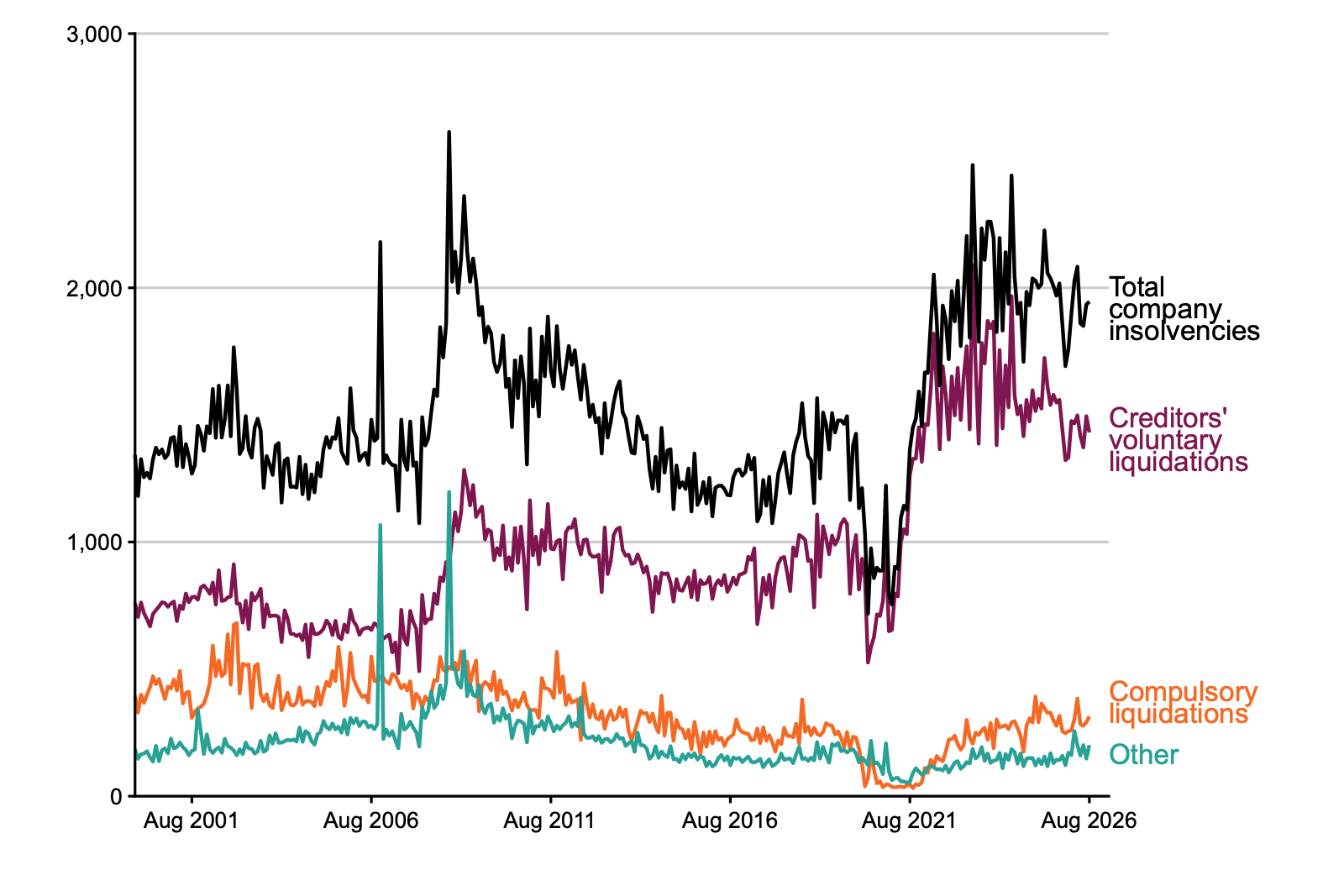
Government statistics meanwhile show company insolvencies running at approximately 2,000 per month and on a par with levels witnessed during the 2008/09 banking crash:
FRP’s website spotlights insolvency case studies such as Body Shop, Carluccio’s and Monsoon.
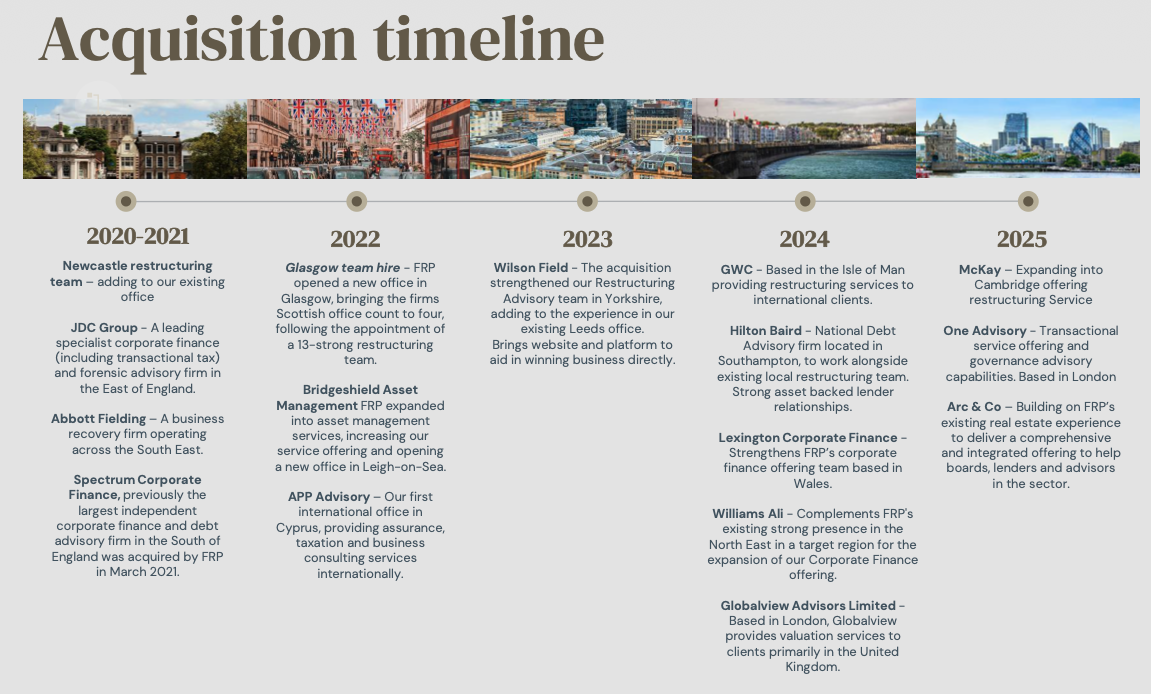
The group joined AIM during 2020 and has since undertaken 16 additional acquisitions:
The extra acquisitions have helped revenue reach £177 million:
Operating profit meanwhile tops £35 million:
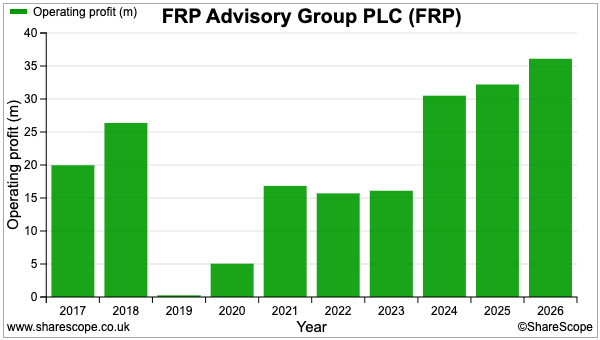
(Note: FRP’s reported pre-flotation profitability was influenced considerably by the accounting for partner remuneration. Such remuneration was effectively deemed as a dividend during 2017 and 2018, but then included as an operating expense for 2019 that left a minimal 2019 profit. Profits for 2017 and 2018 calculated on the same 2019 basis would have been minimal as well).
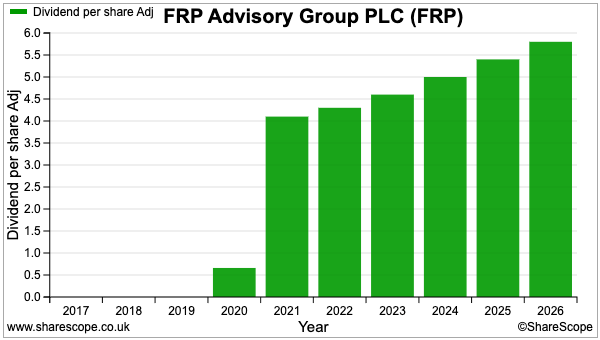
The dividend has experienced regular uplifts, with payouts commendably declared quarterly:
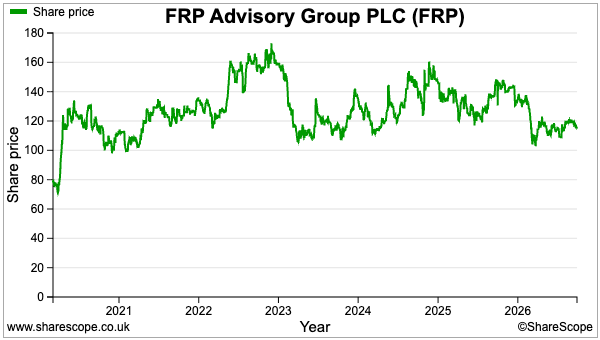
Priced initially at 80p, the shares have unfortunately not yet set the market alight:
Partners and employees
FRP is very much a ‘people’ business and the group’s latest results confirmed progress was “underpinned by the quality, commitment and professionalism” of the employees.
Unsurprisingly then, the first ‘principal risk’ identified within FRP’s annual reports confirms the group is “significantly dependent” on partners and IPs:
“The Group’s performance and continued growth are significantly dependent on the expertise, relationships and reputation of its Partners and employees. In particular, the Group relies on its Licensed Insolvency Practitioners to lead and deliver insolvency and restructuring engagements, which represent the majority of Group revenue.”
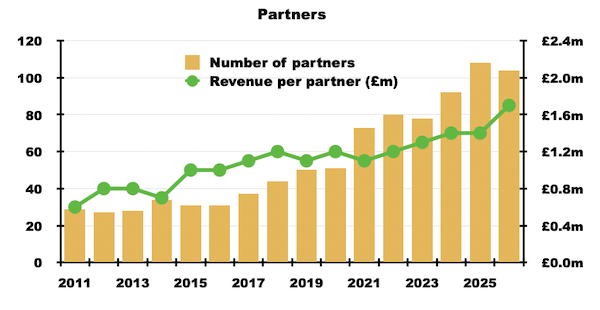
That significant dependence is reflected by 30% of 2026 revenue being generated by the top ten partners:
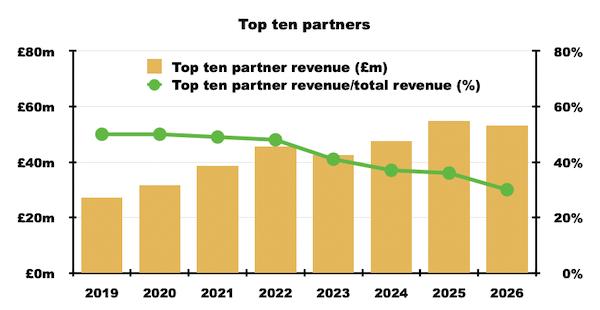
Although the top-ten proportion used to be 50%, the stats do make you wonder what FRP’s other 90-odd partners were doing last year. Revenue per partners 1-10 averaged £5.3 million versus only £1.3 million for partners 11-104.
Still, revenue per partner overall has advanced to £1.7 million since the group’s formation:
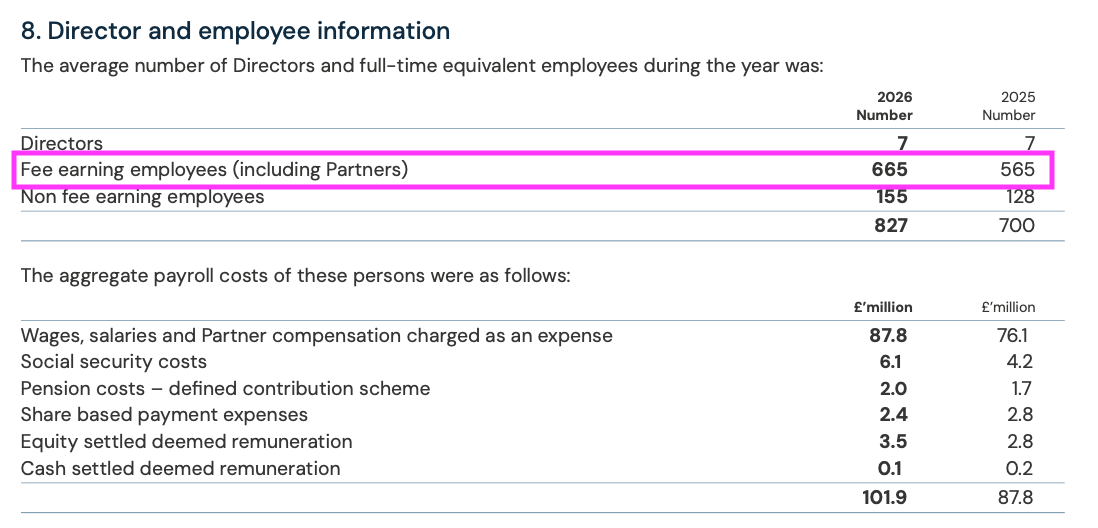
Note that as well as partners, FRP also employs other ‘fee-earning’ staffers:
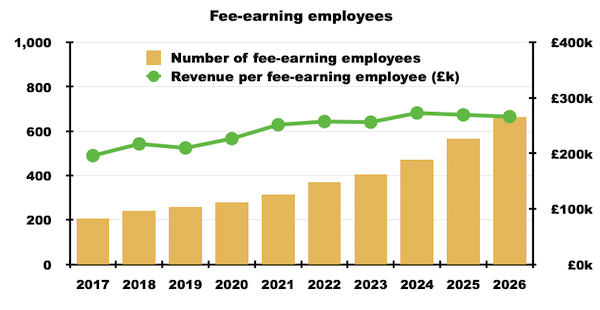
Revenue per fee-earning employee (including partners) has bobbed around £260,000 since 2021:
Revenue per total employee has meanwhile stabilised around the £210,000 mark:
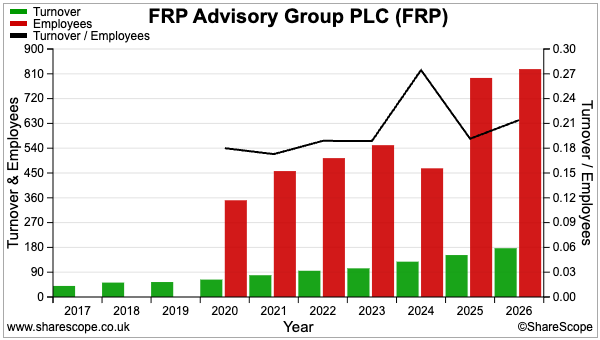
While partner productivity has enjoyed respectable improvements, total employee productivity seems to have stagnated somewhat. The cause could be FRP recruiting proportionately more non-partners since going public — the number of non-partners for every partner was 6.9 last year versus only 4.4 during 2021.
Employee productivity does not seem to be helped by FRP’s staff utilisation history. Utilisation has been kept between 60% and 70% and the target is the “high sixties“:
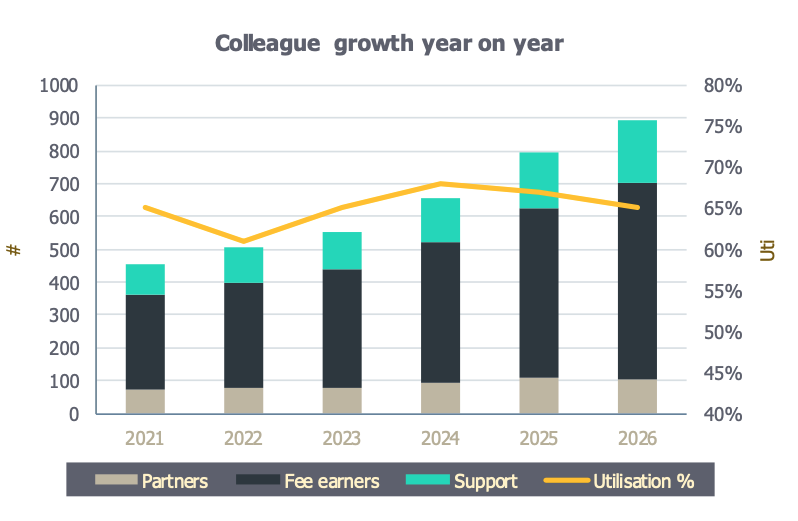
FRP says utilisation is calculated as “the percentage of available hours that FRP colleagues spend on chargeable activities“, although the group does not specify whether “FRP colleagues” means all the employees or just the fee-earners.
The utilisation calculation also states “available hours” are based on “a standard 7.5 hour day“, although I suspect many partners work longer hours.
Staff pay is not low. The average wage, salary and ‘partner compensation’ per employee last year was £106,000 and has averaged £102,000 since the flotation. I dare say a notable part of the £88 million paid to employees last year found its way to the top ten partners who supported the aforementioned 30% of revenue.
Financials
Chunky employee pay has not stopped FRP from earning very respectable margins. The last three years have witnessed at least 20% of revenue convert into profit:
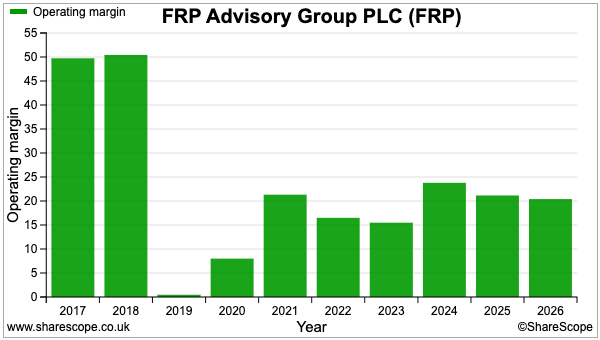
(Note: FRP’s reported 50% operating margins for 2017 and 2018 were influenced considerably by the aforementioned pre-flotation accounting for partner remuneration.)
Bear in mind FRP’s margin could even be a little higher if you, as the group does, exclude share-based payments and ‘deemed remuneration’ to arrive at the ‘adjusted’ figures:
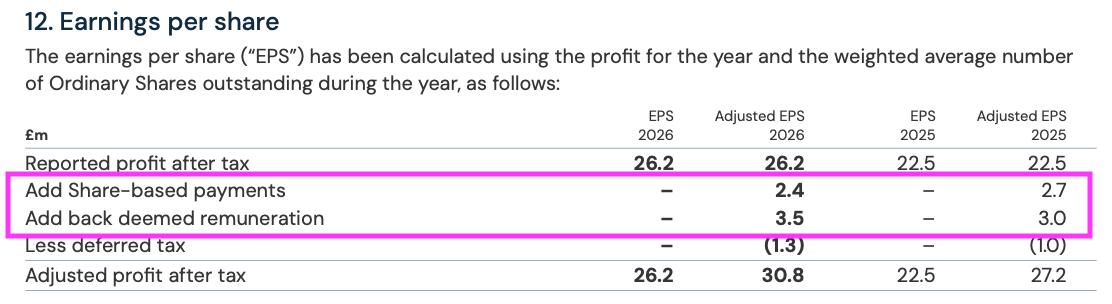
‘Deemed remuneration’ reflects the cost of the shares given to the vendors of acquisitions. This expense — £13 million since flotation — is in addition to the £41 million cash spent on those 16 acquisitions:
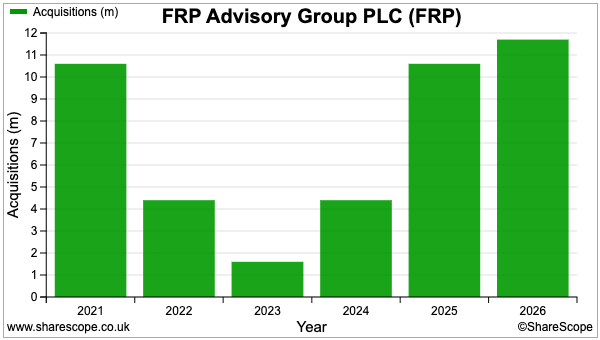
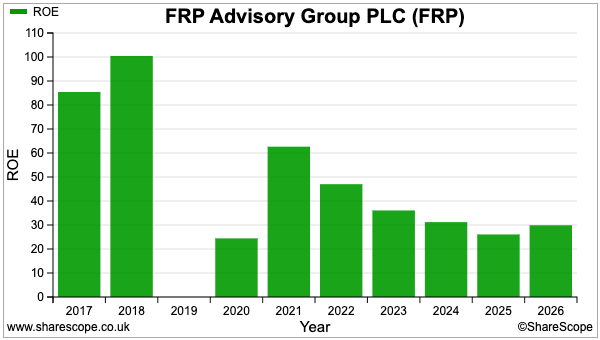
The acquisition expenditure appears to have been worthwhile. Conventional ROE calculations show recent returns surpassing 25%…
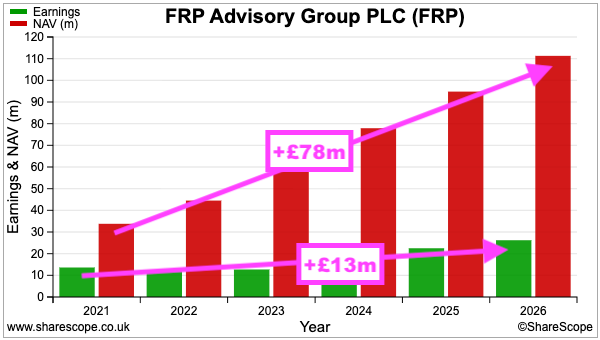
…while the incremental ROE between 2021 and 2026 is a worthwhile 17% after additional shareholder equity of £78 million delivered additional earnings of £13 million:
FRP claims organic annual revenue growth following the flotation has been +15%, +11%, +8%, +19%, +11% and then +10% for 2026, which feels rather impressive and supports the notion FRP has enjoyed some ‘2 + 2 = 5’ economics with its M&A.
I also calculate the major purchases brought in initial extra revenue of £40 million, versus a total £100 million or so revenue added since joining AIM.
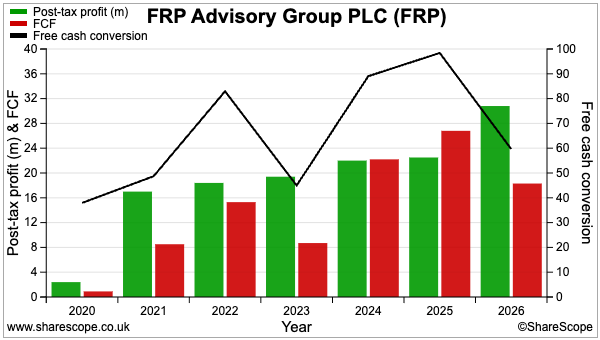
Cash conversion has not been perfect…
…and the main culprit appears to be working-capital investment:
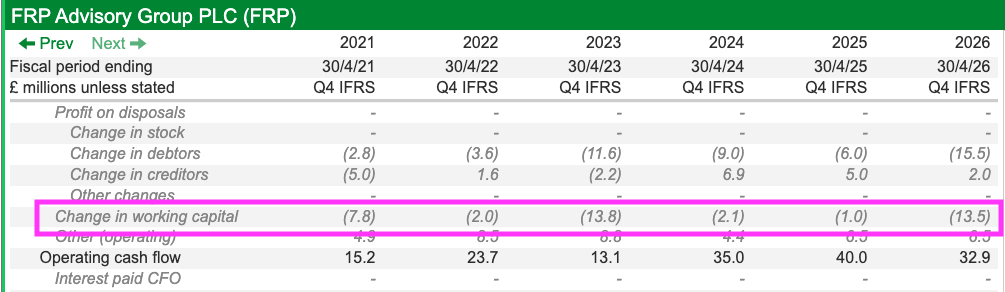
FRP’s working capital is primarily ‘unbilled revenue’…
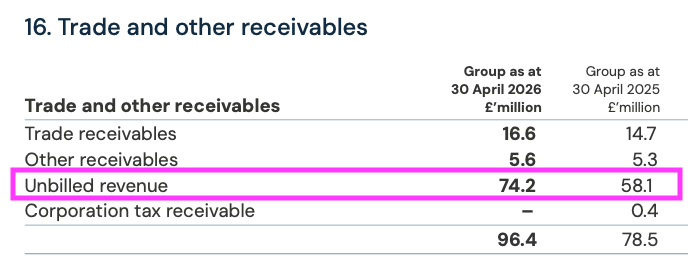
…which reflects revenue recognised in the accounts but where FRP “does not yet have an unconditional right to invoice“.
In other words, FRP has estimated how much the company is owed for some of its IP work, has not yet sent an invoice… but has booked the amount as revenue anyway.
FRP says its IP work typically remains ‘unbilled’ for between five and seven months, which will always create a gap between reported profit and cash being received.
Despite the hefty acquisition outlay and money spent on yet-to-be-invoiced work, FRP’s balance sheet has been consistently net cash positive:
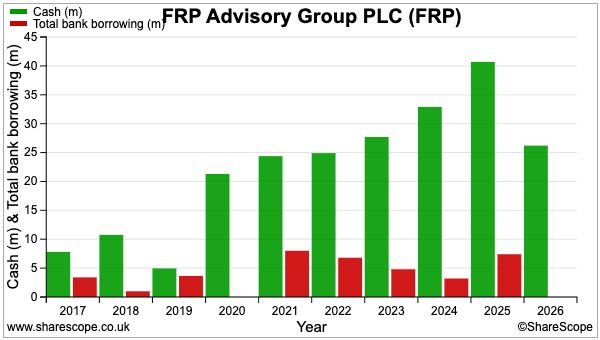
Net cash last stood at a healthy £26 million, with funds supported by £20 million raised at the flotation and a further £7.5 million raised during a 2022 placing.
Boardroom
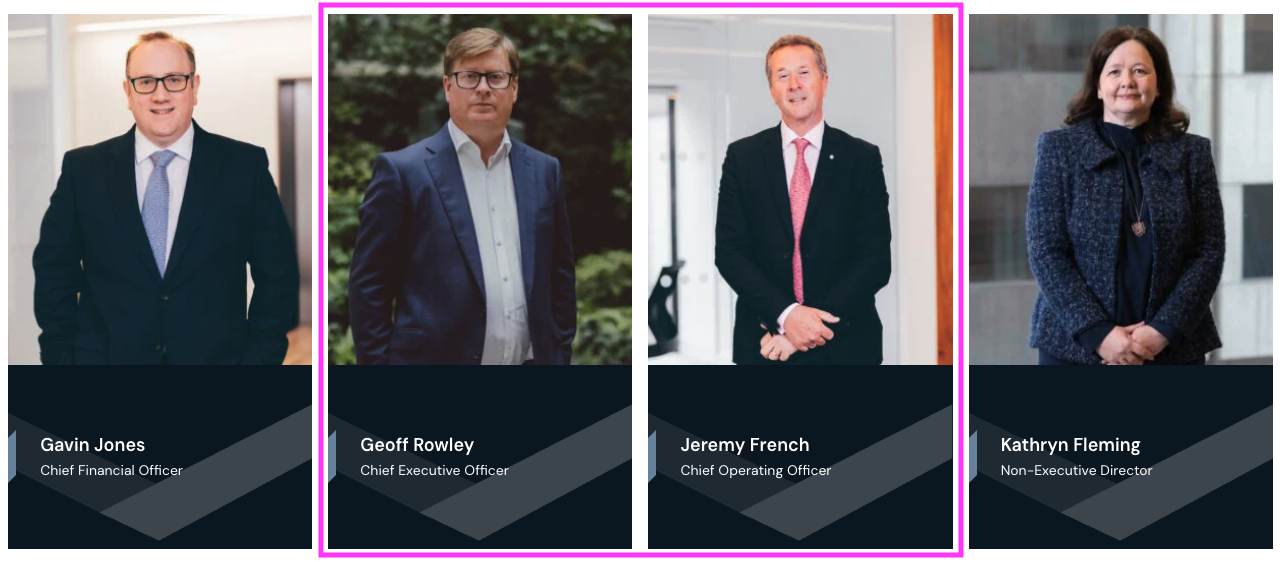
Co-founders Geoff Rowley and Jeremy French both remain involved with the day-to-day running of FRP. Mr Rowley still serves as chief executive while Mr French continues to act as chief operating officer:
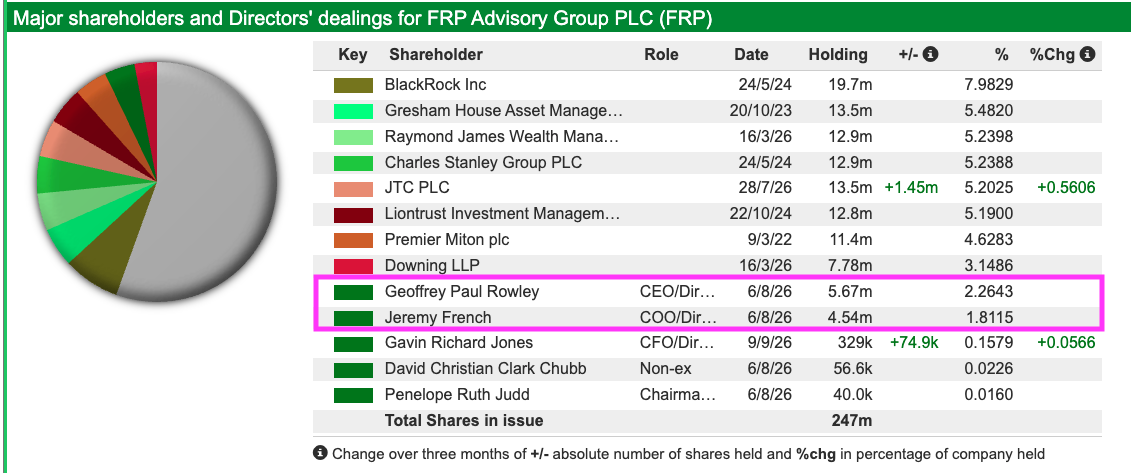
The co-founders have used AIM to reduce their shareholdings. Both sold 39% of their stakes at the flotation and have since sold a further 40%. Their last disposals were conducted during 2024 at 128p per share.
Mr Rowley now holds a 2.3%/£6 million stake while Mr French presently owns a 1.8%/£5 million stake:
FRP’s executive pay structure reflects the partner-type nature of the business. Base salaries for Mr Rowley and Mr French are a very modest £12,000, which are then bolstered by a fixed £315,000 ‘partner base profit share’ (which rises to £400,000 next year) alongside a variable ‘partner profit allocation’:
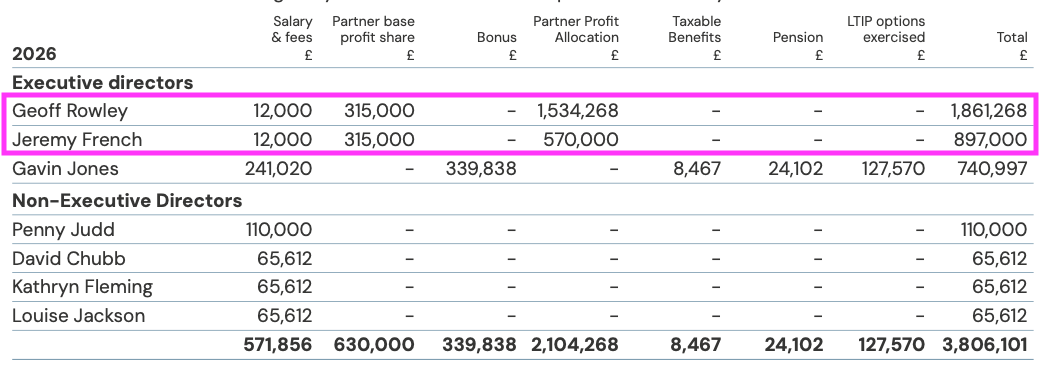
Aggregate remuneration for the two co-founders has been a very useful £14 million since the flotation. Neither Mr Rowley nor Mr French hold any LTIPs, but the finance director is an LTIP holder and requires earnings to compound by at least 6% for his award to pay out.
Mr Rowley is 55 years old and, if Mr French at 68 is any guide, may continue to steward FRP for many years to come.
Although FRP’s quoted track record does not indicate obvious leadership drawbacks, not everyone was happy with the way the group was established after Vantis failed.
Financial blogger Ian Fraser in particular was scathing about certain employees abandoning Vantis for new ventures: “Sources assure me the culture that pervaded at Vantis — “inflated egos looking for any way to inflate the share price” — will carry through to the successor outfits“.
AccountancyAge meanwhile cast doubt over the Vantis administration process, with IPs apparently lined up months before Vantis finally went under.
But 16 years on from FRP’s formation, shareholders can surely now brush off those 2010 allegations of dubious behaviour.
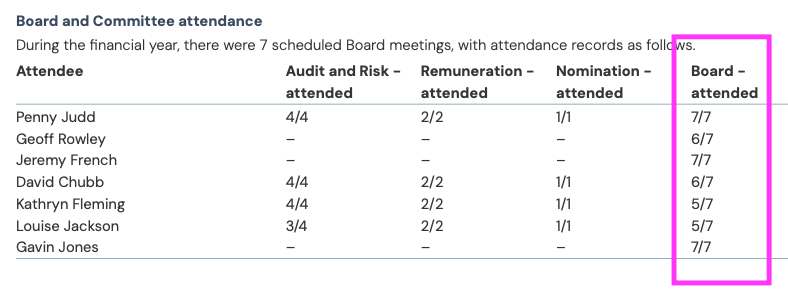
Mind you, FRP’s annual reports always include full-page pictures of the chairperson and Mr Rowley — something that warns of ‘over-importance’ to me. I am also slightly uneasy with Mr Rowley and a few other directors skipping at least one board meeting during the last couple of years:
Valuation and verdict
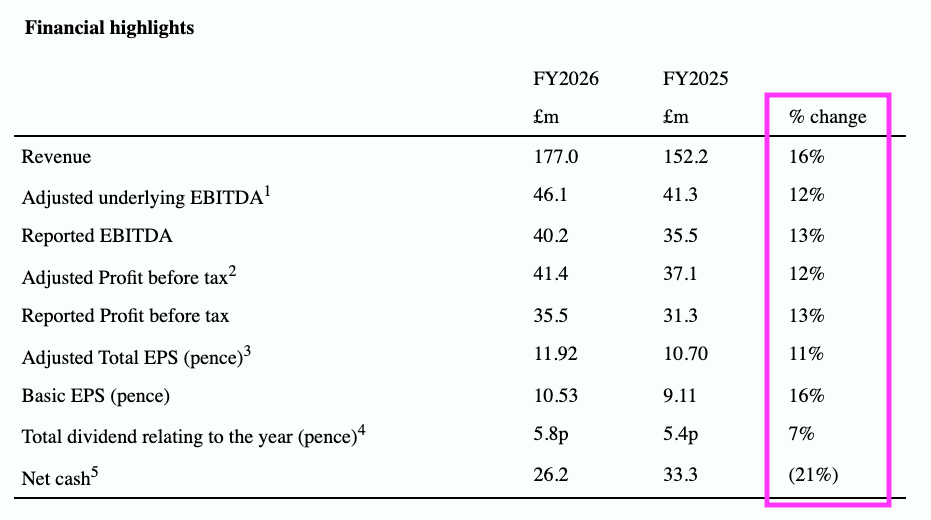
July’s annual results revealed a positive 2026:
But the accompanying outlook statement was somewhat vague:
“Trading in the early months of the current financial year has been in line with the Board’s expectations. Accordingly, we remain confident in the Group’s medium-term prospects and in our ability to deliver sustainable long-term value for shareholders and other stakeholders.“
At least last month’s AGM update suggested the positive progress might continue into 2027:
“Trading year-to-date continues to be in line with the Board’s expectations. The integration of the businesses acquired during FY2026… has progressed as planned and all are performing in line with expectations. The near and medium-term outlook for our service pillars remains positive and we are confident of continued progress for the rest of the year“
The AGM commentary was backed by a 5% lift to the Q1 dividend.
Brokers have translated the board’s remarks into the following single-digit growth forecasts:
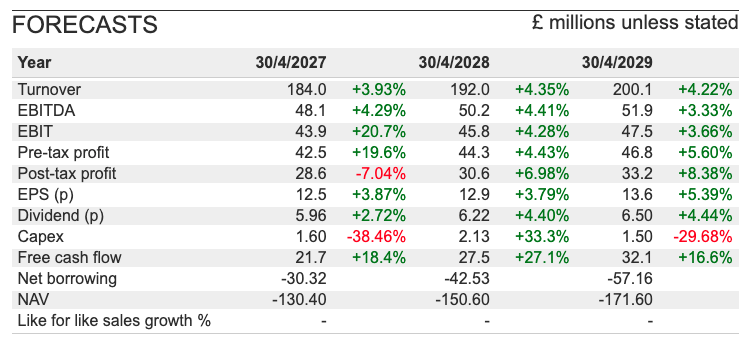
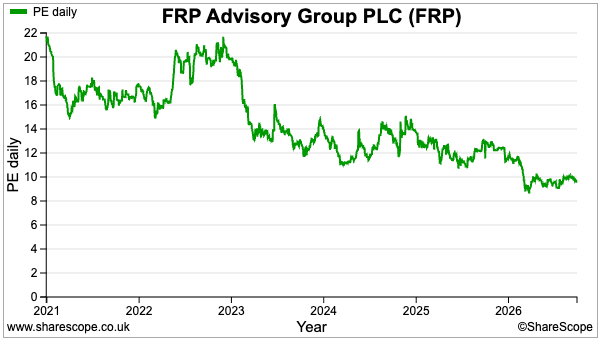
The 116p shares trade at 9x anticipated 2027 earnings and only 8x the projected 2029 earnings.
The P/E chart below shows how the shares have de-rated since the flotation:
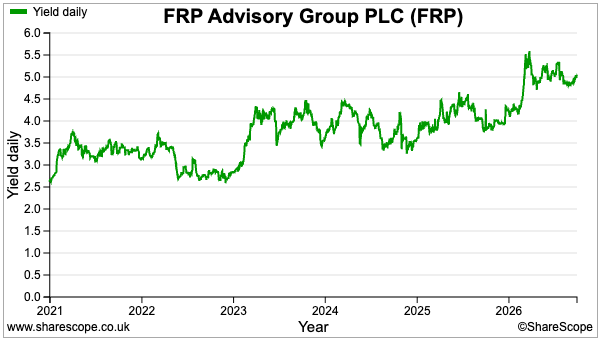
The yield meanwhile has been climbing higher, with the trailing 5.85p per share payout supporting a useful 5% income:
I must be honest here and admit FRP would never have appeared within my initial ShareScope filtering had the business not declared its partner remuneration as dividends before the flotation.
Nonetheless, the margins the group has subsequently delivered in particular indicate a very respectable business that — despite many highly-paid individuals on the payroll — appears to be managed with outside shareholders in mind.
I suppose future profits may always be at risk of fee-earning employees demanding much greater bonuses or FRP recruiting less-productive staff.
Furthermore, the acquisition M&A could go wrong while that significant dependence on a handful of partners each year might one day prove troublesome should insolvency proceedings generally dry up.
But will insolvency proceedings ever dry up? I am not so sure.
Those government statistics currently indicate a steady, elevated flow of opportunities and I can easily imagine chaotic macro events leading to an increased insolvency workload that extends FRP’s recent run of double-digit organic growth.
All told, I get the impression FRP is among the more appealing ‘people’ businesses quoted on AIM and may actually become a beneficiary of any forthcoming recession. The decent yield backed by the sizeable net cash could in the meantime provide useful compensation while awaiting an upturn from a downturn.
Until next time, I wish you safe and healthy investing with ShareScope.
Maynard Paton
Disclosure: Maynard does not own shares in FRP Advisory.
This article is for educational purposes only. It is not a recommendation to buy or sell shares or other investments. Do your own research before buying or selling any investment or seek professional financial advice.




Thanks for sharing that article Maynard. I’m invested in FRP and similar business BTG for the dividends and hopes of capital gain on top. Both have been rather sleepy but I didn’t invest in them for excitement. Just as well. I think they’re both good companies. I must think FRP is higher quality as I have more invested in it.
Thanks Graeme. Begbies has been quoted since 2004 and has not as far as I can recall cropped up on the ShareScope screens I employ for these articles. So I think you may be right to think that FRP is higher quality. I am not sure whether both will actually enjoy sales bonanzas in a really difficult economy, but I can’t think of many quoted companies that will! And as you say, there are dividends available in the meantime.
Maynard