Since his last update, nine companies have passed Richard’s minimum quality filter. Most are very large businesses. He takes a peek at GlobalData, the smallest of four investment candidates to score less than two strikes.

5 Strikes
Annual reports for companies with year-ends that coincided with the financial year end have swelled from a trickle to a stream. Soon there will be a flood.
| Name | TIDM | Prev AR | Strikes | # Strikes |
|---|---|---|---|---|
| London Stock Exchange | LSEG | 12/3/26 | ? Holdings – Debt – ROCE – Shares | 3 |
| Persimmon | PSN | 10/3/26 | – Holdings – CROCI – Growth | 3 |
| BP | BP. | 6/3/26 | – Holdings – Growth – ROCE | 3 |
| GSK | GSK | 6/3/26 | ? Holdings – Debt ? Growth | 2 |
| Intertek | ITRK | 3/3/26 | ? Holdings – Debt ? Growth | 2 |
| Keller | KLR | 3/3/26 | – Holdings – CROCI – ROCE | 3 |
| Anglo American | AAL | 2/3/26 | – Holdings – Growth – ROCE | 3 |
| GlobalData | DATA | 2/3/26 | ? Acquisitions – Debt ? ROCE | 2 |
| Pearson | PSON | 27/2/26 | ? Holdings – Debt – Growth ? ROCE | 3 |
| InterContinental Hotels | IHG | 26/2/26 | ? Holdings – Debt | 2 |
| Click here for our 5 Strikes explainer | 17/03/2026 | |||
The nine companies that have reported since my last update are a middling bunch, all of them scoring between two and three strikes. A strike is something questionable about the historical numbers.
To make my life simpler I focus on probably the easiest companies to analyse, those with fewer than than three strikes. Consequently today’s candidates for investment are all borderline. Four of the nine make the cut.
Three are very large businesses. Big business can be complex, and I think the biggest of them GSK (market capitalisation £81m) falls into that category. Analysing the pharmaceutical company might end up being my life’s work.
I am more inclined towards InterContinental Hotels (market capitalisation $19m) and Intertek (market capitalisation £5.6m) because though large, outwardly they are relatively straightforward businesses.
InterContinental Hotels is a collection of Hotel franchises. Mostly, it avoids the costly business of owning, leasing and managing hotels, by providing franchisees with booking systems, loyalty schemes and famous hotel brands like InterContinental, Holiday Inn and Crown Plaza. I took a peek at InterContinental Hotels two years ago.
News that the Competition and Markets Authority is investigating InterContinental Hotels, Hilton and Marriott, takes some of the shine off the numbers though. They could be sharing sensitive data using a third party data platform.
Intertek inspects, tests, and certifies a vast array of products, services and operating systems.
Today, though, I have picked out GlobalData, the smallest of the quartet. GlobalData’s market capitalisation is just under £500 million.
GlobalData [? Acquisitions – Debt ? ROCE]
GlobalData provides data on over twenty industries to over 5,000 clients. It says they include the world’s largest corporations, financial institutions, and government organisations.
Investors may have come across it in other companies’ annual reports. Retailer Dunelm, for example, quotes market share information from GlobalData.
The company’s website publishes lists of “Top 10 companies”. InterContinental Hotels, for example, is a top 10 hotel chain by number of properties. We’d have to subscribe, to find out how many it has of course (or perhaps look at the annual report!).
Technically all shares that pass my minimum quality filter fulfill my criterion for acquisitions, which is that they should have spent less than they earned in free cash flow over the last eight years. However, I flag companies that get close with a question mark.
Over the last eight years GlobalData has spent £241 million of its £314 million free cash flow on acquisitions. In two years, 2021 and 2024, it spent more than twice what it earned (you can scroll through acquisitions on its website).
Maynard wrote GlobalData up recently. He highlighted the experience of its founder and majority shareholder, who previously founded and sold Datamonitor. He cited AI as a potential factor that could make or break the company.
GlobalData says AI is a “positive theme”. Its fundamental strength is proprietary data and the AI tools the company is developing are making it easier for customers to query and analyse. AI is also improving internal productivity, the company says.
This is also RELX’s pitch, which I have examined. By “grounding” its AI tools in high quality hallucination-free information, the scientific, legal, and risk information behemoth expects to preserve its competitive advantage.
Somewhat tautologically, GlobalData believes that by marrying AI to its data platform, it is creating “defensible competitive advantage”.
I wonder whether proprietary data is the defensive moat traditional suppliers expect. Some AI companies have been pretty cavalier, scraping data from dubious sources to get around copyright.
Many of them are well resourced, and could collect or buy high quality data themselves. Whether or not AI companies reach the standards of traditional data providers, cost conscious customers might accept lower standards at lower cost while they try.
Companies are much less willing to discuss the competitive threat of AI in their annual reports than they are the opportunities. But GlobalData does at least mention AI in its risk report.
After a long list of disclosures about the potential for misuse of AI and policies to mitigate this risk in GlobalData’s business, it finally gets to the competitive threat. It does not offer much succour to a doubtful investor seeking reassurance:
“To address the competitive threats around the use of AI in existing and emerging competitors, we have a strict focus around proprietary data and protecting the proprietary channels and sources used in the collection process.”
Source: GlobalData annual report 2025
Old school data providers like RELX aren’t as well resourced as they could be. Reliable earnings from subscriptions have given them the confidence to borrow in pursuit of higher returns.
Although GlobalData is not old, it traces its current form back to 2016, the company has followed the model and used debt to fund acquisitions. Debt is the only full strike I gave GlobalData.
According to ShareScope, debt is almost 100% of capital employed. The level of borrowings, which includes lease obligations, doesn’t look so bad relative to free cash flow for the firm, but is still more than two times the cash flow earned by GlobalData in 2025.
Debt’s been higher in the past, but the company raised money in 2024 by selling a minority interest in GlobalData’s health business.
If cash flow is sustainable, the debt is affordable (crudely the company could pay it off in less than three years). But it might not perform as well as it did in future if the cost of innovation increases, or competition from AI companies intensifies, or both.
The shares trade at very modest multiples, and the share price is lower than it was at the beginning of 2018, the eight year period I focus on when filtering shares.
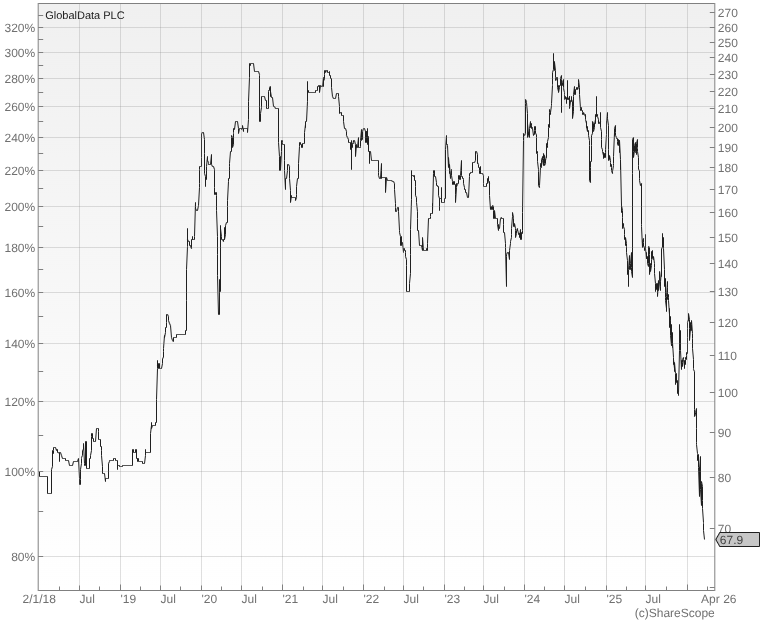
Normally I would back a business that has done well over speculative doubts embodied in the share price. But I am not yet ready to do that because AI is such a novel and potentially fundamental threat.
Richard Beddard
Contact Richard Beddard by email: richard@beddard.net, web: beddard.net
This article is for educational purposes only. It is not a recommendation to buy or sell shares or other investments. Do your own research before buying or selling any investment or seek professional financial advice.