Likewise is one of the very few flotation start-ups that has actually delivered on its growth ambitions. Maynard Paton recounts the career of the group’s boss and its successful progress against floor-covering rival Headlam.
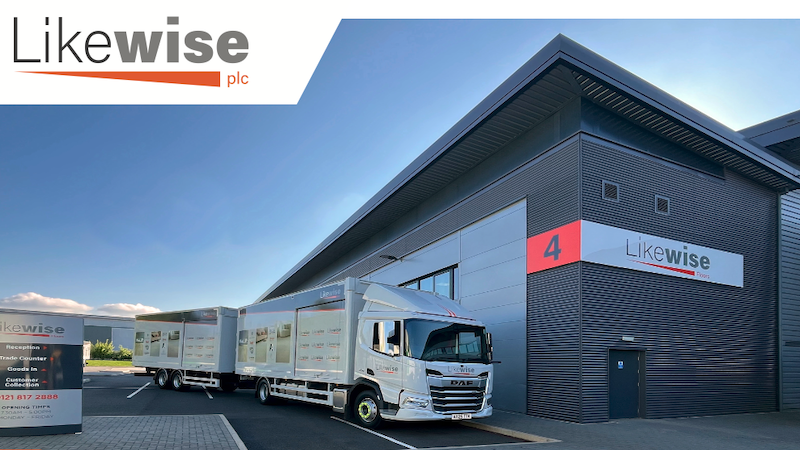
The stock market is littered with sorry start-ups that floated with persuasive growth stories but then failed to deliver.
But very occasionally, a quoted venture does go from nothing to meet its ambitious targets.
Likewise for instance went public during 2019 and at the time claimed it enjoyed “an opportunity to build a business of national scale and over time become a strong alternative to the current larger industry competitors within the sector“.
Seven years later, and Likewise has indeed built a “business of national scale“… and its rapid expansion led by a sector veteran may have actually contributed to the downfall of the industry’s largest operator.
Likewise’s success is all the more remarkable due to its seemingly dull business. The group purchases floor-coverings — carpets, vinyl, laminate, rugs and so on — from manufactures, and then cuts and delivers them to thousands of independent retailers and contractors.
Let’s take a closer look.
From Headlam to Likewise
Likewise was established during 2018 but the real story started in 1977 when Tony Brewer, then 17 years old, began working at Midlands Carpets Distributors in Kidderminster.
Mr Brewer recounted during this podcast how, during his time at MCD, he “really learnt” all aspects of the floor-coverings industry including “the warehouse, telesales, the products and the logistics“.
Mr Brewer must have eventually caught the attention of MCD’s founder, Graham Waldron. Some 14 years after joining MCD, Mr Brewer found himself alongside Mr Waldron and MCD colleague Ian Kirkham acquiring a joint 22% stake in Headlam:
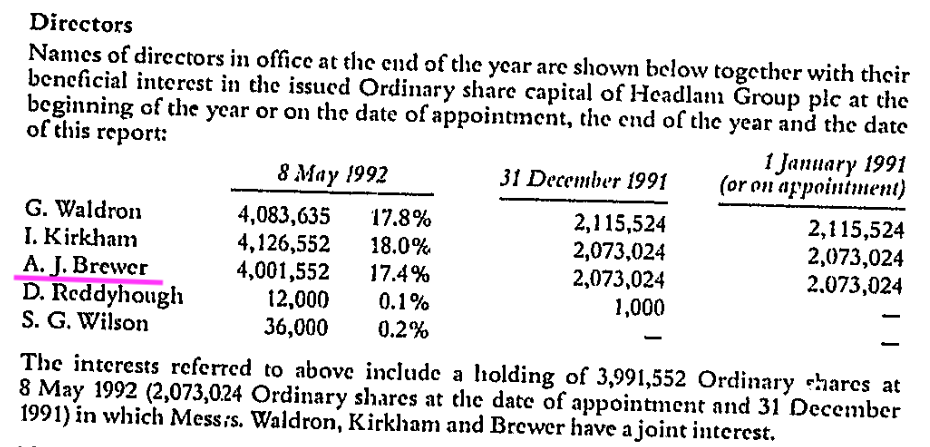
Mr Waldron installed himself as Headlam’s executive chairman and appointed Mr Kirkham as chief executive and instructed Mr Brewer to oversee Headlam’s diversification into floor-coverings.
Headlam’s progress thereafter was impressive. Under Mr Brewer’s guidance, various floor-covering acquisitions were undertaken — including MCD during 1997 — alongside disposals of Headlam’s original footwear and fabric operations.
By the time Mr Waldron retired from executive duties during 2013 — at age 83! — Headlam’s revenue had advanced from £22 million to £603 million while underlying operating profit had surged from less than £1 million to almost £28m. Headlam’s market cap during Mr Waldron’s 22-year tenure improved from less than £10 million to more than £300 million:
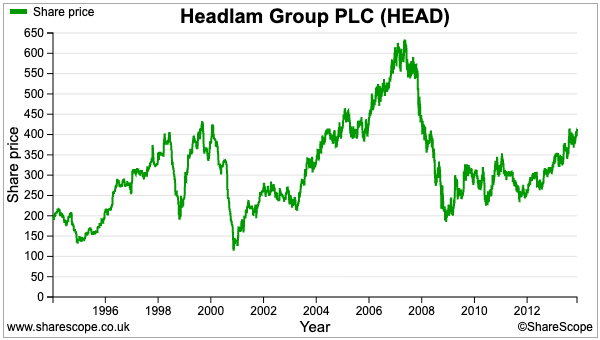
Mr Brewer was appointed Headlam’s chief executive during 2000 and a surprise RNS reported his departure during 2016:
“Headlam, Europe’s leading floor-coverings distributor, announces that, after more than 25 years with the business, Tony Brewer is stepping down as Group Chief Executive. Tony, who was Group Chief Executive for 16 years, has been instrumental in building the group, and the board would like to place on record its thanks and appreciation for all that he has achieved. ”
The market took Mr Brewer’s exit in its stride — the shares dropped only 2% on the day — but the board change would have enormous long-term ramifications for Headlam’s shareholders.
Exactly why Mr Brewer exited Headlam is still something of a mystery. Online searching suggests Headlam’s non-executives were “not satisfied with the information from Brewer on… future strategy and asked him to step down“:
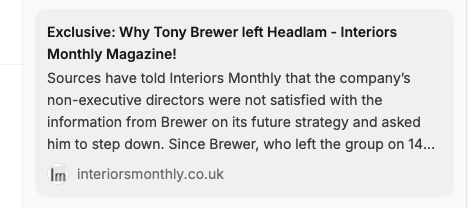
Headlam’s non-execs at the time consisted of an auditor, a solicitor and an accountant, who may not have understood the floor-coverings industry as well as Mr Brewer.
Mr Brewer then spent a year or two consulting for a South African business before establishing Likewise. Similar to Headlam’s early floor-covering days, Mr Brewer built Likewise mostly through acquisition. Purchases have included:
- William Armes (£1.7 million, 2018);
- Bruce Starke & Co (£1.1 million, 2018);
- Lewis Abbot (£0.8 million, 2019);
- Heatseam (£9.8 million, 2019);
- H&V Carpets (£0.1 million, 2019);
- A&A Carpets (£0.9 million, 2020);
- Valley Wholesale Carpets (£30.0 million, 2022), and;
- Delta Carpets (£3.0 million, 2022).
The deals have run alongside Likewise’s in-house investments to create a national network of warehouses:
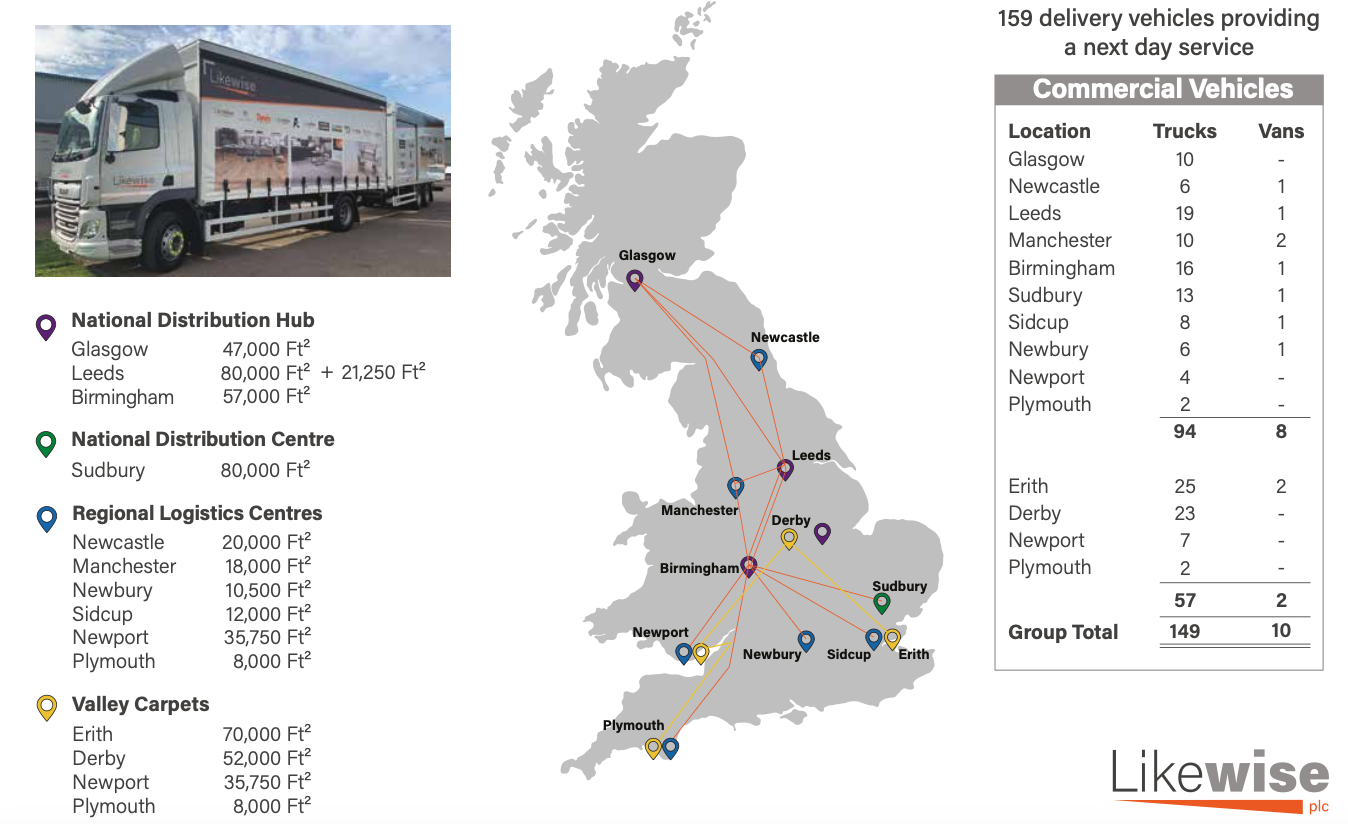
Early funding for the expansion came via the International Stock Exchange, with the initial 2019 flotation at 10p per share raising £6 million and a subsequent 25p per share raise collecting £7.5 million.
The shares transferred to AIM during 2021 at 25p, and the associated placing raised a further £10 million. Another £14 million was raised one year later at 35p.
The share price was in retrospect somewhat exuberant about Likewise’s prospects when the firm joined AIM:
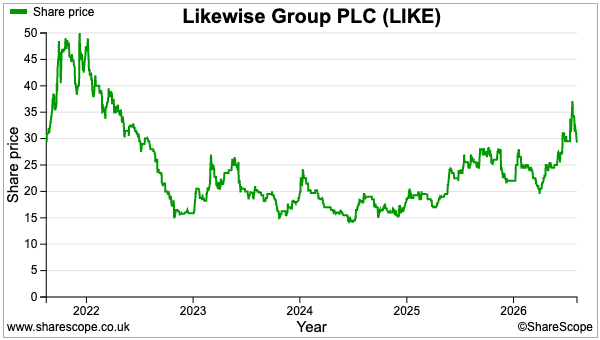
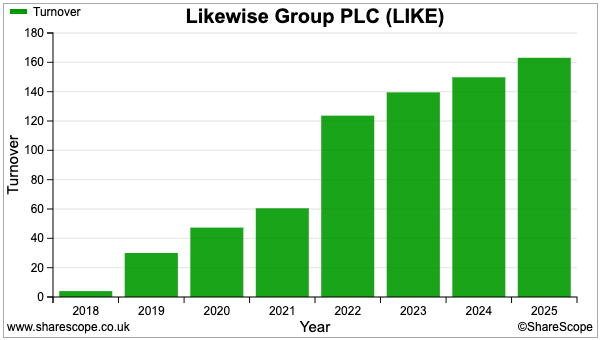
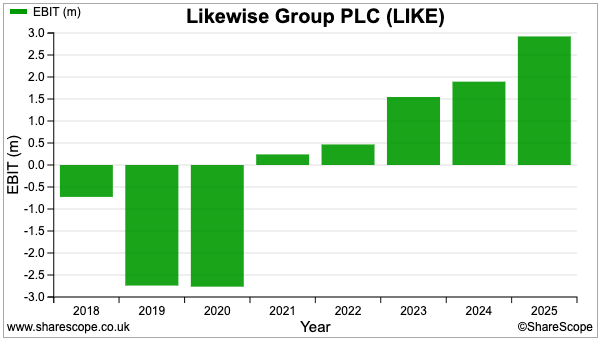
But Likewise’s headline financial performance as a quoted group appears very credible. Last year’s revenue topped £160 million while operating profit was nearly £3 million:
Another equity raise — conducted just a few weeks ago and garnering £33 million at 28.5p per share — ought to give Likewise ample support for further progress.
Having floated with the ambition of capturing sales of £200 million, the goal was lifted to £250 million by 2025 and the aim now is to reach sales of £300 million.
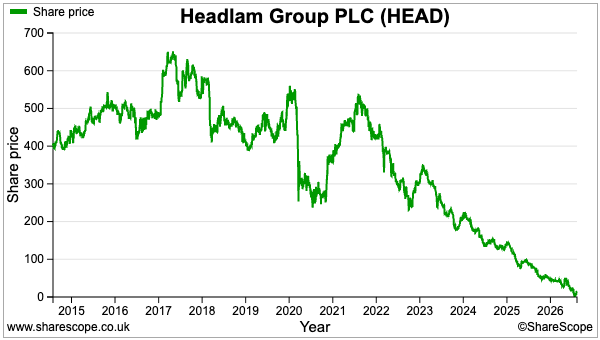
Likewise’s market cap at the recent 30p share price is £110 million. Headlam in contrast has fallen into extremely deep operational and financial trouble — it’s market cap is now £9 million at 11p:
Likewise’s latest fund raise may even be able to support purchasing parts of Headlam.
Financials
The aforementioned run of acquisitions does not make Likewise’s accounts the easiest to interpret.
The group’s results have been blighted in particular by regular ‘non-underlying’ items:
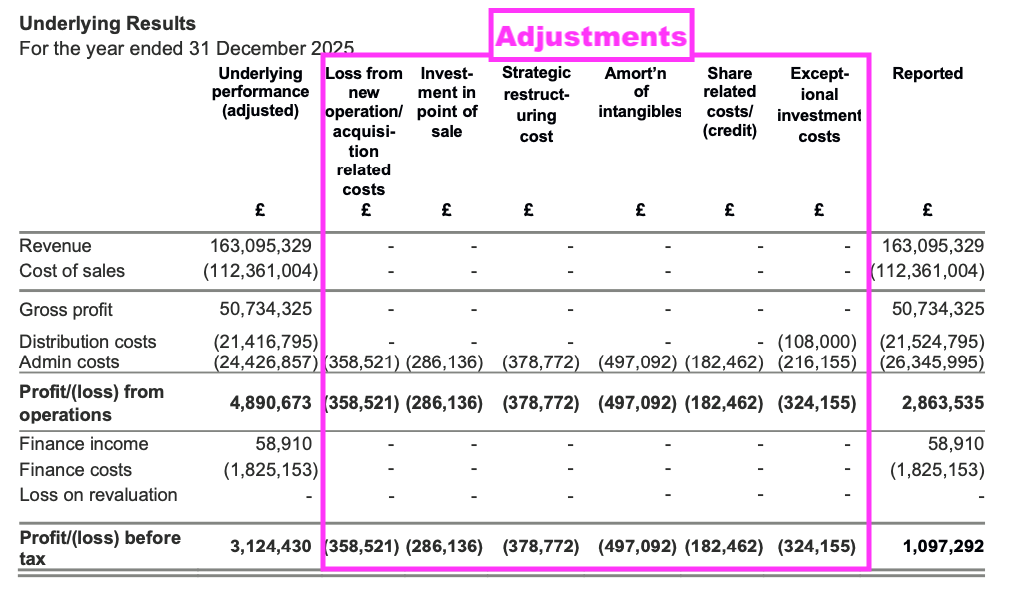
Some of the adjustments seem very cavalier.
‘Loss from new operations’ for example reflects the “substantial investment” in new depots, with such costs leading to early site losses that require “time to mature before delivering the anticipated returns“.
‘Exceptional investment in point of sale’ meanwhile encompasses “expenses incurred in increasing the Group’s market presence by providing heavily discounted in-store retail displays to retailers to accelerate the Group’s growth in market share“:
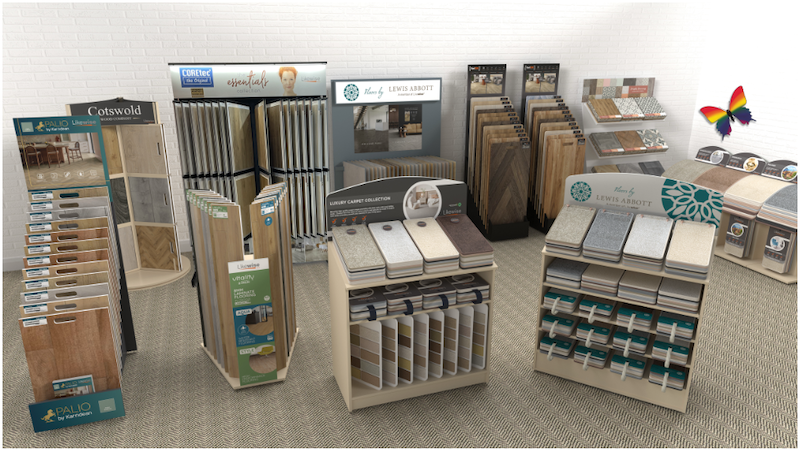
Both items seem very much part of parcel of running the business. I note the ‘underlying’ results do not subtract the associated revenue that such ‘non-underlying’ items generate.
The losses from new operations, the point-of-sale displays plus various acquisition-related costs, relocation expenses, restructuring charges and other ‘exceptional’ investments totalled £7 million between 2021 and 2025.
Excluding those £7 million of ‘non-underlying’ costs allowed aggregate ‘underlying’ profit during the same five years to reach £17 million.
Irrespective of the profit adjustments, what is very clear is distributing carpets, vinyl and so on is not a high-margin activity. The group’s margin excluding all the ‘non-underlying’ costs was only 3% last year, and was less than 2% including every charge:
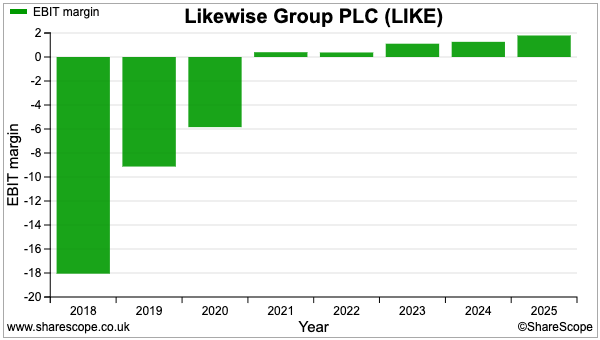
As the ShareScope chart below suggests, interpreting Likewise’s cash conversion is not straightforward either:
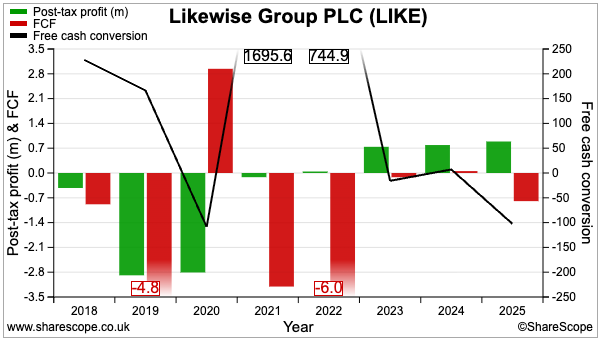
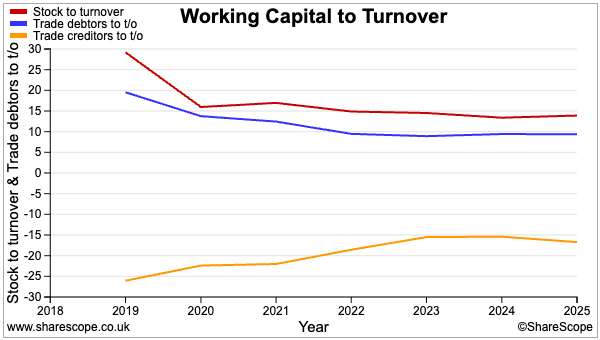
The rapid revenue increases have required extra working-capital investment. ShareScope indicates more than £8 million of extra stock, debtors and creditors were required between 2021 and 2025:
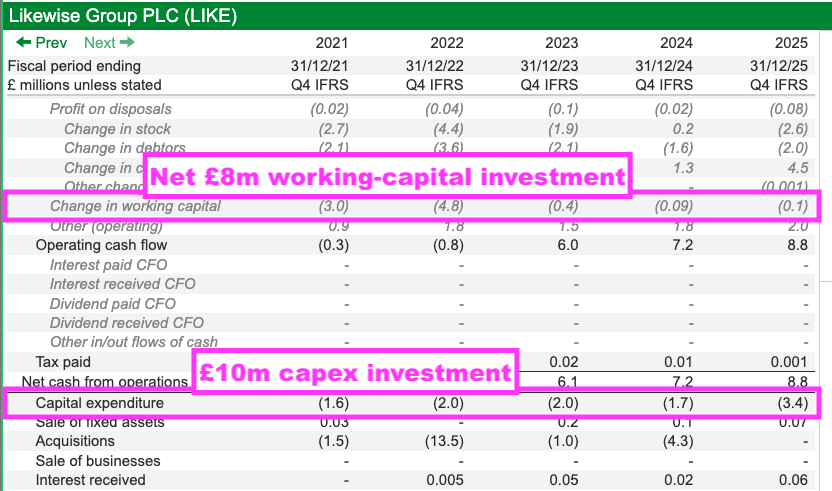
Some £10 million has also been absorbed by capital expenditure during the last five years.
But the significant cash investments do not seem untoward. The level of stock and trade debtors versus revenue for example has reduced and then stabilised, allowing faster payment for suppliers (trade creditors):
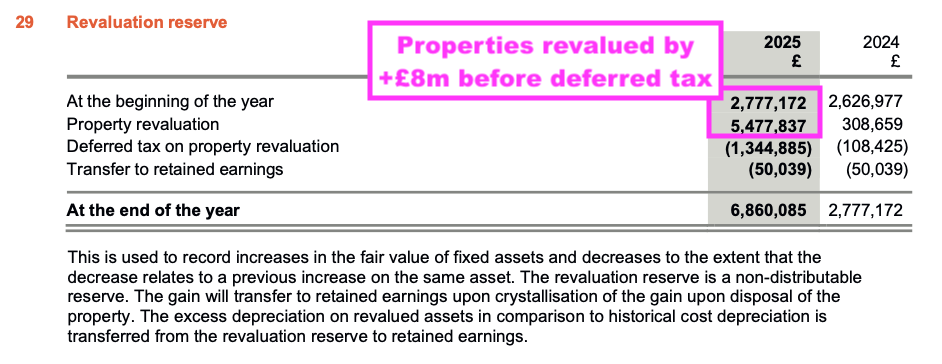
Likewise’s capital expenditure meanwhile has been counter-balanced by third-party revaluations to the group’s properties. The 2025 accounts showed the freeholds were now carried at an £8 million (pre-tax) premium to their purchase price:
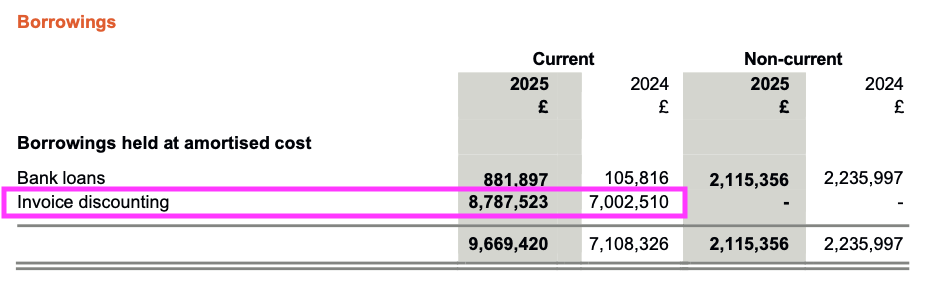
Note that the latest accounts show the bulk of Likewise’s debt relates to invoice factoring…
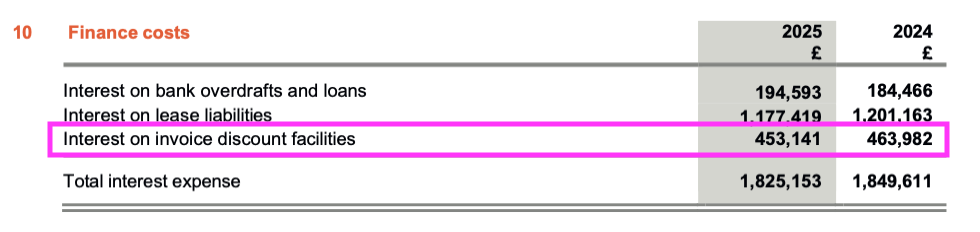
…which results in faster cash collection but does carry an extra interest charge:
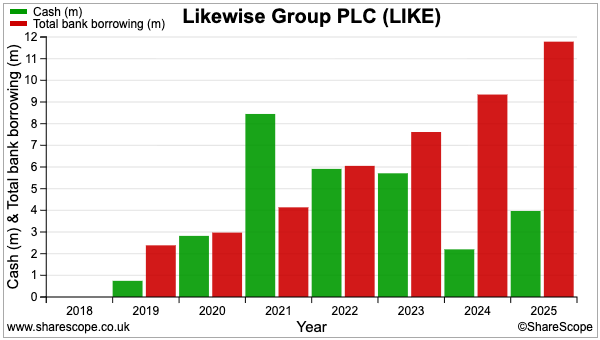
Reported borrowings (including factored invoices of £9 million) were £12 million at the end of 2025 and exceeded cash in the bank by £8 million:
The aforementioned £33 million equity raise should mean the group’s conventional borrowings will not prove troublesome.
Boardroom
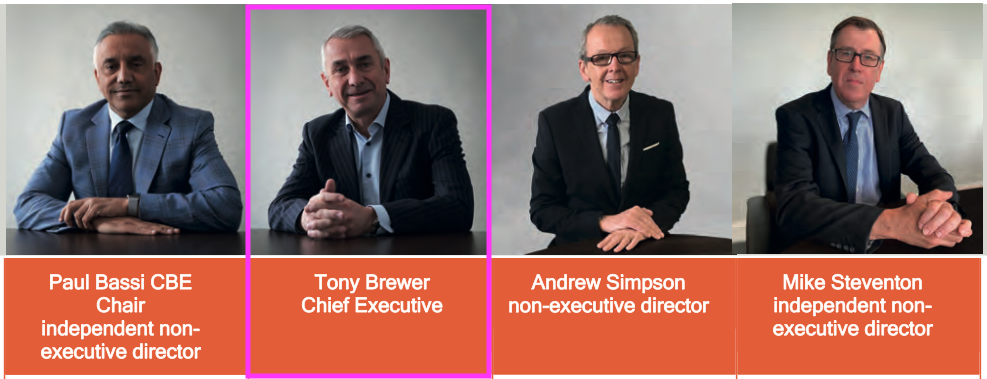
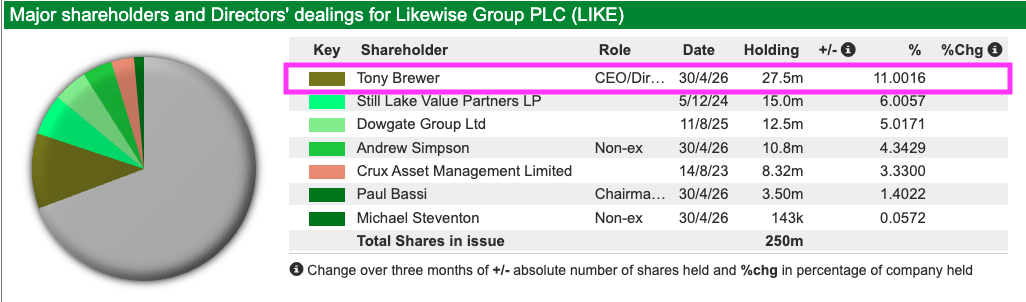
The aforementioned Tony Brewer remains Likewise’s chief executive and largest shareholder:
Mr Brewer has commendably increased his shareholding since the initial 2019 flotation, adding approximately one million shares to what is now an £8 million stake at 30p a share:
Mr Brewer is accompanied on the board by non-executive Andrew Simpson, who boasts a £3 million holding and worked alongside Mr Brewer for five years at MCD and 19 years at Headlam.
Mr Simpson is by no means the only former Headlam employee to now work alongside Mr Brewer — 26 members of Likewise’s senior management team once worked for Mr Brewer’s ex-employer.
Maybe Mr Brewer has attracted so many Headlam employees by adopting the people skills of his industry mentor, Graham Waldron. This interview with a senior Headlam manager recounted a charming festive anecdote about Mr Waldron’s management style:
“Graham Waldron, the former chairman of Headlam, would always take time out of his busy schedule to check in with his team. Every year he would ring all the Branch Managers on Christmas Eve to show his appreciation.”
Likewise’s workforce appears to be at least as productive as Headlam’s staff.
Revenue per employee at Mr Brewer’s new venture is close to £300k…
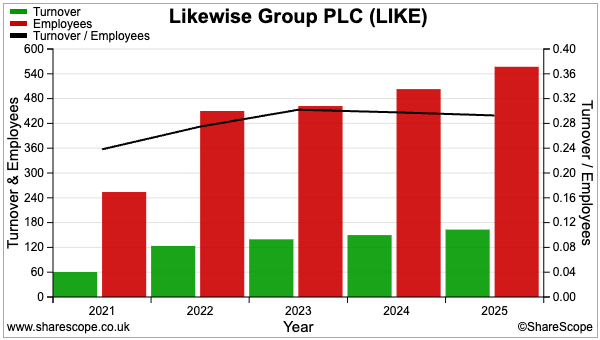
… and broadly matches what Headlam employees achieved during their heyday:
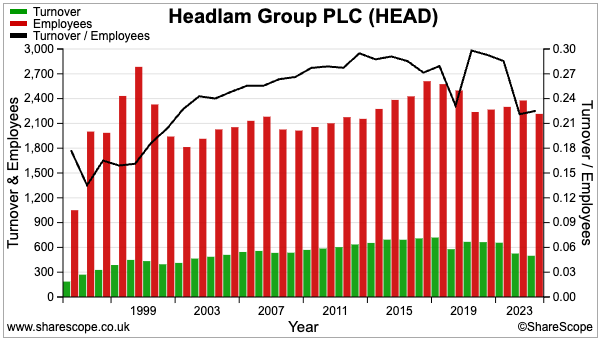
Most people working in floor-coverings are not extravagantly remunerated, with both Likewise and Headlam paying approximately £39k average salaries last year. Mr Brewer meanwhile collected a £312k salary (and no bonus) during 2025 year versus a £544k salary and £592k bonus for his final full year at Headlam.
Mr Brewer is 66 years old and, if Graham Waldron’s retirement at 83 is any guide, could continue as a Likewise executive until 2043.
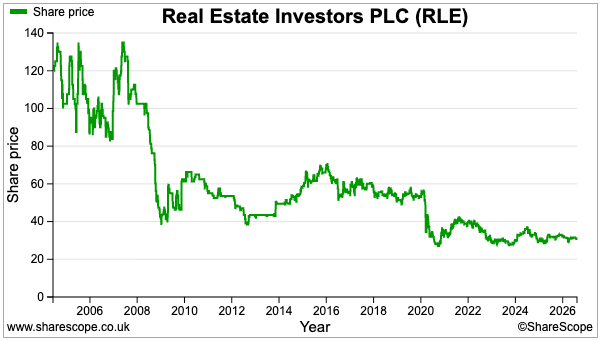
Be aware that Likewise’s board lacks a chief financial officer and includes a chairman whose 20-year executive leadership at Real Estate Investors has been disappointing:
Latest fund raise
The aforementioned £33 million raised the other week has been used in part to fund a new warehouse in Corby:
“The Company today also announces that it is at the latter stages of discussions before entering into a conditional agreement to acquire the freehold of a new 60,000 sq. ft. high-bay distribution facility in Corby, England from PBBE Corby B.V. for total consideration due on completion of £9.5 million (inclusive of stamp duty)”
The £9 million (before stamp duty) spent on the 60,000 sq. ft. Corby freehold does seem high versus Likewise’s other properties. The Corby purchase was undertaken at £150 per square foot while the six other freeholds are valued at an aggregate £33 million…
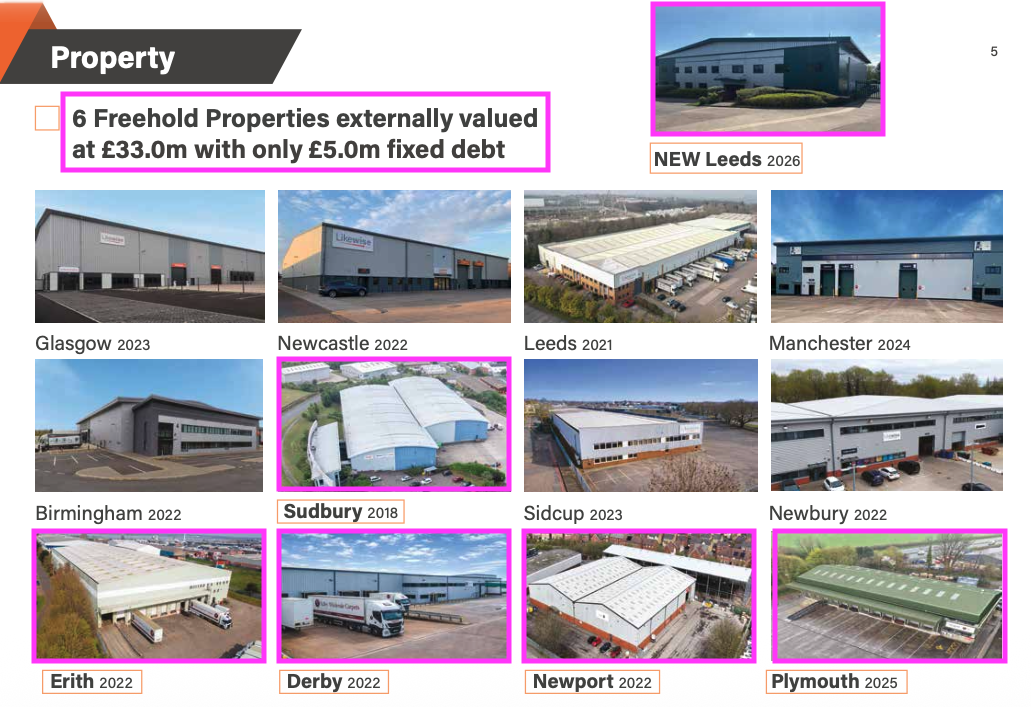
…which equates to approximately £100 per square foot with their collective area at nearly 350,000 sq. ft.
The remaining £23 million or so from the latest equity raise will be employed to “strengthen the balance sheet” and “provide flexibility to execute the Group’s growth strategy, including additional strategic acquisitions, with a number of additional 60,000 sq. ft. high bay distribution facilities and 25,000 sq. ft. logistic centres under consideration”.
Perhaps Likewise will find itself buying properties from Headlam. The latter has suffered sizeable losses for the last two years…
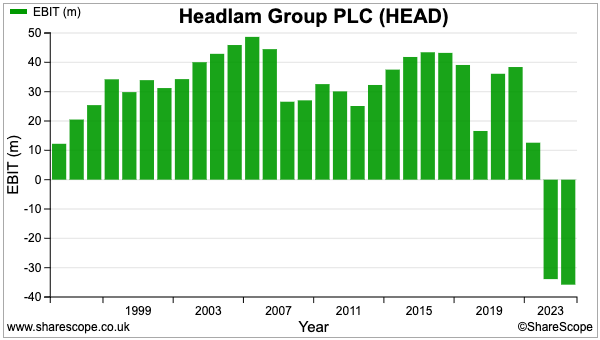
…and has been busy disposing of properties to reduce debt. This year Headlam has raised £15 million selling depots in Nottingham, Rochdale and Rochester, while further property sales are expected as the troubled rival “continues to carefully manage day-to day operations and liquidity within its existing facilities.”
Headlam has also referred to “competitor dynamics“…
“Revenue has been further impacted by weak market conditions, poor inventory availability on core product lines, competitor dynamics and unseasonably warm weather late in the Period, impacting enquiry levels.”
…which seems to acknowledge customers turning to Likewise for their floor-coverings. At the last count, Headlam’s 2026 sales were down 23% while Likewise’s were up 18%.
Valuation and verdict
Likewise claims the Corby purchase and other investments should help the group surpass revenue of £300 million:
“The Board is developing a medium-term five-year strategy to provide the infrastructure… to take full advantage of the many opportunities in the UK Flooring Industry. There are numerous projects to be completed in the coming years to elevate the Group to achieve its future aspirations of delivering revenues in excess of £300 million.”
Taking further business from Headlam — where annual sales may still be approximately £360 million — provides plenty of scope to achieve that £300 million.
For now, though, brokers expect Likewise to report 2026 revenue of £191 million and earnings of £4 million:
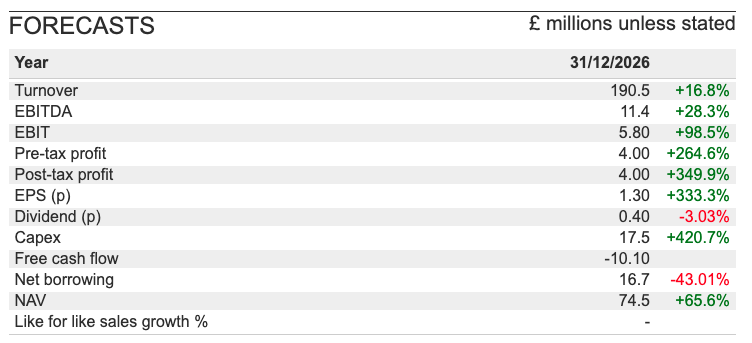
The recent £110 million market cap therefore supports a near-term P/E of 27.5x.
Assume, however, that sales do reach £300 million and a 5.6% operating margin can be achieved (as witnessed at Headlam during Mr Brewer’s final year), then maybe Likewise could be reporting earnings of £12.6 million after standard 25% UK tax…
…and the P/E in say, 2031, may be only 9x.
There could therefore be good upside to Likewise’s shares assuming sales do race towards £300 million, but true multi-bagger gains might need Likewise to replicate ‘peak’ Headlam.
Headlam’s shares hit their all-time high during 2017 at 650p to support a then market cap of £550 million — some 5x Likewise’s present valuation. Headlam’s sales at that time approached £700 million and profit topped £40 million.
Likewise replicating ‘peak’ Headlam and seeing profit one day top £40 million might be a tall order even for the talented Mr Brewer.
But at the very least, 2026 sales up 18% and Headlam itself plunging into disarray has set the scene for what could soon be a seismic leadership change within the floor-coverings industry.
As well as wholeheartedly backing Mr Brewer, Likewise bulls will need to overlook all those profit adjustments while trusting the hefty investments will indeed push revenue to £300 million (and beyond) and eventually deliver significant free cash.
However, what remans absolutely clear is Likewise is one of the select few quoted start-ups that looks like surpassing its original industry ambitions. Just that alone is worthy of continued shareholder support and the wider market’s respect.
Until next time, I wish you safe and healthy investing with ShareScope.
Maynard Paton
Disclosure: Maynard does not own shares in Likewise.
This article is for educational purposes only. It is not a recommendation to buy or sell shares or other investments. Do your own research before buying or selling any investment or seek professional financial advice.