Bruce takes a look at historic examples of ‘platform shifts’ and why Alphabet has bundled Gemini LLM, even though that may hurt the core search engine. Companies covered DGE, PTAL and TPX.
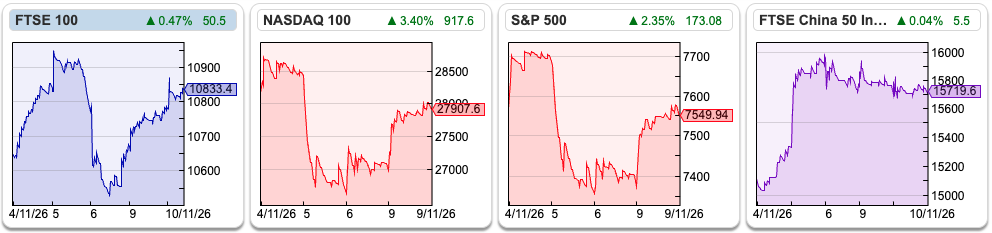
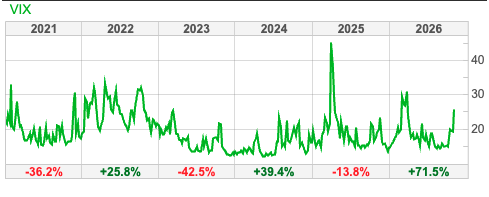
The FTSE 100 was up +1.8% in the last 5 trading days to 10,833. The Nasdaq100 was flat after a volatile week while $4.3 trillion market cap Nvidia was down -4.3% on Monday, as we all speculated how Singapore based Megaspeed went from total assets of $33m in 2023 to buying over $4bn of Nvidia processors in the following 2 years. The Vix rose to 25, but still well below the 45 peak that index hit when Trump announced his tariffs in Q1 2025. Brent fell -13% to $91 per barrel.
Jensen Huang, CEO of Nvidia, has certainly added some spice to the coming Anthropic IPO. Historically, the winning strategy was to build software on top of hardware (Microsoft / IBM). Then in 1995, Netscape attempted to play Microsoft at their own game and build a separate browser on top of Microsoft’s operating system (ie Netscape / Microsoft). Before the IPO, a sceptical investor was questioning the economics of a standalone browser. In response, Jim Barksdale, Netscape’s CEO, pushed back with an off the cuff remark that has since become axiomatic in Silicon Valley:
“Gentlemen, there’s only two ways I know of to make money: bundling and unbundling.”
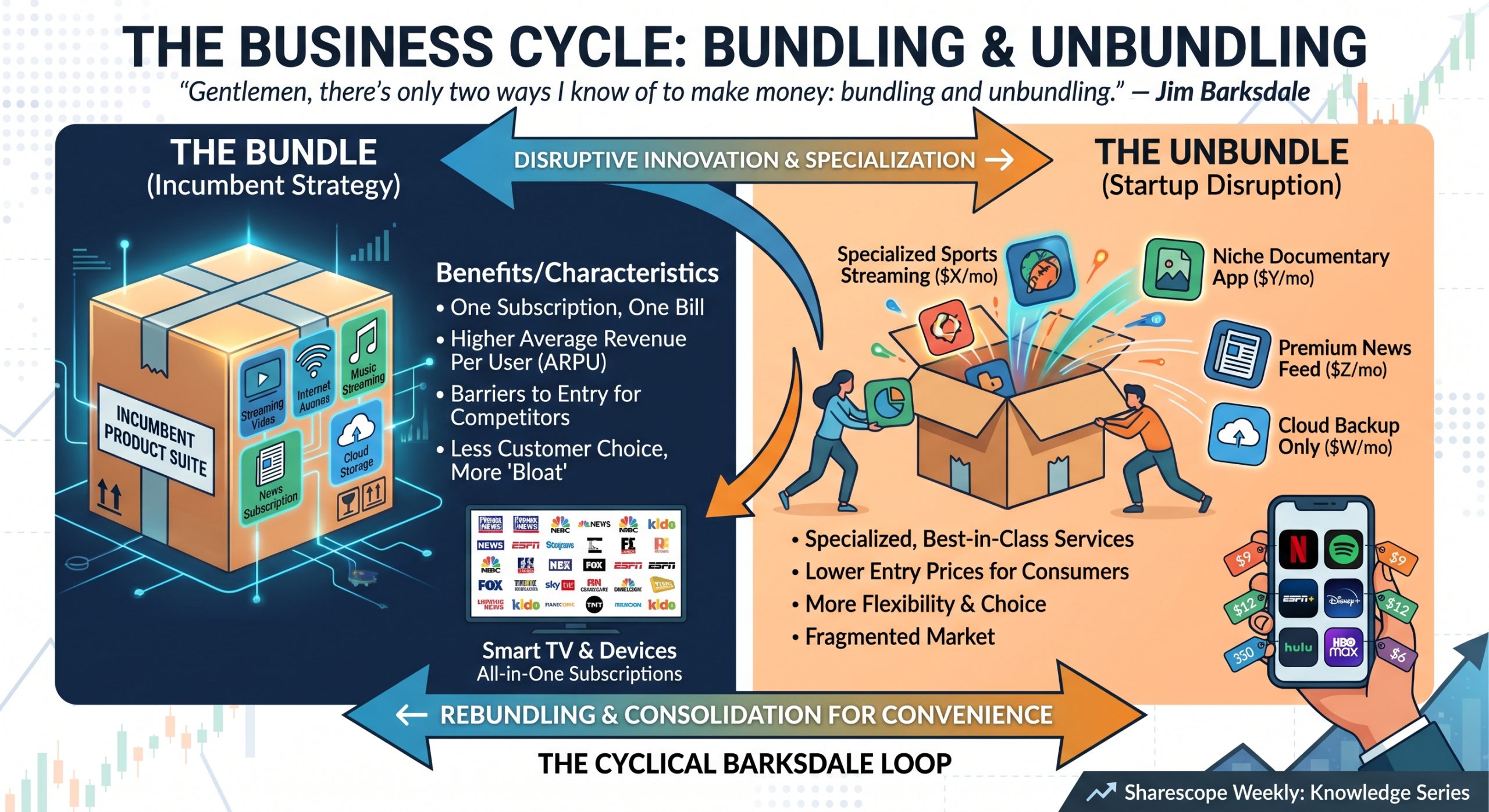
Netscape’s investment case was an unbundling story: customers would pay for a separate browser, unbundled from MS Windows, effectively making the MS operating system a cheap commodity that Netscape could build an application layer on top of. Ultimately Microsoft responded and went on to win the browser wars by bundling Internet Explorer into Windows for free; AOL acquired Netscape and sued Microsoft for anti-competitive behaviour, winning $750m in 2003. MSFT currently has a market cap of $3.96 trillion. AOL was a portal and a search engine, they lost out to Google/Alphabet search engine.
For contrast, the investment case in Anthropic and OpenAI are the exact opposite of Netscape’s 1995 strategy. They’re hoping to lock-in customers with integrated, all-in-one software all bundled together so that we can’t live without them. For instance, a friend has been using an LLM to read all his emails, write a draft response (stored in the draft folder) where needed and flag anything significant. On the other hand, the same friend has just been offered a job at large hedge fund, being told “we think there’s no analytical edge left in online sources – we’re hiring you to go to conferences, lunch, connect, chat: see what you can find out that’s not available online.” He’s already picked up some good insight on the report into Manchester City’s financial breaches and he hasn’t even started his new role yet.
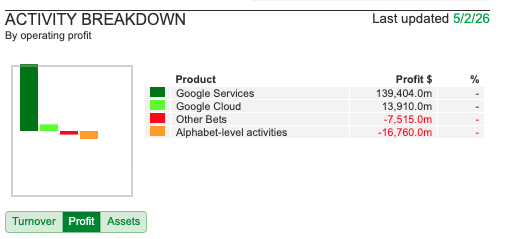
Google’s core search and advertising business looks at risk as Alphabet decides to bundle Gemini into the search engine – people are clicking on links from the search engine less frequently. Looking at Sharescope’s “Activity Breakdown” we can see that the core Google Services business made $139bn of profit last year, around 10x more than the Cloud division, while Other Bets (Waymo’s self driving cars, Wing drone delivery plus “moonshots”) continued to make losses.
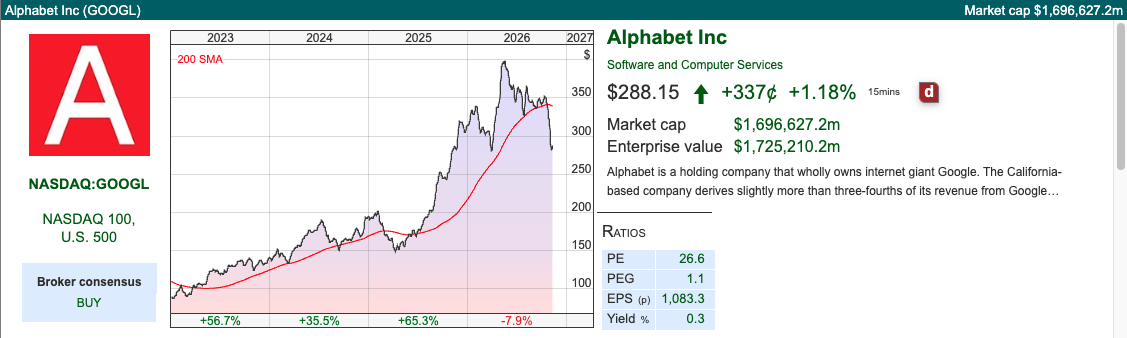
Who “wins” this round of bundling v unbundling is hard to say at the moment. But I think if you believe Anthropic and OpenAI bundling are worth trillions, then probably Alphabet’s core search engine is considerably less valuable than it was a few years ago.
Often companies fail because they are too rational. Management find it hard to accept that a business currently generating very high returns on capital is about to be disrupted: Nokia or Research in Motion (Blackberry) are examples, but there are many others in financial services. It looks like Alphabet management have grasped the threat, but the response could still hurt their core business, the last 15 years have enjoyed exceptionally favourable economics for the search engine. Perhaps some Alphabet employees can be replaced by AI, and they will need to retrain as plumbers and electricians?
Mello Events is coming up on Tuesday 17th and Wednesday 18th November at the Clayton Hotel in Chiswick. David has published the full schedule here, with plenty of new names who I haven’t seen present live before. For example Verici DX, a kidney transplant technology, which raised £8m a month ago and Richard Penney at Oberon mentioned in a recent podcast. I won’t be there in person, but am planning to attend the next one.
This week I look at Diageo Q1 Sept trading update, as the group does its own version of rebundling with Ready To Drink (RTD) Smirnoff Ice and similar. I also look at PetroTal, Peru’s largest oil exporter and TPXimpact that does digital transformation in public services.
Diageo Q1 Sept trading update
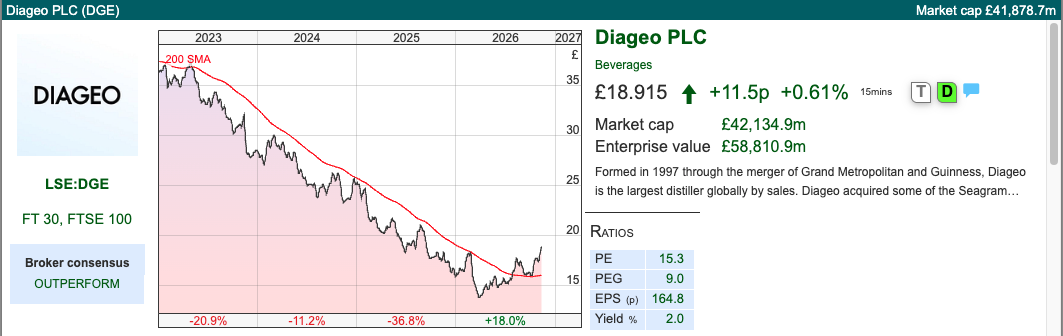
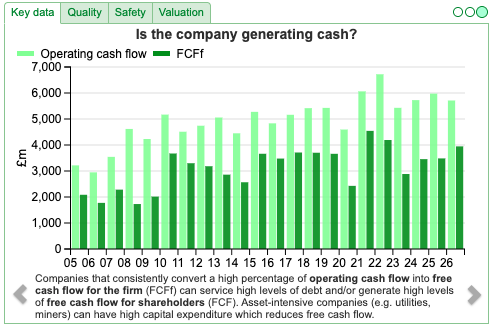
Diageo reported organic sales +0.6%, excluding their East African Breweries (EABL), which they’re disposing of. Ironically, they are selling the business in the fastest growing region, showing double digit growth, whereas sales have been declining in the USA and China. The latter is around 2% of the group, but could potentially represent a significant growth opportunity. North America on the other hand is just under 40% group sales, and investors are worried that reduced spirits consumption from GLP-1 receptor agonists, like Ozempic and Wegovy which blunt the dopamine surge associated with drinking alcohol. To be clear, GLP-1s are not currently prescribed to people who suffer from alcohol addiction, but instead it is a side effect of the weight loss drug, with around 44% of drinkers reporting reduced intake within 3 months of taking the drugs. North America sales declined mid single digits, according to last week’s RNS. The Sharescope chart below shows that low growth predates GLP-1s though, Free Cash Flow for firm has struggled to rise above £4bn, except for one year during the pandemic.
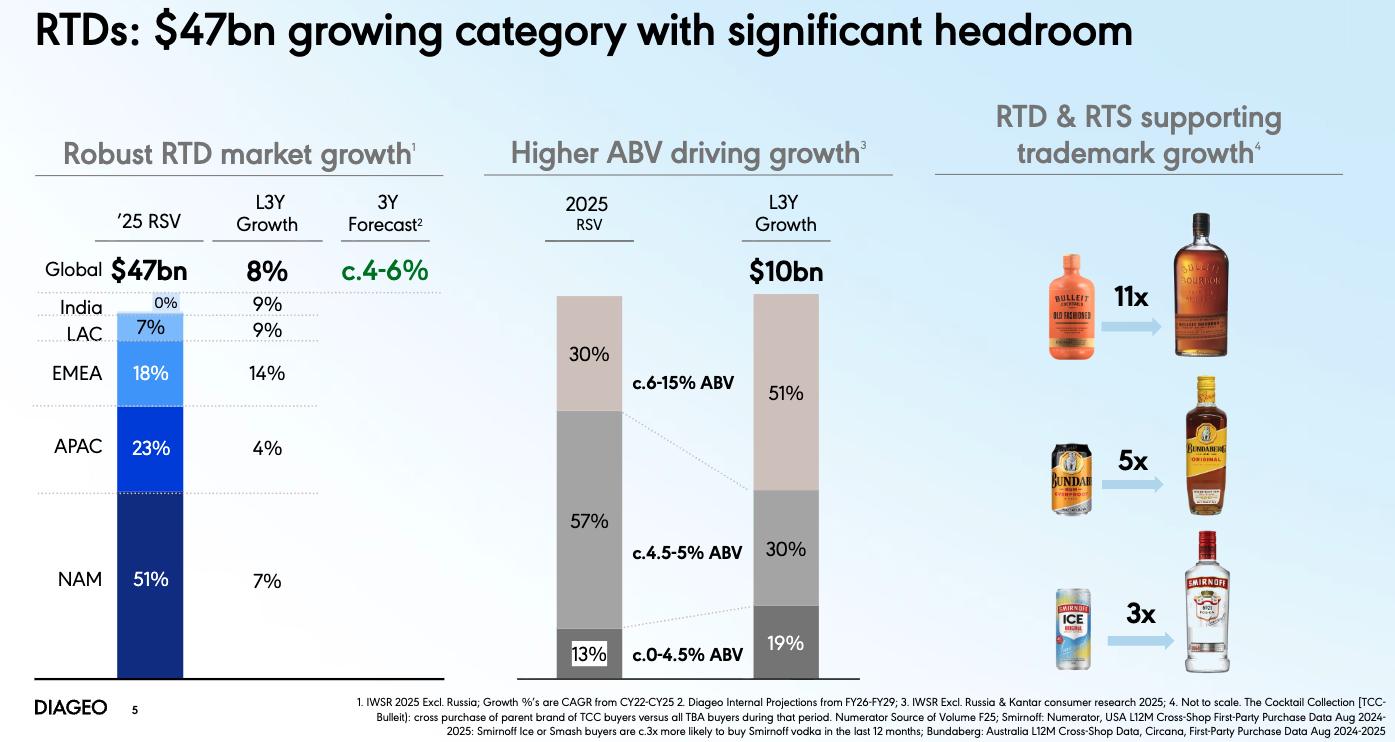
A second point is that youngsters are drinking less and buying more Ready to Drink (RTD) premixed drinks, as this slide from Diageo’s Capital Markets Day shows.
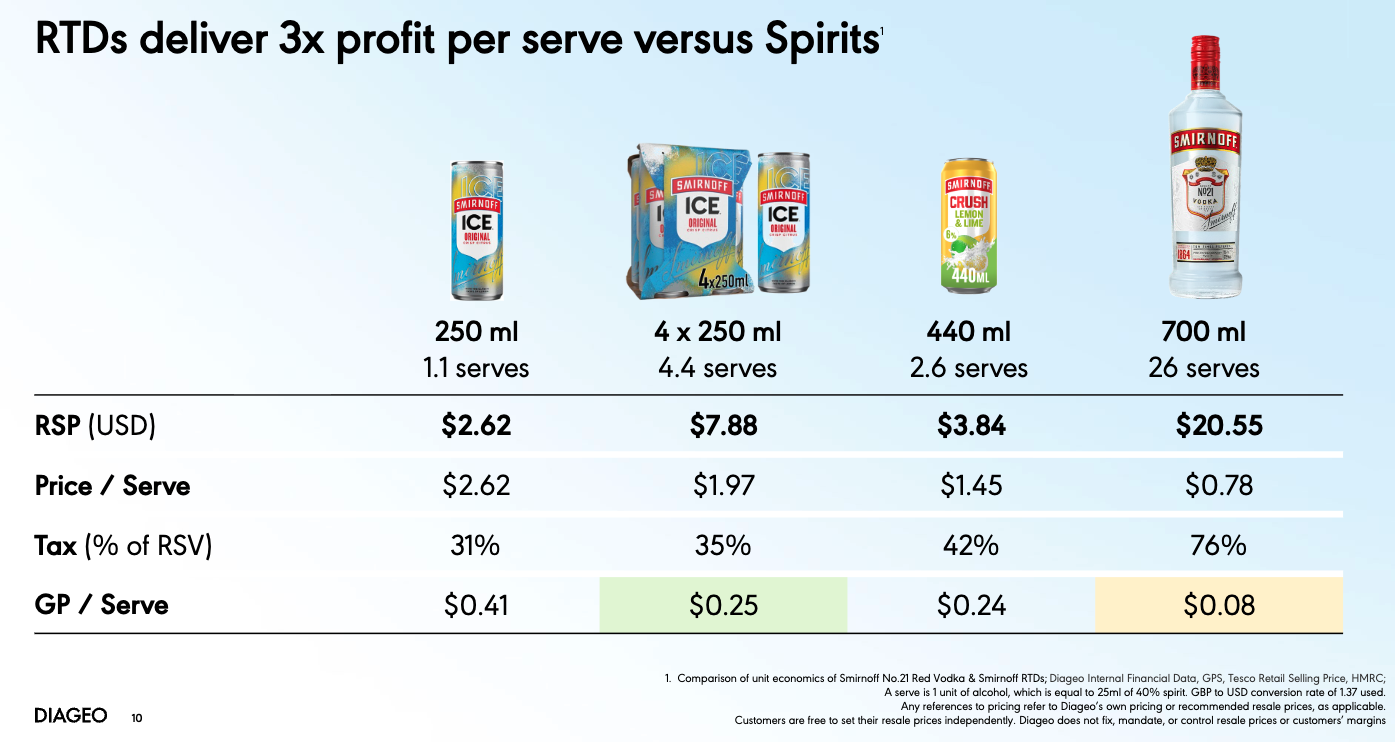
Although the media reports that Generation Z are economising, RTD benefits DGE because the category delivers strong unit economics: i) When consumers buy a 75cl bottle of spirits, they pay a lower price per cl of alcohol. Or put another way RTD is “cheaper” but achieves a significantly higher price-per-unit of alcohol. ii) Selling through off-trade retail channels (supermarkets, corner shops) is easier and higher volume than on-trade (bars and restaurants) which are more fragmented and require more complex distribution. iii) There’s also a tax benefit, with a single 250ml of Smirnoff ice 31% tax rate, versus more than 3/4 of the contents of the vodka bottle going to the taxman.
Another reminder of Jim Barksdale’s quote: “Gentlemen, there’s only two ways I know of to make money: bundling and unbundling.” Effectively DGE are bundling their core product (Smirnoff, Bulleit Bourbon or Bundaberg Rum). In the current cost of living environment a customer might hesitate to spend £30 on a full bottle of spirits, or expensive cocktail in a glamorous bar, but buying pre-mixed can in the supermarket still feels like economising.
Smirnoff Ice grew in Q1 at double digit rates in North America, EMEA (Europe, Middle East, Africa) and Latam. Guinness continues to grow at double digit growth rates.
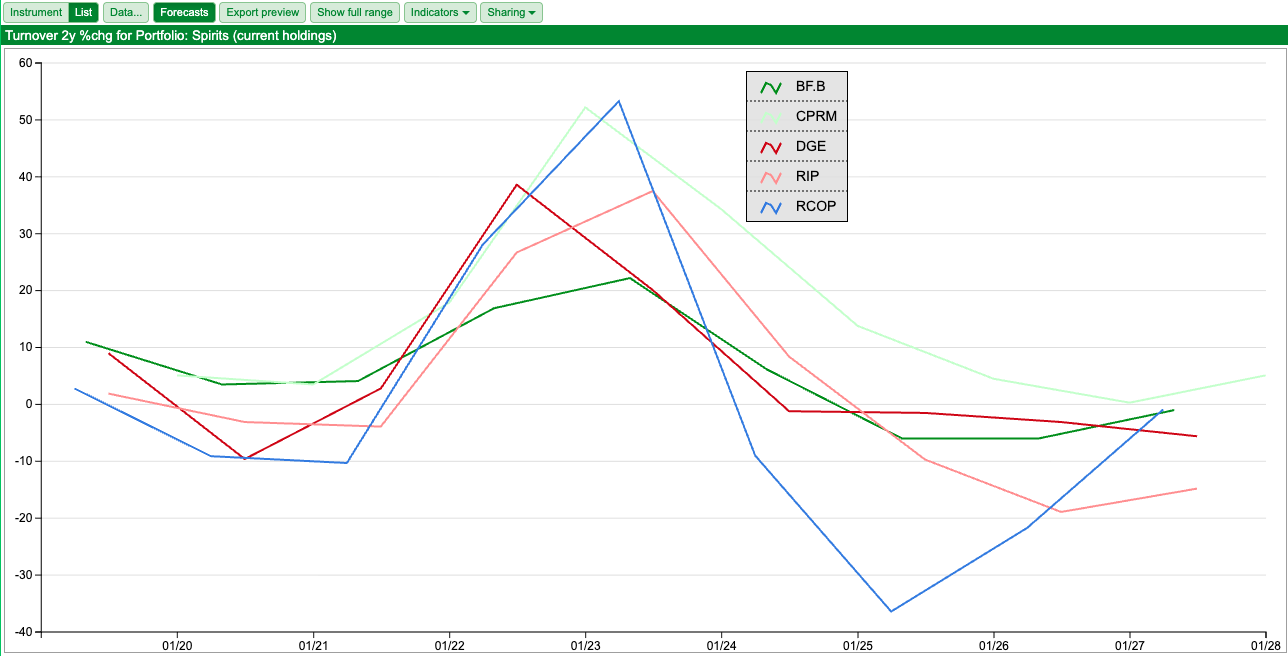
To be fair to Diageo, the whole spirits sector has been struggling for growth since enjoying a one off benefit during the pandemic. Using ShareScope’s “List” tab in the “Financial Charts” view, we can see 2 year revenue growth (to adjust for y-o-y volatility) across Brown Forman (BF.B), Campari (CPRM), Pernod Ricard (RIP) and Remy Cointreau (RCOP).
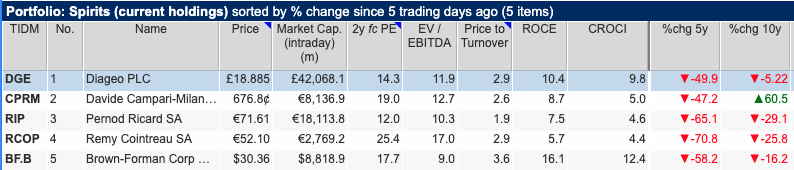
Valuation: Diageo shares are trading on 14.3x PER Jun 2028F or 11.9x EV/EBITDA the same year. The new Chief Exec, Dave Lewis, cut the dividend earlier this year and the yield is now just over 2%. I’ve used ShareScope to create a valuation comparison table with the other spirits groups, with DGE looking attractive on a PER and EV/EBITDA basis.
Opinion: I bought DGE shares half way through last year (6 months too early, yet again). DGE strikes me as relatively immune from disruption from AI. The gross margin was 59% at FY June 2026, historically investors like Nick Train and Terry Smith liked the investment case, based on the idea that a high gross margin/low cost of sales protects shareholders against inflation. That hasn’t worked and I have written up a full article for MoneyWeek to explain why consumer brands have done so badly in the last 5 years. I think though that this could be a good recovery story, with the well regarded new Chief Exec Dave Lewis (ex Tesco, Unilever) likely to have a positive impact.
Petrotal Q3 Sept Update
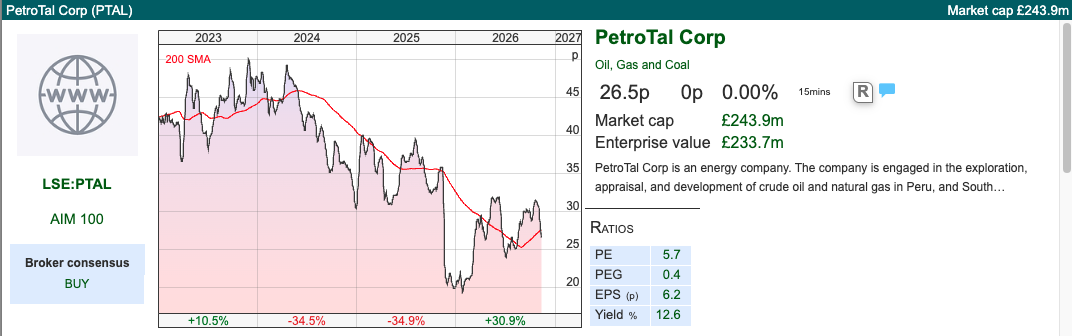
This Peruvian oil group has three listings: Canada, US and AIM. PTAL isn’t an explorer, they have 100% working interest in the Bretaña Norte oil field in Peru’s Block 95, which is in the Amazon basin and has been in production since June 2018. Their Bretaña Norte site is a conventional oil field, the group’s biggest challenges is shipping crude out in barges from the middle of the rain forest, which adds around $15 per barrel to the cost, meaning their break even price is around $40 per barrel.
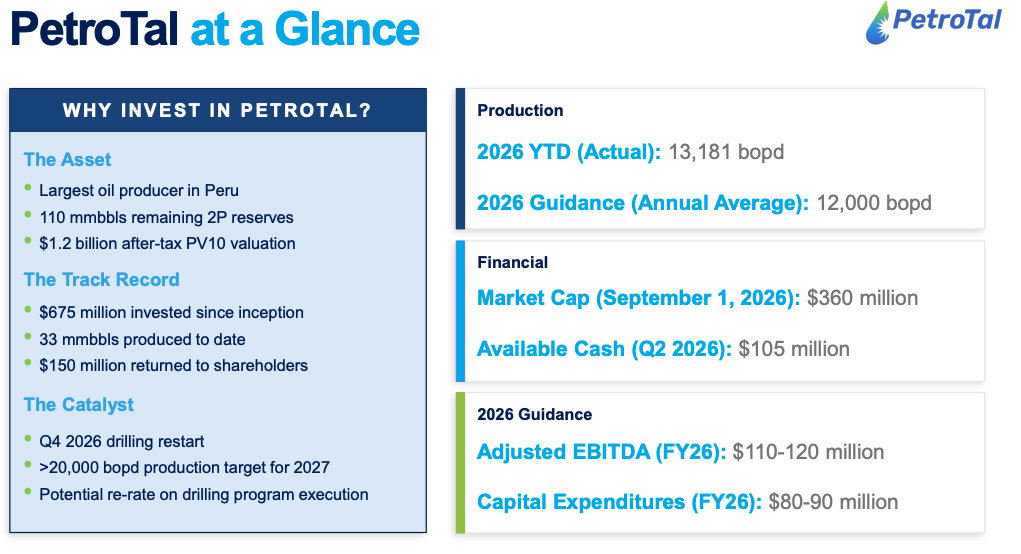
Q3 production was down -36% to 11,797 barrels per day (bopd) due to planned downtime for maintenance. In the first nine months of 2026, PetroTal’s total production averaged 13,076 bopd, which means that production is still roughly 3% ahead of budget expectations. Q3 net operating income (oil revenue after royalties, barging, storage and other expenses) was $45m, and adj EBITDA was $34m, versus capex of $12m in the quarter. Despite that, the group managed to report a loss of $5.5m in the quarter due to a fair value loss on a hedging derivative. The group has $116m of unrestricted cash.
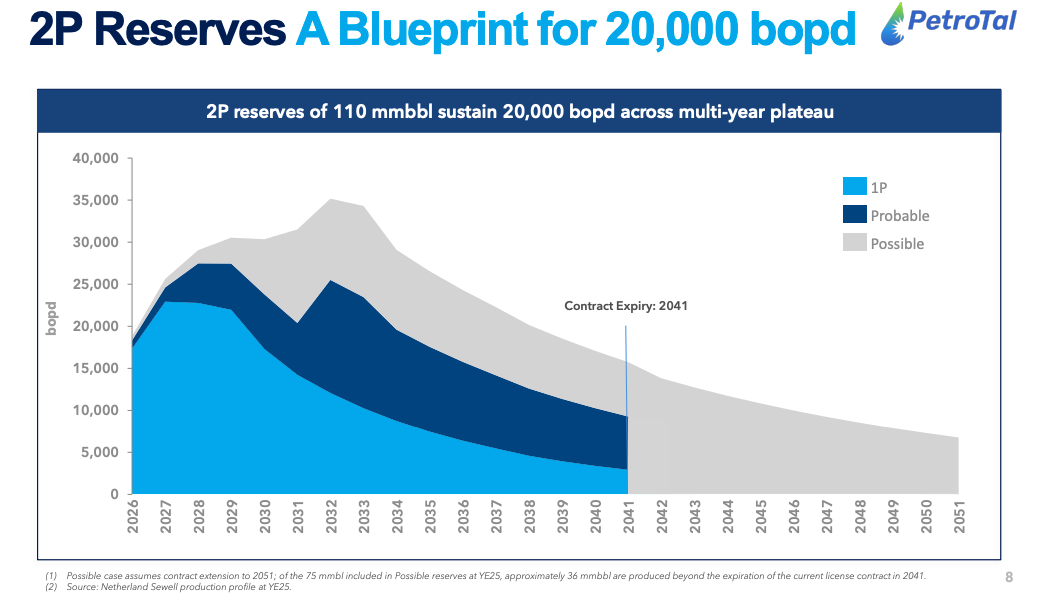
Outlook: There are 8 planned development wells, which have been sequenced to drill the highest-expected-return locations first. Management are guiding to approx 20,000 bopd by late Q1 2027, which implies an incremental 8,000 bopd in five months. The chart below shows 1P, proven reserves with 90% probability, peaking in 2027 before declining slowly. Dark blue is probable (50% probability) and the grey is possible (10% probable). The 2P layer (dark and light blue) is what supports PTAL’s production plateau above 20,000 bopd well into the early 2030s. The 2041 date marks their Peruvian licence expiry.
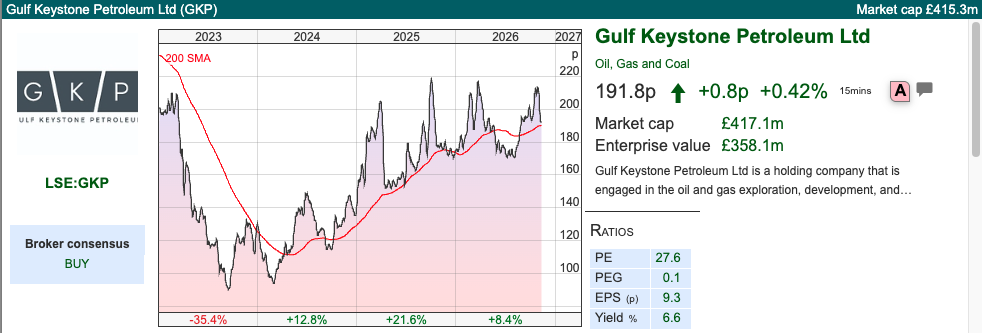
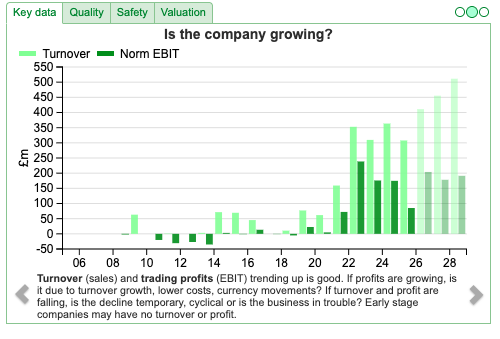
Comparison with GKP: The PTAL investment case makes an interesting contrast with GKP, which has much lower breakeven: around $5 per barrel versus around $40 per barrel for PTAL. Late last year GKP was able to pipe oil through to Ceyhan in Turkey, but regional conflict (Trump attacking Iran) has disrupted operations this year. One of the problems with GKP is that their arrangement with the Iraqi state oil company doesn’t involve a standard WISE transfer of US dollars to their bank account, instead they are allocated physical barrels of oil (top up barrels) which GKP sells on the open market for dollars. When pipeline exports resumed in September 2025, they were paid around $16 per barrel to cover basic production and transport costs, well below what GKP were owed and it has taken a year for them to convert their receivables into cash. GKP put out an RNS at the start of this week saying they received $16.5m in cash and they expect to receive the entire $31m top up receivable by the end of November 2026.
Valuation: The PTAL investor presentation suggests 110 million barrels of Bretana 2P reserves as of Dec 2025. At $100 per barrel, that equates to $10bn, versus a current market cap of £243m ($316m). We need to account for taxes, costs, transport, and a standardized oil price curve, with the September 2026 presentation suggesting after-tax PV10 (industry standard 10% discount rate) valuation is approximately $1.2 billion. If you prefer to value your oil companies on PER, the group is trading on 4.3x Dec 2027F and less than 1x EV/EBITDA. That compares to 4.4x Dec 2027F and 1.5x EV/EBITDA for GKP.
Opinion: Looks good, I own a few of these, as I believe we’re going to need a combination of fossil fuels and renewable energy in future. There are clearly risks with oil companies like PTAL, such as potential local community protests (though PTAL contributes 2.5% of net revenues to a social fund), river blockages, low water levels or oil spills. I also own some GKP. I know many investors prefer to avoid the resources sectors, gold miners etc, but I think at the right point in the cycle these can make significant gains, so it’s worth being open minded without getting carried away.
TPXimpact Holdings H1 Sept Results
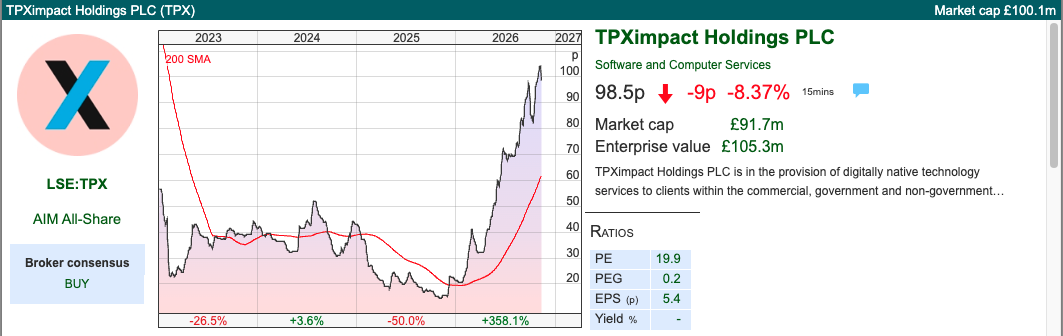
This public sector IT digitisation group has had a strong year, up 358% YTD. They reported H1 Sept revenues up +60% to £57.9m and statutory PBT of £3.5m versus a £1.1m loss in the H1 Sept last year. That’s driven by contract wins in central government including Ministry of Justice (£16m), HM Land Registry (£19m), HM Prison & Probation Service (£25m) and £21m other smaller contract wins and extensions. The group is now debt free for the first time since 2019, with £1m of net cash.
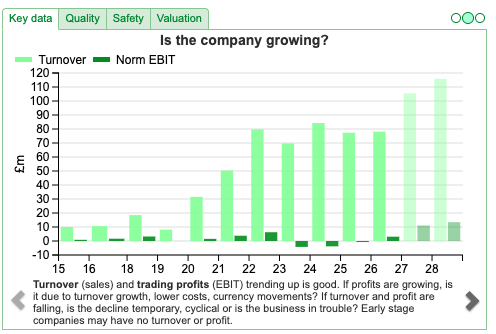
Outlook: Management reiterate guidance of £105m revenue and adj EBITDA of at least £14m, for FY Mar 2027F. They talk about having a strong platform for continued growth beyond FY Mar 2027F.
Valuation: The shares are on 9.5x Mar 2028F and EV/EBITDA of 6x. That’s a remarkably low valuation for a group growing so rapidly, implying that investors are sceptical that the positive trends will continue. For contrast MadeTech, which is also up +53% YTD and up more than 10x from its lows in April 2024 is trading on 15x May 2028F and 7x EV/EBITDA.
Opinion: I’d need to understand why TPX management are so confident that government contract wins are repeatable and will keep growing. Looking at TPXimpact’s website they give case studies, for instance helping the National Land Information Service collect data with API calls rather than in PDF form. That seems fairly basic and also one-off in nature – I’m not familiar with this area, but had assumed that the large management consultancies like Accenture and big 4 accounting firms were all over government digitisation projects. I asked the LLM about this, which said that Central Government procurement frameworks mandate working with smaller consultancies and also pointed out that this type of business is people dependent and low EBIT margin. Well done to holders of both of MTEC and TPX, but I think this is a cyclical bounce from negative margin to breakeven.
Bruce Packard
@bruce_packard
Notes
Bruce owns shares in Diageo, PetroTal and Gulf Keystone
This article is for educational purposes only. It is not a recommendation to buy or sell shares or other investments. Do your own research before buying or selling any investment or seek professional financial advice.